
Quick Summary
In answer to Dr. Andrew Snelling’s response to our critique of his articles regarding the Tonto Group in the Grand Canyon, this reply seeks to again demonstrate that these units were not deposited during Noah’s flood. If the units had been deposited by such a flood, we would expect to find certain characteristics that are absent. There are also features that we do find that tell us that the deposits formed more slowly, with significant pauses. Dr. Snelling has provided his response, but there are many examples where his responses are inadequate.
We also reply to his response regarding when the Tonto units were hardened and folded. He rejects our interpretation that the Tonto Group was at least partially turned from sands and mud to stone before the folding event occurred. We recognize that the rocks were never hot enough or under enough pressure to either be metamorphosed or to show some of the microstructures that can occur with deformation. For example, data from the nearby Palisades fault blocks demonstrate that, in places at least, the Tapeats Sandstone was turned to stone and then shattered by the deformation. This only would have occurred if the sands had been cemented before the tectonic folding occurred.
Table of Contents
Introduction
Christians have different interpretations of the Biblical doctrine of creation and how to integrate our understandings of scripture and scientific data. As part of that discussion, in 2024, we published a three-part critique of Dr. Andrew A Snelling’s papers that proposed to explain the Cambrian-aged Tonto Group in the Grand Canyon as having been formed and deformed during Noah’s flood (Mitchell and Tillman 2024a, 2024c, 2024b). (Link to critique) Dr. Snelling has now published his response, also in three parts in “Answers in Depth”, a publication by Answers in Genesis (AIG). Links to his response articles are here:
Responding to “Peaceful Science” Critics on Grand Canyon Evidence, Part 1
Tonto Depositional Processes and Rates: Responding Again to “Peaceful Science” Critics, Part 2
The Tonto Deformation: Responding Again to “Peaceful Science” Critics, Part 3
In turn, we want to provide readers with a reply to this response. We hope to clarify a number of misconceptions and misrepresentations and let the readers make up their own minds. The more complete version is here: Unabridged full text. In this article, we will summarize points that we made in that more expansive document, though admittedly even the summary is fairly long.
Dr. Snelling has written over 1200 pages in his reports on the Tonto units, including significant appendixes that document his observations and his interpretations. This is one of the most complete efforts to collect scientific data and place it into a flood geology context. We recognize that he has put considerable effort into this project. As Answers in Genesis’ director of research and editor-in-chief of the online “Answers Research Journal”, he has devoted considerable resources to his effort. While his articles include large amounts of repetition, they do provide a strong effort to document both his observations and his interpretation. He has presented his results in many forums, including several that are available online, e.g. Grand Canyon Folds. As far as we are aware, he has not presented his work at any non-YEC forum. He devoted significant effort to going through our articles and we want to present a response that is meaningful. We will not respond to every assertion that he made but will address many of his comments. We will try to avoid character attacks and ad hominem. We find that the geological data do not support his proposed interpretations. In our articles, we have focused on the technical geologic details and interpretations, not the Biblical interpretation. We believe that the Bible is the inerrant Word of God, but that it does not tell us how old the Earth is or what the geological effects of Noah’s flood were.
The articles that Dr. Snelling wrote and ours deal at times with detailed geologic data. We expect that some non-geologists will see these as technical details that may not really be that important. These are not small details. Here is an analogy. When a car’s wheel rim is damaged, it must be replaced. However, not just any rim will do. It must be the right size and beyond that, the holes must line up. Otherwise, it just won’t work. This is just like the situation with the deposition and folding of the Tonto units. The holes just don’t line up.
Reply to Part 1
About ourselves
Dr. Snelling’s Part 1 article suggests that we should have begun our article with biographical information about ourselves. Scientific articles are not written that way, any more than Snelling’s articles begin with such. Admittedly, we are not as well-known as he is. He quoted the information that we provided on the “Peaceful Science” website about ourselves and we are quite happy to be known as Christian geologists and are glad that Dr. Snelling makes that clear. Our disagreements on the age of the Earth and flood geology are between believers.
Why were our articles published on “Peaceful Science”? We appreciate Dr. Swamidass’ eagerness to engage in discussions on science and faith. He also has indicated that he is perfectly willing to publish articles from a young earth perspective, including responses from Dr. Snelling. Dr. Snelling writes, “Dr. Josh Swamidass, Stephen Mitchell and Kennen Tillman profess to be Christian evolutionists. They also wholeheartedly embrace conventional uniformitarian geology.” (Snelling 2025). It is true that Dr. Swamidas considers God to have worked through what we see as evolution to populate the Earth with life. Steve considers himself an Old Earth Creationist and has written extensively on this both in his book, A Texas-Sized Challenge to Young Earth Creation and Flood Geology (free download available here: Link) (Mitchell 2018) and on his website: Jesus in History and Science. He recognizes that many times God probably worked through natural selection and mutation, but believes that God worked more directly at times, particularly in events such as the origin of life and human beginnings with Adam and Eve. Ken believes that God created the universe and the world over deep time, but the details of neither geologic nor life’s history are revealed in the Bible. He believes that the focus in faith should be on sharing the gospel of Jesus. The philosophy that Christians should focus on countering is naturalism, the view that only natural processes work in nature, to the exclusion of supernatural actions, such as actions by the God of the Bible.
How do our perspectives shape our conclusions?
Several times Dr. Snelling complains that we have compromised our commitment to scripture and sold out to “uniformitarian geology”. For example, he states,
“Now that we have established the a priori and anti-biblical commitment of Christian geologists Stephen Mitchell and Kennen Tillman to the modern uniformitarian geological interpretation of earth’s past history, it is easy to understand their claimed critique of young-earth creation geologists’ claims about the Grand Canyon.”(Snelling 2025)
It is certainly true that we have concluded that the Young Earth Creation (YEC) interpretations of both Genesis and of the Earth’s geology are invalid. In our response to him, we tried to evaluate the geologic data that Dr. Snelling reported. Of course, we bring in our experience and knowledge. Does Dr. Snelling find what he is looking for because he begins with his conclusion? Here is a statement from Dr. Snelling, available on YouTube, recorded while he was on the expedition to sample the folds in the Grand Canyon:
“As a Christian, I believe that God’s word is a record, and eyewitness account of what happened, and therefore as a scientist, I can expect that the evidence in God’s world will confirm what we have already read in God’s word.” (Midwest Creation Fellowship 2023)
This confirms that he was not unbiased. Dr. Snelling went looking specifically for data that would validate his firmly held interpretation. This does not invalidate his observations, but does say that he can be biased in his interpretation. The question that we continue to address is: did he actually find it? We have not assumed deep time in our analysis, but have tried to set that aside and simply looked at his and other available data to see if Snelling’s proposed explanations for the Grand Canyon rocks are supportable. We don’t assume that God cannot act in miraculous ways as He chooses, but that miraculous ways and rates would be evidenced in the data.
Two other general complaints that Dr. Snelling makes are: 1. That we have not detailed all of the alternative explanations that YEC writers have made to explain the various features that he describes in the Tonto, and 2. that neither Ken nor Steve have personally visited and studied the outcrops that he describes. First, regarding the various explanations that YEC have given, we have read YEC literature extensively and deal a bit more with it in our reply article. As a generalization, it is worth pointing out that just because an explanation has been proposed does not make it adequate or valid. We will look at some examples where, in our opinion, the explanations fail. Flood geology still needs to explain the observations in geology effectively.
Regarding the second complaint, he is, of course, right that this is a bit of “armchair geology” as he terms it. We bring to bear our experience in other areas. We can also draw on the cumulative expertise of many other researchers in the well-developed fields of structural geology, sedimentology and stratigraphy. Of course, we would like to have the time and funding to do our own onsite investigation. We are trying to assess – did Snelling prove his case? He has provided many photographs of the described folds and in most cases, other photographs are available. Many key characteristics are visible. We can, as he also does, leverage many studies of the Grand Canyon geology that have been done. Dr. Snelling provided photographs of the samples that he collected. He should not complain that we have studied them. We sent Dr. Snelling a request to use his actual photographs in our articles but never heard from him. We would like to have shown interpreted and uninterpreted versions of the folds and thin-section slides. Without that permission, we chose to provide our interpretation of folds where we did not have access to photos and a selection of the slides. We shortened and reduced the number of images several times, trying to keep our articles as short as we could, in order to hopefully expand the number of people who would actually read them. We also offered to provide him with a copy of our papers before they were published, but apparently at the time, this did not interest him.
Two of the issues that Dr. Snelling commented on from our Part 1 are the Great Unconformity and radiometric dating. In our reply, we point out that while we certainly agree that over large parts of the Earth, the top of the Precambrian rocks is an erosional surface. That does not mean that all of this erosion took place simultaneously. Both the rocks beneath the unconformity and those above it are of different ages around even just the USA. It is difficult to make this the base of a single global flood when this is true. We find other explanations for the Great Unconformity plausible, in part because there is so much evidence of slow deposition above it. The limestone stromatolitic reefs in the Cambrian are particularly difficult to reconcile with considering the Great Unconformity as the base of flood deposits, but this will be addressed further later.
In our original response articles, we did not go into radiometric dating. In our reply, we have gone farther into it, though still not in much detail. We pointed out that Snelling and other YEC authors recognize that radiometric dating does reflect the same order of rock formation that we all see in the rocks and that it shows that vast amounts of radioactive decay have occurred. This is very significant. YEC recognize that radiometric dating results are not random but provide ages that reflect the real stratigraphic order in which rocks were formed. They also recognize that the radiometric decay calculated was real, not an artifact of some flawed physics. The physics that forms the basis for the analysis is robust. Certainly, there could be cases where the sampling was poor or the analysis was done incorrectly, but there is no denying that real data supports the calculated ages.
How do they account for all of this decay? Dr. Snelling writes,
“However, Vardiman, Snelling, and Chaffin (2005) have demonstrated from six lines of evidence, supported by experimental results, that the reason for this systematic consistency of radiometric ages in the Grand Canyon stratigraphic sequence is because during some catastrophic event in the past there was a systematic acceleration of nuclear decay rates, potentially by six orders of magnitude.” (Snelling 2021) emphasis added
Saying that one’s best explanation requires a systematic acceleration of nuclear decay rates of six orders of magnitude, without the release of the heat that the physics demands, is sort of a way of saying that their proposal is really contrary to the physical evidence. Dr. Snelling’s proposed date for the end of the flood is at the top of the Mesozoic section, conventionally dated as 66 mya. This means that rocks from the whole Cenozoic era, dated after 66 mya, also must have experienced large amounts of accelerated nuclear decay, but without the explanation of acceleration during the flood. It is as if the hypothetical accelerated decay extended all the way to the time when Dr. Snelling recognizes that C14 is valid, approximately 400 BC (Snelling 2009a, 856).
While the RATE project's proposal of accelerated nuclear decay is clearly motivated by a sincere desire to reconcile radiometric dating with a young-earth timeline, it introduces insurmountable physical paradoxes. If billions of years' worth of radioactive decay were compressed into a single year during the Flood, the resulting release of thermal energy would have been catastrophic. The heat generated would have been sufficient to melt the Earth's crust entirely, while the massive spike in ambient radiation would have sterilized the planet, rendering the survival of any life on the Ark physically impossible. Therefore, the scientific data does not support accelerated decay as a viable mechanism.
Even so, Dr. Snelling claims that radiometric dating is hopelessly flawed. What issues do YEC consider critical failures for these techniques? Dr. Snelling referenced his article: “Radiometric Dating: Problems with Assumptions” where he presents three “unproven assumptions” that he believes invalidate radiometric dates (Snelling 2009b). In our reply article, we have pointed out that these objections are inadequate, at best, to cause serious concerns about the general validity of radiometric analysis. Recognize that for the YEC timeline to be valid, small variations would be totally inadequate. We discussed Dr. Snelling’s more specific concerns about dating in the Tonto Group. We do not have definitive answers for what may be anomalous results, but recognize some options and still find that the overall weight of the data supports the dating provided by Karlstrom et al. (2020).
Reply to Part 2
Tonto Depositional Processes and Rates: Responding Again to “Peaceful Science” Critics, Part 2
Not surprisingly, Snelling found disagreements with our paper on the Tonto depositional processes and rates. In his model, most of the phanerozoic record, representing sediment columns miles thick, was laid down in one year. That dictates enormous rates and eliminates many processes and depositional systems. If any bed or set of beds took longer to form than the one-year timeframe, then they cannot be considered as part of deposits from Noah’s flood. In fact, as Snelling hypothesizes and we pointed out in our article, the flood geology timeline means that individual formations and units had to form over days. This has to further constrain the rates and types of processes that can be considered. We are not saying that no cataclysmic processes were involved in the deposition of the Tonto group or its equivalents elsewhere, but are assessing whether or not the evidence really supports that all of it was.
Geologists recognize that cataclysmic processes have acted in Earth’s history. At least hypothetically, the Tonto units could have been deposited very rapidly, but that would tell us nothing about other formations, such as those interpreted to have been laid down in ancient salt flats (sabkhas) in the Permian of West Texas. However slow deposition would not fit for flood geology wherever it is recognized.
Dr. Snelling makes a series of complaints regarding our papers that come down to either: 1. we would accept his views if we just had read more of the flood geology literature or 2. “we weren’t there”. Here are examples:
“And if Mitchell and Tillman had read the Flood geology literature, they would know that during the global Flood cataclysm, rapid-fire devastating earthquakes were generating multitudes of rapidly consecutive humungous tsunamis that surged right across continents, which have been modeled to demonstrate the Tapeats Sandstone and all the overlying units could easily have been deposited within the Flood year” (Snelling 2026b)
This claim assumes that we have not read the voluminous YEC literature. We have read much, but it would be hard to have read all of it. It also assumes that if we had read flood geology literature, we would find their hypotheses convincing. In our new article, we cite more additional YEC articles than the previous article, but it is the job of YEC authors, such as Dr. Snelling, to prove their theses.
For example, we pointed out some of the issues that we recognize in John Baumgardner’s latest paper (Baumgardner and Novarro 2023). Baumgardner and Novarro use a computer model that inputs the paths for the tectonic movements that were published by conventional paleogeographers, Dr. Christopher Scotese (2021) and Dr. Ronald Blakey. (2018). It is interesting that they use this data, though Baumgardner would not accept much of what supports it. As they use positions and movement based on Scotese and Blakey’s work, it is not surprising that the program erodes and deposits sediment in areas that are somewhat similar to what is shown in maps by Scotese and Blakey. Even assuming processes and products that required big assumptions, they cannot explain key characteristics of the Earth’s stratigraphy, such as carbonates and evaporites like halite or the heat generated by they hypothesized rapid generation of new oceanic crust or the conversion of feldspars to clay minerals. Being familiar with flood geology literature does not help.
Dr. Snelling wrote:
“But how can they be so sure when no geologists were present to witness the deposition of the many sandy layers of the Tapeats Sandstone?” (Snelling 2026b)
Neither we nor Dr. Snelling were there. Both we and Dr. Snelling argue that the rocks accurately record how they were deposited. When we examine the rocks, we try to integrate all available data and identify the best explanation for their formation. In this case, we are not claiming to know every detail of their deposition, but we can rule out some proposals, including the claim that they were deposited in only a few days or weeks.
We replied to the objections from Dr. Snelling in our article by grouping the topics in this way:
-
- Things we would expect to find, but didn’t
- Things found that we would not have expected to find

Things we would expect to find, but didn’t
Snelling is correct that we were not there. Just as he references studies of sedimentary bedforms and other characteristics, he recognizes that the sedimentary bedforms, ones that we find or don’t find, tell us about the depositional processes, even though we weren’t there (Snelling 2022). Snelling provides key hypotheses that the rock record can be checked against. He hypothesizes velocities of water currents, and provides duration predictions that dictate average sedimentation rates. These in turn dictate a range in what should be the dominant bedforms through whatever he calls flood deposits. This is not about an interpretation of scripture. It is about does the rock record fit flood geologist’s claims.
If the Tonto Group was deposited in a short period by cataclysmic processes, we continue to believe that the sediments should reflect this. As noted earlier, Dr. Snelling does recognize that information from modern processes is useful in assessing the ancient record, such as when he notes that mica flakes are rare in modern eolian deposits. He reports differences between what are found in modern environments vs. the Tonto characteristics. If he can use the modern as a contrast, then the modern is a key means of understanding what is or is not in the ancient record. Of course, a global cataclysmic flood would be of a different scale than modern examples, but there would have been key similarities and some processes just would not have been involved.
Megaflood deposits and Megabeds
What type of features should a global cataclysmic flood deposit include? We don’t dispute that there would be variability. We suggested two analog deposits that we would expect in a cataclysmic deposit that formed quickly and included sediments that moved at his hypothesized velocities: megaflood deposits and megabeds. The analogs demonstrate that geologists recognize catastrophic deposits have been laid down. We looked for the most analogous flow rates and depositional rates, recognizing that in the hypothetical flood model, deposits might be larger, but should be expected to share some properties.
What also is strange is that in the Tonto formations, if they formed rapidly and cataclysmically the way he proposes, why do they look more like deposits from normal deposition? Why don’t they look more like deposits from actual floods with very high flow rates and rapid deposition? Additional photographs of such comminuted (mechanically ground and smashed) materials are shown by Carling and Fan (2020) and can be compared to deposits from normal processes. Compare outcrops in the Tapeats Sandstone to those from such deposits (P. Carling 2017). We think it is logical that deposits from a brief global event would include many larger beds and features such as from megafloods, but it is not obvious why they would not include any features such as beds dominated by comminuted grains.
Sixtymile Formation
Dr. Snelling highlighted the Sixtymile Formation as something that we missed that supports his interpretation, apparently considering the breccias from it to reflect cataclysmic deposits, somewhat like the megabeds. This formation is only found over a very restricted area, but it is interesting because it contains features that are consistent with deposition that was controlled by faults that were active at the time (Elston 1979). The conglomerates, breccias and slide blocks are quite consistent with deposition over time along actively growing fault scarps. No evidence is presented indicative of high velocity fluid movement. The conglomerates are often characterized as “fanglomerates”, such as often form with continental alluvial fans in recent deposits. Similar deposits can form in marine settings, but there is no reason to say these, particularly the younger ones, were laid down by cataclysmic waters here. In our article, we highlight the chert whose formation again implies longer time. Then after the chert was formed and hardened, it was brecciated (see Kenny (2017, fig. 4), again while the overall deposition of the unit was occurring; This demonstrates a pause in sedimentation and a time duration of far greater than one year.
Fossils
A further example of what we would expect that has not been found is Mesozoic or Cenozoic fossils, animals or plants in the Cambrian Tonto Group. We gave examples of a dolphin bone (or any other modern megafauna) or even plant pollen. Dr. Snelling replied,
“However, Flood geologists have repeatedly explained over decades that this pattern of fossils represents the burial order of the global Flood cataclysm.” (Snelling 2026b) (emphasis in the original)
It is true that flood geology has come up with three basic hypotheses. (Roth 1998; Snelling 2010; Clarey 2020). Saying the same thing more times doesn’t make it more true. Perhaps Dr. Tim Clarey said it best here:
“The global pattern of fossils cannot be denied. Why certain animals and plants are only found in certain rock layers is still largely unresolved. Creation scientists have often speculated and proposed various ideas to try and explain the patterns we observe in the fossil record.” (Clarey 2020)
Although terminology can vary, these explanations revolve around the same three speculations:
- The motility factor (Roth 1998); Increasing mobility (Snelling 2010)
- The buoyancy factor (Roth 1998); Decreasing density and other hydrodynamic factors (Snelling 2010)
- The ecological zonation theory (Roth 1998); Increasing elevation of habitat (Snelling 2010)
Each speculation could have some validity in local areas, but as we discuss in our article, these are wholly inadequate for explaining the global fossil record or the absence in the Cambrian of recent flora and fauna. For instance, the idea of mobile animals trying to outrun flood waters takes advantage of the difficulty many people have in thinking three dimensionally. Once a region of any size was covered over with initial Flood sediments, everything else would have to be swept in laterally by hyper-fast, continent-scale sediment flows. Thus, after initial Flood sediments were laid down, any animal’s ability to move from one place to another would be irrelevant – they could only just be “along for the ride” with transported sediment.
Dr. Snelling noted the presence of microfossils in the Tonto. It is interesting that the Bright Angel Shale does contain fossils known as cryptospores. Baldwin, et al. (2004a) studied the cryptospores in detail through the Bright Angel formation and concluded that there was a definite freshwater source for the muds. A key significance of the cryptospores is that microfossils were preserved, making the absence of more modern microfossils all the more striking.
What about the preservation of fossils? Dr. Snelling wrote:
“However, Mitchell and Tillman do not grapple here with the proverbial “elephant in the room.” After all, how these creatures were fossilized tells us how quickly they were buried and thus how fast these sedimentary layers were deposited. They never explain how fossils form! In their uniformitarian belief system, creatures are slowly and gradually buried by sediments.”(Snelling 2026b)
Simply put, we do not believe there is an elephant in the room. Fossils are preserved in many ways. The scientific study of the processes by which fossils are preserved is called taphonomy. Many taphonomic processes involve rapid deposition. The fact that many fossils were preserved by rapid events in no way proves that they were all formed by the same rapid event or that some fossiliferous beds were not deposited slowly. If the Phanerozoic period lasted over 500 million years, then we can safely assume that many, many floods, storms and catastrophes occurred that could preserve fossils.
Things found that we would not expect to find
Normal marine, fluvial and other paralic (non-marine) deposits
Field work and descriptive geology continues today, in part because of the number of classic exposures found in Arizona. Yet, no one reports the type of chaotic, high velocity deposits that one would expect from a global cataclysmic flood. What do recent studies report? In November of 2024, Dr Carol Dehler et al. (2024) published a refined stratigraphic model for the Cambrian of the Grand Canyon. Their refinement was based on more measured sections and extensive biostratigraphic analysis. Building on the work of previous investigators, they describe the environments this way:
“Rather than being fully marine in origin, these sequences were formed by a mosaic of depositional environments including braided coastal plain, eolian, marginal marine, and various shallow marine environments.” (Dehler et al. 2024)
They present a series of generalized paleogeographic maps for eight different portions of the Cambrian system in the Grand Canyon area. Environments range from fluvial and shallow marine in the Tapeats Sandstone to marine with local carbonate banks higher up in the Muav Formation. These are interpretations, but they are consistent with all of the observations. We continue to see evidence that sedimentation was not continuous but had many pauses of various duration.
Dr. Snelling believes that the features that he has observed are consistent with tsunamis, but what we see are many small channels, particularly like those from settings without vegetation. A recent study of the Tapeats Sandstone highlights this relationship (Myrow et al. 2025). They compare channels exposed in the Tapeats Sandstone outcrops around Payson, Arizona to characteristics of fluvial systems elsewhere. They find that the systems in the Tapeats shared characteristics with other low-sinuosity river systems, particularly those in areas without vegetation, since that would have increased tendencies toward meandering styles. The facies suggest “low sinuosity meandering rivers in a sandy floodplain”, with well-preserved point-bar packages.
Sedimentary structures
Dr. Snelling doubled down on his interpretations of the features that we presented as inconsistent with flood geology. Again, every hill is a hill to die on for flood geology. Here we will look at his position again for herringbone cross-stratification, mudcracks, and fossils, such as trace fossils and stromatolites.
Herringbone Cross-Stratification
One surprising thing to find is strong evidence of tidal deposits that reflect normal tidal ranges. We noted that six different investigations reported a specific type of cross-stratification with alternating ‘V’ shaped bedding, known as 'herringbone cross-stratification’ in the Tonto Group and it is also found in other Cambrian formations in the southwestern U.S. The reversal of the bedding demonstrates a reversal of fluid flow in a relatively short time frame. We know that this type of bedding forms today in some tidal settings. Finding these delicate, cyclical tidal signatures through the Tonto Group is a clear indicator of daily, rhythmic tides operating over vast stretches of time, which directly contradicts the chaotic, unidirectional flow expected from a global mega-tsunami.
Snelling proposes that such sedimentary structures can be formed during hurricanes and tsunamis but provided no support for this beyond the fact that formations that he interprets as resulting from Noah’s flood contain such features. Hypothetically one could have enhanced tides during prolonged storms, but none seem to have been reported in the literature, though perhaps a more extensive study might identify such. It does seem clear that such stratification would be rare.
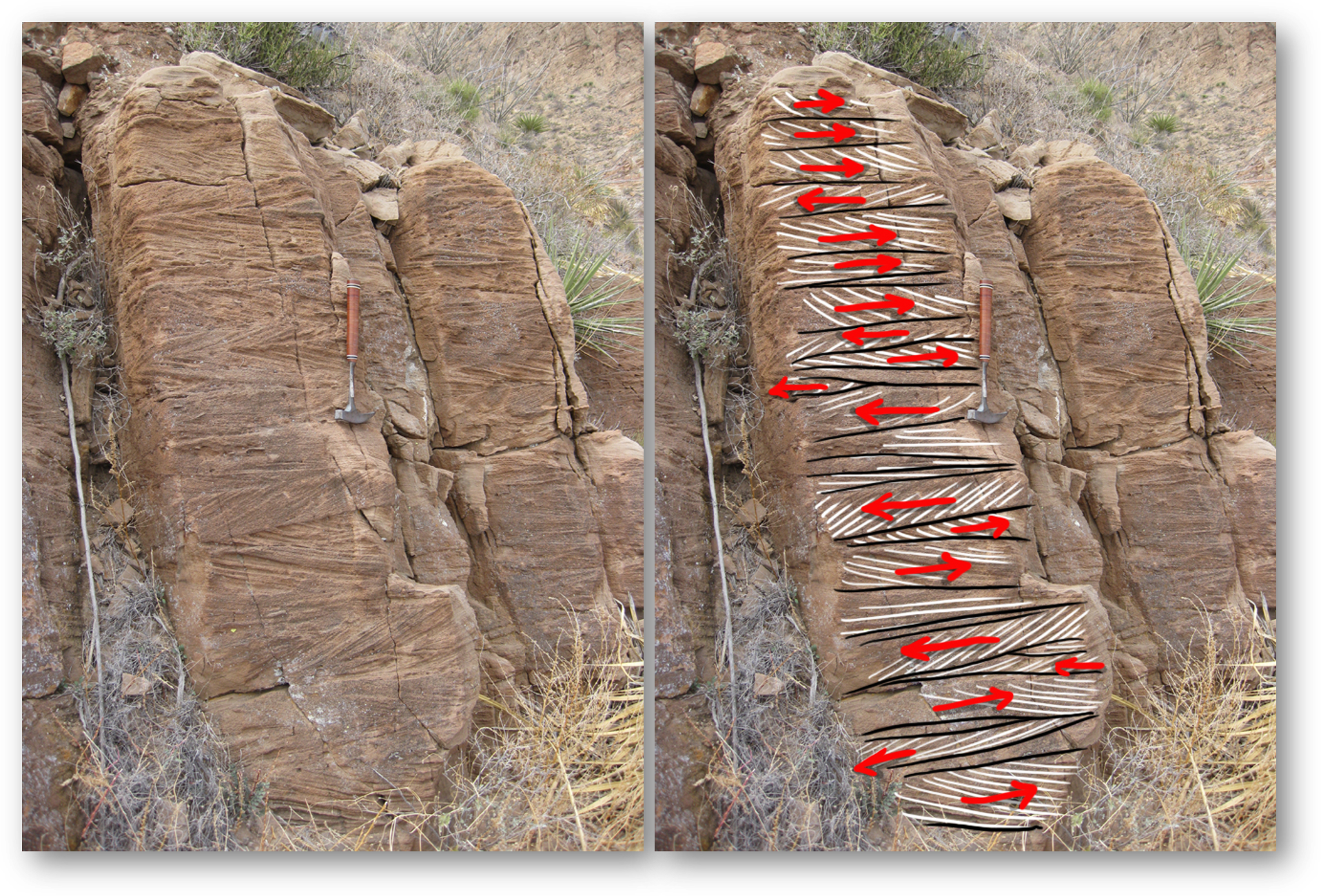
Figure 1: Herringbone cross-beds from the Bliss Sandstone, Ordovician, Franklin Mountains, El Paso, TX. Used with permission of Callen Bentley (Bentley, 2014)
Neither we, nor Dr. Snelling have produced photographs showing examples of herringbone cross-stratification from the Tonto Group. We can however show a photographic example from what he would consider an equivalent unit, based on Dr. Snelling’s Figure 1 (Snelling 2025) though it is better dated to Early Ordovician in age. Here in the Bliss Sandstone, we see preserved at least portions of 16 cycles, representing deposition over a minimum of 4 days (Figure 1). Remember that this is a tiny portion of the Bliss Sandstone. Other examples of tidal deposition in units that would be flood deposits in flood geologic models are found here: Tidal Clocks and Flood Geology. In one case, daily and monthly tidal bundles have been documented representing 6 years of continuous deposition. Certainly, flood geologists would come up with other explanations, but are they valid?
Mudcracks
In our article, we included a discussion of features from the Tonto Group interpreted by several investigators to have resulted from desiccation, as sediments dried out. These features, called “mudcracks” provide a real challenge to flood geology.
Dr. Snelling recognized the issue that these features raise in this quote:
“Today these polygonal features are indicators of at least some time of exposure and drying of sediment surfaces. Thus, such features in the Tonto Group layers, if validly interpreted, would be difficult to reconcile with either the rapid rate of sedimentation or the limited time available during the biblical, yearlong, global Flood cataclysm because their formation demonstrates periods when deposition stopped.” (Snelling 2026b)
Dr. John Witmore put it this way:
“It is unlikely that true desiccation cracks would have formed at the height of Noah's Flood because of the time needed to expose, desiccate, and crack the sediments. It is even more difficult to imagine forming multiple layers of desiccation cracks during the Flood.” (Whitmore 2009)
This is another hill to die on. Flood geologists really cannot bend too much on this, given that the number of apparent beds with these polygonal features surely numbers in the thousands, often with multiple levels in the same section.
Regarding the examples that we gave, Dr. Snelling wrote:
“I have argued strongly already that “these cannot possibly be ‘mud’ cracks because these features are in a clay-poor sandstone, not mud. And as seen in [Hill and Moshier’s] photograph[s] [their figures on pages 66 and 67 and Mitchell and Tillman’s photograph (their Fig. 5)] of modern mud cracks, when the mud dries the polygonal shapes become concavely arched, whereas the claimed fossilized ‘mud cracks’ are flat.” (Snelling 2026b)
We do not have additional data on the Tapeats example that we showed in our original article but can show or reference additional examples that meet every criteria for mudcracks vs. features that might be confused with them, including those given by Dr. Snelling (2026b) and Dr. Steven Austin (1994). We don’t have the permission to show some of the images referenced. Examples in cross-sectional view show upturned edges, multiple horizons with mudcracks with the cracks clearly only extending downward from an upper horizon. Such features and those with vertebrate tracks on them can be confidently interpreted as desiccation cracks.
Trace fossils (Ichnology)
Why would we find horizons covered by the tracks and burrows of various animals if the formations were being deposited at rates of meters per day? In our article, we considered trace fossils to be inconsistent with flood geology. We wrote, “These were not some sort of death assemblage, transported into place, where a few survivors dug around before finally succumbing to the pressure of burial.” (Mitchell and Tillman 2024c). Dr. Snelling, who says that we are not familiar with flood geology literature, wrote this:
“No Flood geologist has argued that these were “some sort of death assemblage, transported into place, where a few survivors dug around before finally succumbing to the pressure of burial,” (Snelling 2026b)
While we may have paraphrased it, this is essentially what flood geologist, John Woodmorappe described in his article, “Are soft-sediment trace fossils (ichnofossils) a time problem for the Flood?” (Woodmorappe 2006). Although Dr. Snelling might describe it differently, something like this is also what he must rely on. What alternative does he have? There certainly would have been no time in his timeline for new generations of animals to grow to maturity, to later burrow or make other kinds of trace fossils. Burrows like we showed in our Figure 7 (Mitchell and Tillman 2024c) and Snelling showed in his Figure 10 (Snelling 2026b) don’t appear overnight. They imply pauses in sedimentation for days, days flood geology models just don’t allow for.
The example in Figure 2 shows trace fossils in a relatively sandy portion of the Bright Angel Formation (Santucci and Tweet 2020). Teichichnus trace fossils, such as this, were made by animals that fed by burrowing along the water bottom (Baldwin et al. 2004b). Notice that there are at least three surfaces along which these animals burrowed. The simplest explanation is that each of these was the water bottom for some period of time.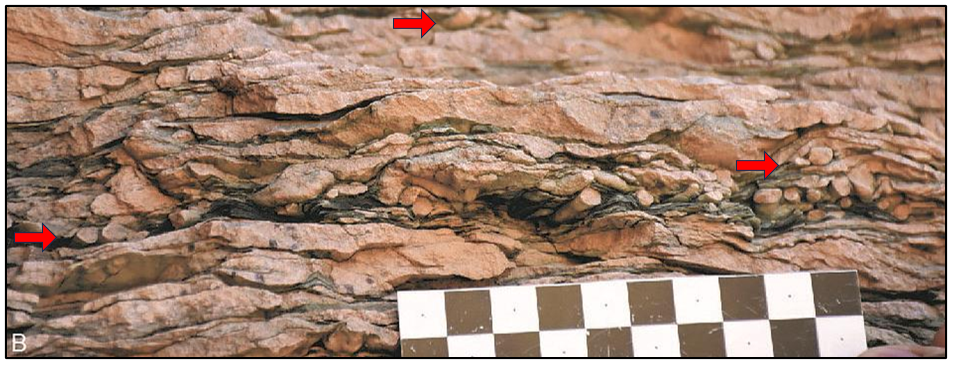
Figure 2. Trace fossil, Teichichnus from the Bright Angel Formation. Red arrows highlight different horizons where the trace fossils are preserved. (Santucci and Tweet 2020)
We referenced other examples from the Cambrian where slow sedimentation and pauses in sedimentation allowed large burrows to be developed (Mata et al. 2012). How could all of these trace fossils have developed on different levels and then been buried to be preserved? Do trace fossils make sense in deep time scenarios? Storm and turbidity currents have covered tracks even in modern times. This would be expected through millions of years. If it were a problem to preserve trace fossils with normal sedimentation processes as Snelling suggests, then we would expect very few trace fossils in units that he interprets as post-flood. That clearly is not the case. Trace fossils from mammal tracks to earthworm burrows (Verde et al. 2007; D’alessandro and Bromley 1986; Williamson and Lucas 1996) are common in Pleistocene sediments and other intervals that Snelling interprets as post-flood. Obviously, a global flood is not required for trace fossils to be preserved.
Algal Mats (Stromatolites) and other reef deposits
Reefs are common features of ancient sediments and modern marine shelves. We find them in every time period from the Proterozoic to the present. The cast of characters changed through time, but the features are recognizable and provide challenges for any flood interpretation.[1] In our opinion, no other single characteristic of the rock record is easier to document and more difficult to reconcile with flood geology processes and timelines. In our article, we focused on Cambrian examples.
The earliest and most prominent reefs in the Cambrian period were stromatolite reefs. Stromatolites represent stacked layers of biogenic deposits and are a particular form of features known as microbialites or microbially induced sedimentary structures (MISS). Many microbial features are noted in the Cambrian (Noffke and Gass 2026). Such features are found in rocks and sediments from the Archean and Proterozoic eras all the way to recent (Chivas et al. 1990; Vahrenkamp et al. 2024; Macintyre et al. 1996). Stacks of sediment that formed layer by layer as biofilms trapped sediments and enabled their preservation are categorically not part of any cataclysmic flood deposit. Modern laminations have been measured to grow at rates of 1.6 to 5.6 years per lamination (Petryshyn 2013). Figure 3 is one example from central Texas where many small patch reefs are exposed. (Ahr 1971; Chafetz 1973; Nielson and Barker 2016; Khanna et al. 2020; Hopson et al. 2025).
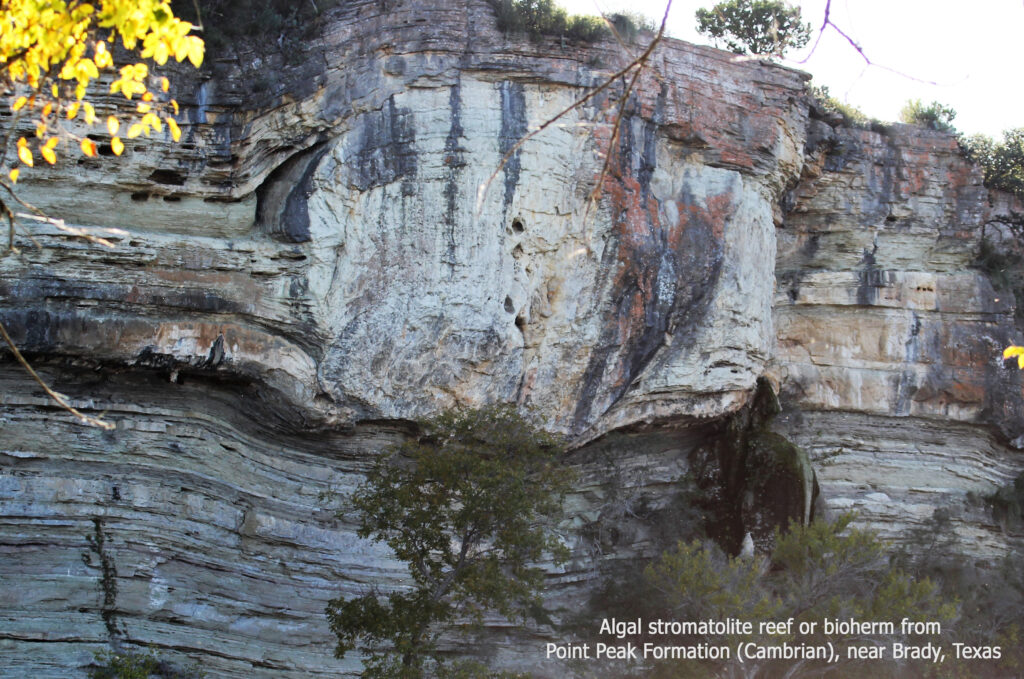
Figure 3. One of a set of algal stromatolite reefs or bioherms from Point Peak Formation (Cambrian) in central Texas (Ahr 1971; Chafetz 1973; Nielson and Barker 2016; Khanna et al. 2020; Hopson et al. 2025).
Stromatolites in the Muav Formation in the Grand Canyon area have been reported by several investigators, as we pointed out in our article (Resser 1945; Hardy 1986; Korolev 1997; Wanless 1973; Mitchell and Tillman 2024c). Stromatolites are clearly problematic for flood geology and Dr. Snelling fully recognized the issue as he wrote:
“Mitchell and Tillman are correct in asserting that true stromatolites “demonstrate alternate periods of flooding and exposure, typically by tides,” as seen for example in Hamlin Pool in Shark Bay, Western Australia today. And it is true that genuine stromatolites in the Muav Formation would be a challenge for the biblical global Flood cataclysm interpretation.” (Snelling 2026b)
Thick accumulations of tidal layers just could not have been formed as tiny parts of a one-year cataclysmic flood deposit. Dr. Snelling gives two possible rescuing proposals: 1. maybe they aren’t really algal. or 2. maybe they were transported. Certainly, many have been identified as algal accumulations by expert paleontologists. Even if they weren’t algal, one would still need to explain how these features formed. Regarding the second rescuing proposal, there is no evidence to support the many apparent stromatolitic units were transported to where we find them today. No, none of us were there to observe them forming, but God did not place them in the many places we find them just to confuse us.
[1] Further discussions of the issues that reefs pose for flood geology are here: Ancient Reefs confirm Deep Time and sink Flood Geology and Issue #1: Ancient and Modern Reefs
Part 2 Conclusions
When we wrote our response to the Snelling papers on the petrology of the Tonto units and their interpretation of the duration over which they were deposited, we knew that these would not be acceptable to Dr. Snelling or other flood geologists. Our claim was that the features in these rocks and other time equivalent units are incompatible with the flood geology timeline and the processes that it demands. We pointed to a number of characteristics that one should expect in a deposit from a global cataclysmic flood where sediment was moving at very, very high rates and depositing at enormous rates. Chaos and mixing of sediment, comminuted grains should dominate most units, but they don’t. The fossil record should be mixed as well, but it is not so. Flood geologist’s explanations could be reasonable to explain local anomalies but are inadequate for the overall pattern.
We also went through his explanations and arguments against the features that we reported as inconsistent with flood geology. Such features include sedimentary structures that classically are seen as indicative of normal sedimentation, such as tidal deposits, including herringbone cross stratification. We probably would never convince him that the mudcracks reported in the Tonto units are desiccation features, but other examples through his flood interval are common and we showed a number that seem conclusive.
Finally, we came to the stromatolitic reefs. By faith in his model, Dr. Snelling suggests that they must not be stromatolites or else they must have been transported. We showed conclusively that these are algal stromatolites and that even if some were not algal, he still has no option for the layer-by-layer deposition that they record. Moving them as large bodies of rock is not feasible and no mechanism is suggested by Dr. Snelling or any other flood geologist. We continue to be comfortable with the green dots and red dots that we placed in our Table 1.
Reply to Part 3
The Tonto Deformation: Responding Again to “Peaceful Science” Critics
Since at least 2009, Dr. Snelling has been publishing that the folding of the Tonto Group, particularly the Carbon Canyon Fold, occurred while the sediments were soft and pliable, and that this proves that this deformation did not occur millions of years ago (Snelling 2009b). It is important to note that we and Dr. Snelling agree on some aspects of the Tonto deformation. For instance, we agree that the sampled folds in the Tonto Group all formed as a part of a major mountain forming event, known as the Laramide Orogeny. We agree that the folding in the Grand Canyon area involved older Precambrian normal faults. Regional compression caused large-scale reverse movement on them, as monoclines developed and the Colorado Plateau was uplifted. We agree that the folding took place after the deposition of thousands of feet of sediment above the Tonto Group. We also agree that the folding did not involve metamorphism.
We both also recognize that sediments can be folded both by soft-sediment deformation and by slow deformation of lithified sediments. Dr. Snelling recognized the slow alternative but stated, “Incremental strain over sustained periods of time is harder to differentiate. As noted above, it can also result in ductile deformation” (Snelling 2023). Part of the challenge in classifying incremental strain is that we must all recognize that there is a continuum between soft sediment deformation and high pressure / high temperature metamorphic deformation. The evidence in Snelling’s folds, in our view, is consistent with the Tonto deformation reflecting incremental strain over deep time at relatively low temperatures and pressures. Dr. Snelling has correctly pointed out that the units do not show significant evidence of features such as sub-grains, undulose extinction, deformation lamellae and deformation kink bands, all associated with higher grades of temperature and pressure, but he has not dealt with explaining when such features begin to develop along the continuum. The Tonto deformation, where sampled by Snelling, just did not reach the necessary temperatures and pressures for these to develop.
It is evident that Dr. Snelling’s rock sampling was primarily to address the question of whether or not the Tonto units were metamorphosed. He didn’t systematically sample depositional facies or map bedding geometries, etc. to determine depositional environments. He also did not map fractures or faults that are evident in the outcrops. These aspects just were not a focus for him. He seems to remain convinced that rock deformation in lithified sediments must be associated with metamorphism, and hence if the Tonto Group were lithified before the folding took place in the sampled folds, the rocks must, in his view, have been significantly metamorphosed.
In addressing Dr. Snelling’s Part 3 response in more detail, first, we will address some of the specific statements that Dr. Snelling made that deserve replies. Some were addressed earlier in the introductory section, but need to be responded to more specifically here.
Images used
One concern that Dr. Snelling points to is our use of figures. We presume that he provided the set of images of all of his slides to allow his work to be examined and potentially critiqued. As pointed out earlier, we were not free to use his images without his permission, and he did not respond to our request for permission. Many of his claims needed to be addressed by referring directly to his images. We had hoped to be able to show uninterpreted and interpreted versions adjacent to one another. Fortunately, we found images of some of the outcrops with folds that we were able to use, such as from USGS images which are in the public domain, but in some cases, that was not possible. We chose to present interpretations of his photographs. These were clearly labeled as interpretive line drawings. While he may not agree with the interpretations, this was the only way to appropriately show the features that we recognized in the folds and he is welcome to publish his interpretations.
Thin-section images were critical, given the interpretation presented by Snelling and the importance that he attributes to them. Simply describing slides as fractured would hardly have substituted. All of his slides were examined in the detail that we could. No doubt he would have different interpretations, but we are comfortable with the interpretations that we presented. Dr. Snelling pointedly accused us of deceit on our Figure 24. Again, we find ours a reasonable interpretation. First, recognize that we did not claim that this showed an open fracture. We see a linear healed zone of deformation with small displacement. The dark rounded areas that we suggest could be concretions clearly have abrupt flat sides. These flat sides are bounded by a linear zone of fine-grained rock with what we recognize as a different texture than is found in most of the sample. The displacement that we suggested is probably just a few millimeters in strain, but still was the result of deformation. We would certainly have preferred to have had the ability to present the actual slide image with it, but that was not an option. In any case, we certainly engaged in no deliberate deceit!
Reference to the Palisades Fault
We included some discussion of the Palisades Fault, because it provides additional data to help understand the deformation along the monoclines. The objection from Dr. Snelling is really surprising. He wrote,
“However, as I emphasized previously, what happened on the Palisades Fault is not relevant to the Carbon Canyon fold adjacent to the Butte Fault. In any case, the issue even with respect to the Palisades Fault is not the fault itself, but what happened adjacent to it.” (Snelling 2026a) Emphasis in original
This might sound like a serious objection, unless you understand where the Palisades fault is with respect to the Carbon Canyon fold. Figure 4 should clarify this. The Palisade fault is a branch of the same fault that the Carbon Canyon fold is developed along. Deformation along the same fault from the same overall forces is clearly relevant, especially when they relate to the same rock units.
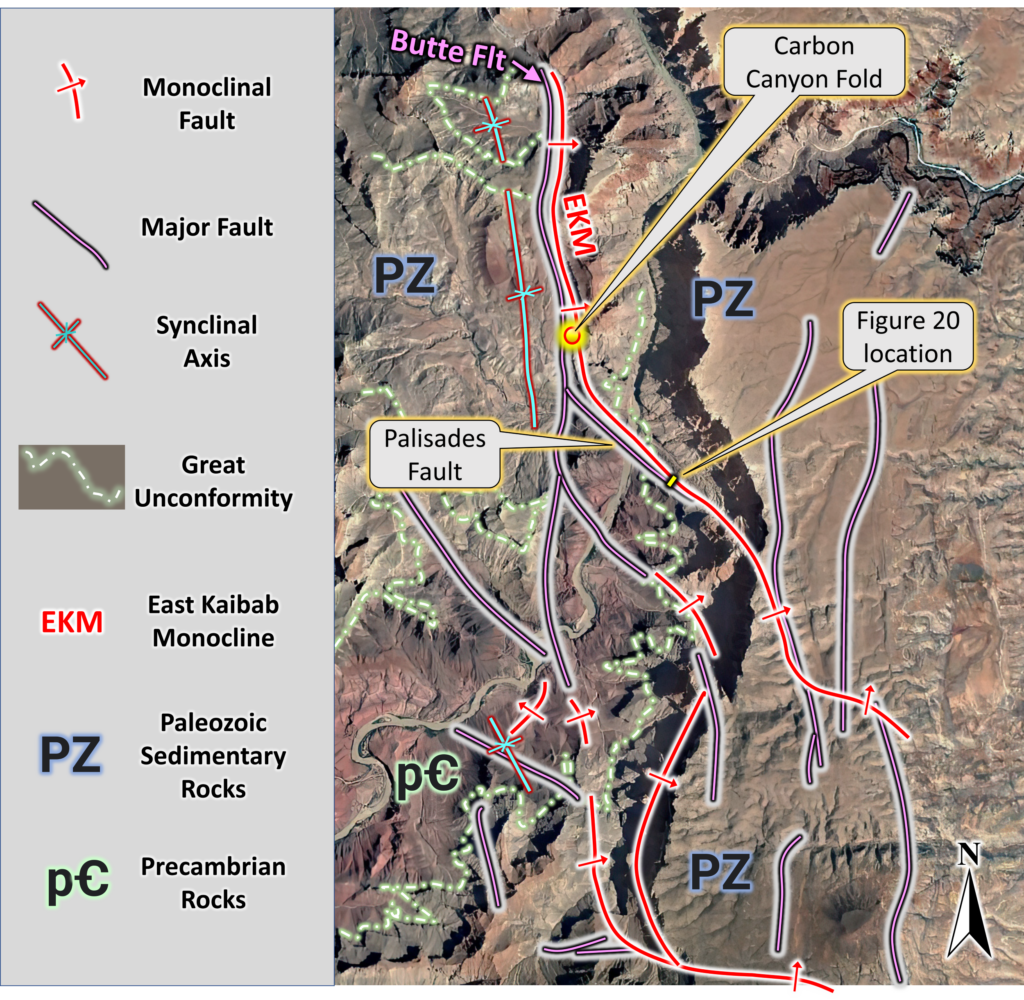
Figure 4. Location of Palisades fault relative to the Butte Fault and the Carbon Canyon Fold. (faulting from Reches and Matthews, 1978 over Google Maps image)
What does the Palisades fault tell us about the folding? How does this help? The Reches and Matthews study (1978) made three key observations:
- Both the Dox Formation and Tapeats Sandstone were involved in the flexuring.
Since Dr. Snelling agrees that Precambrian sedimentary layers were lithified prior to the Tapeats deposition, this means that the Precambrian lithified sediments were folded during the same Laramide event that caused all of the sampled folds. This was a process that did not happen over one year. (Snelling 2026a)
- The Tapeats formation was brecciated during the faulting and folding.
This means that it was lithified to some degree at the time. We don’t have exposure of the Butte fault zone adjacent to the Carbon Canyon fold, but it may have had the same brecciation. Regardless, for the Tapeats, this demonstrates that in at least some areas in the Grand Canyon region, it was not soft sediment during the Laramide deformation.
- Samples of calcite twinning were examined from the Muav Limestone.
Samples taken from close to the flexure had more twinning than those away from it. This is consistent with deformation of the whole area with uplift, but more intense stress closer to the fault zone. Calcite twinning occurs in the deformation of lithified limestones, not lime mud.
These three observations are all consistent with deformation of lithified Dox and Tonto units in the Palisade fault region. Dr. Snelling described what would indicate that the Tapeats Sandstone was lithified at the time of deformation. He wrote, “These rock layers should have broken and shattered during the folding, unless the sediment was still relatively soft and pliable.” (Snelling 2009a). Breaking and shattering is exactly what is demonstrated at the Palisades fault. Brecciation has not been documented at Carbon Canyon, but the actual Butte fault zone is not exposed at this location. These observations from the Palisade fault are consistent with at least partially lithified sediments folded over deep time under varying stress conditions and this is reasonable for the Carbon Canyon Fold as well.
Fold morphology vs. modeling of soft-sediment deformation
In describing soft-sediment deformation in our article, we wrote, “The resulting folds commonly have a “soupy” appearance such as might develop in folding damp clay or mud with significant thickness changes and varying fold amplitudes and wavelengths.” We contrasted the “relatively planar limbs and fairly sharp hinges”, particularly evident in the Monument fold and the nearby kink fold, with the more fluid appearance so common in soft-sediment deformation. Dr. Snelling responded:
"Of course, the sediment layers in these Grand Canyon folds obviously do not have a “soupy” appearance. But their morphology instead does match the features observed in laboratory-scale, experimental, soft-sediment-deformation simulations, including the relatively planar limbs and fairly sharp hinges seen in all four folds documented in my papers." (Snelling 2026a)
This is a strong statement. It is worth looking at the studies that he says document this. He describes these here:
“Some excellent relevant examples are the simulation experiments of Rettger (1935), Handin et al. (1976), Friedman et al. (1976), Weinberg (1979), and Friedman, Hugman and Handin (1980). These and other experiments involved confining pressures, and yet the dampened sand and/or clay layers when compressionally folded would appear to have faithfully simulated soft sediment deformation to produce folds similar and identical to those observed and classified as folding due to soft-sediment deformation in exposed outcrops of now lithified sedimentary layers elsewhere (for example, Waldron and Gagnon 2011, and Alsop et al. 2019). Even the folding of these Tapeats Sandstone beds have been simulated in these soft-sediment deformation experiments (fig. 10), along with the accompanying minor faulting, and the fractures and joints." (Snelling 2023) Emphasis added.
Are these simulation experiments really demonstrating what he believes they are? When we examined the five papers that Dr. Snelling listed, we found that Handin et al. (1976), Friedman et al. (1976), Weinberg (1979) did their modeling using lithified stones, such as limestone and sandstone. This says nothing about soft-sediment deformation. Rettger (1935) and Friedman, Hugman and Handin (1980) did modelling with unconsolidated sediment, but we would argue that they did not demonstrate “relatively planar limbs and fairly sharp hinges”.
Snelling wrote:
“Nabavi and Fossen (2021) have reviewed the history of such experiments, primarily undertaken in squeeze boxes with layers of dampened sand and/or clay, glass sides to the box and a crank handle for moving one end inwards towards the other fixed end so that the compressional folding of the dampened sediment layers can be simulated.”
Nabavi and Fossen (2021) is a fine article on folding, but it really deals very little with physical modeling. They show one line drawing as an example of soft-sediment deformation and it clearly has what we would describe as a soupy appearance, without planar limps or sharp hinges. The figure is taken from “Folding during soft-sediment deformation” by G.I. Alsop, et al, (2020). That paper shows many examples from Israel of soft-sediment deformation, all with soupy appearance. We would argue that the figures in Waldron and Gagnon (2011) all show “soupy” deformation, not planar limbs and sharp hinges.
Davis (1978) did a great job of modeling monoclines similar to those on the Colorado Plateau. He used kaolinite and modeling clay, but apparently did not try to use materials with characteristics that were scaled to represent what either lithified or non-lithified materials would have had. This just was not the focus of his work.
To summarize, Dr. Snelling’s objection that “laboratory-scale, experimental, soft-sediment-deformation simulations” show the planar limbs and sharp hinges has not been demonstrated. We are still quite comfortable that the regional and outcrop scale observations of the Tonto folds are best explained by deformation of at least partially lithified sediments over deep time.
Diagenesis
Both we and Dr. Snelling agree that the folding found in the Tonto formations could not have happened since Noah’s flood if the rocks were as cemented and hardened as they are today. The processes that occurred to transform loose sands, mud and lime into various sandstones, shales and limestones are called “diagenesis”. As we noted in our article, it is difficult to determine when the quartz cementation took place that lends most of today’s strength to the rocks. We cannot radiometrically date it and Dr. Snelling would not accept the results if we could.
Snelling’s timeline demands that quartz cementation took place very rapidly.
“Yet they persist in claiming without justification that “these temperatures will not allow noticeable cementation in a few hundred years.” This claim is entirely refuted by observational and experimental evidence.” (Snelling 2026a)
To support his claim of rapid quartz cementation, Dr. Snelling cites an article by Akahane, et al. (2004) where these authors describe relatively rapid precipitation of opal on wood in hot springs. Opal is hydrated silicon dioxide, not crystalline quartz, and its precipitation on wood is very different than that of quartz from connate waters in sedimentary rocks. Even if opal were somehow rapidly precipitated through the Grand Canyon formations regionally, the opal would still have to be very rapidly converted to the crystalline quartz we see today.
The temperatures and pressures that we all interpret to have been present in the Tonto Group would have permitted quartz cementation and other diagenetic effects over deep time. What about in just a few hundred years? The temperatures do limit the amount of quartz that can be deposited in a short time. Dr. Earle McBride (1989) described how the silica within the original pores would not have been adequate to account for heavily cemented sandstones, but points to other source options, without resorting to any cataclysmic processes. Dr. Snelling would probably say that McBride is biased by his “uniformitarian geology”, but the proposals by Snelling seem short of support. Snelling proposed that cementation can occur regionally at the temperatures that he provides and so far has not given evidence of this.
What do we conclude about diagenesis? We find it consistent that much cementation took place before the Laramide event, when the rocks were heated to their maximum temperature. Cementation may have continued after the deformation, but that is uncertain. However, we do not see a scenario where the regional quartz cementation could have occurred in the timeframe proposed by Snelling.
Carving the Grand Canyon
It is important to contrast the timing of the diagenesis that we suggest with the proposals that Dr. Snelling makes for the Grand Canyon rocks. He views the carving of the Grand Canyon to have occurred over a few hundred years following Noah’s flood and yet after the lithification of the units by a process that also occurred after the flood. Other flood geologists propose that the Grand Canyon was carved during the late stages of Noah’s flood, despite all of the problems inherent in this. (Scheele 2010; Oard 2021; Walker 2012; Clarey 2026)
Dr. Snelling proposes that the Grand Canyon was carved when a dam that held back a post-flood lake was breached and it “rapidly carved the canyon within days.” (Snelling 2026a). Recent findings do support the idea that spillover from a large lake in the Bidahochi basin was important in the erosion of the Grand Canyon and determining its present configuration (He et al. 2026). Even so, the data that supports this, utilizes radiometric dating that indicates that this erosion began around 6.6 million years ago. If YEC do not accept radiometric dating, then they should not use this to support their hypothesis (Duff 2026).
Casting further doubt on the lake spillover hypothesis misused by Snelling is a new paper by Karlstrom et al. (2026). The authors of the new study argue that detrital sanidine tracer grains and fish phylogeny data indicates that “…multiscale mantle-driven uplift, rather than lake spillover, was the primary driver for integration of the proto-Colorado River through Grand Canyon.” No doubt work will continue understanding canyon development over the last few million years.
We have considered Dr. Snelling’s support for the rapid diagenesis and almost instantaneous carving of the canyon, but we have not seen any data that supports this. Even if there were limited areas where rocks could be cemented by the hypotheses that he proposes, applying this over broad regions is just not plausible, even if one calls on his hypothesis for the “fountains of the great deep (Genesis 7:11). Deep time allows for the carving of canyons while preserving meanders and other features along the water courses. Carving canyons over days or weeks does not.
Later Metamorphism in other areas
In our article on the deformation, we pointed out that Young Earth flood interpretations do not just have problems in the Grand Canyon. A global flood explanation for the rock record has to explain it all. One of the issues comes from the late metamorphism that is documented in many places in layers supposedly laid down after Noah’s flood, particularly given Snelling’s interpretation of the top of the flood deposits. We used one example from Taiwan where we recognize that in rocks that Snelling would have as post-flood deposition, miles of sediment were deposited, the rocks were then deeply buried, metamorphosed and then exposed by erosion. Other examples include the Alps (Engi et al. 2004; Vaughan-Hammon et al. 2022; Hoinkes et al. 1999) and the Zagros Mountains (Karim and Al-Bidry 2020; Boutoux et al. 2021). Examples in Arizona include the nearby Catalina metamorphic core complex (Favorito and Seedorff 2021; Ducea et al. 2020; Spencer 2023; Davis 2025). Deformation there took place just south of the Colorado Plateau, during the Cenozoic Laramide Orogeny, approximately while the Grand Canyon monoclinal folding took place and also even later in the Cenozoic.
Referring to our example from Taiwan, Dr. Snelling wrote,
"Thus, “This deposition, burial, metamorphism, and erosion had to take place at incredible rates in any YEC model.” Precisely! But have they not read the young-earth n creationist literature that provides the details of how these processes happened rapidly during the biblical global Flood cataclysm and its catastrophic aftermath, with supporting documentation from the secular uniformitarian literature that Tillman and Mitchell are so fond of citing?” (Snelling 2026a) Emphasis added
What does he mean by the “catastrophic aftermath”? When did it end? Does it just happen to cover everything that doesn’t fit his proposal? First, we know that in this area, sedimentary rocks were deposited. Dr. Snelling obviously has no problem seeing these rocks deposited in a few days, but after the flood he can’t use cataclysmic flood deposition to do so. Many events are recorded globally during the Eocene, Oligocene, Miocene and Pliocene epochs. For example, in the Gulf of Mexico, we find deltas, thick slope deposits, and even small reefs. (see this article for more information: What happened geologically between Noah’s flood and Abraham?) This deposition took far longer than the entire time that Dr. Snelling suggests for all of Earth’s history.
In Taiwan, depositing the Eocene to Oligocene sediments that were metamorphosed is just a small part of the issue though. In order to metamorphose the shales to slate, another eight kilometers (5 miles) or more of sediments had to have buried the Pilushan Formation to form what is slate today. We can’t use internal clues to quantify how long it took for the rocks to be deformed into the folds that we find today. The limiting factor would have been the rate at which plates were moving, rather than the viscosity of the heated rocks. Flood geologists must remember that calling on miraculous rates of plate movement might be a hypothesis for during the flood, but this happened later. Additional deformation was required to bring the deeply buried rocks up from the great depths to the surface and into today’s mountains. The rocks that covered them had to be eroded away and there is no justification to call on the cataclysmic earthquakes or tsunamis that were hypothesized for the early part of the Flood. The rocks that were eroded away were not muds and unlithified sands. How did this happen? Not surprisingly, flood geologists, such as Dr. Snelling, see these factors as not being a problem. Support for this is lacking.
Part 3 summary
We have read all of the articles by Dr. Snelling on the folds that he sampled in the Grand Canyon and, of course, his responses to our papers. We fully admit that we were not there when the folding occurred. We rely on physical evidence from this region and other areas to understand the processes and assess the timing. We find that the best explanation for all of the observations is that the rocks were at least partially lithified before the Laramide orogeny and were folded slowly during this event. We agree with Dr. Snelling that the Phanerozoic rocks in the Grand Canyon were not metamorphosed, though they were metamorphosed in the Catalina region, south of the Grand Canyon. The structural folding we observe in the Tonto Group (such as in the Carbon Canyon Fold) is a direct result of the Laramide Orogeny, a massive mountain-building event caused by tectonic plate collisions. This was not a sudden, rapid squishing of soft mud during a flood year. Instead, just like the slow, grinding tectonic forces currently pushing up the Himalayas and the Alps, this continental collision slowly warped miles of solid, previously lithified rock. Snelling's hyper-compressed timeline simply does not allow for the millions of years of slow heat and immense, sustained pressure required to fold solid rock on a continental scale.
Were the Tonto rocks lithified? Some lithification of the Tonto is consistent with these observations:
-
- Associated folding of Precambrian lithified units along the Palisades Fault, a fault that developed with the Butte fault along which the Carbon Canyon folding developed.
- Brecciation of the Tonto units in the same area.
- Planar limbs and sharp hinges in the Tonto folds, including the kink fold near the Monument fold
- Fracturing associated with the folding, often cutting through grains and often most intense in the more tightly folded portions of the folds.
- Timing of overall diagenesis, given the temperature and pressure constraints.
Dr. Snelling made the claim that the lithification of the sediments that are now stone in the Grand Canyon could have all taken place in a very brief time. His associated hypotheses just don’t have any technical support. They fail because they need to explain the diagenesis of vast volumes of sediment hardened by many different types of diagenesis. For example, euhedral quartz crystals forming in many different temperature and pressure situations speak to long time periods, time that just doesn’t fit the YEC model.
The entrenched meanders of the Colorado Plateau provide evidence of the gradual uplift of the region, especially given that we both agree that the sediments were lithified prior to the carving of the Grand Canyon. Rapid carving would not preserve the meandering morphology. Perhaps some form of spillover contributed to the reorganization, but we see no data to support this having occurred over the timeframe that Snelling predicts.
Dr. Snelling seems to believe that if his proposal for soft-sediment deformation folding is true in the Grand Canyon, that would prove that flood geology is valid and that the Earth is young. We used a number of examples to point out that deformation over deep time is confirmed over and over. Much of the metamorphism would be considered post-flood in any published young earth model. It is not reasonable to propose that sediments were deposited, buried, metamorphosed and then uplifted and then much was eroded away in a few hundred years, all after any of the YEC models date Noah’s flood.
Final Comments:
No, neither we nor Dr. Snelling were there when the Grand Canyons were there. In fact, neither was Moses. God was, but His account does not describe the geologic effects of Noah’s flood, let alone in what is now the Grand Canyon region. YEC make their case based on three anchors:
- The Bible can only be interpreted faithfully as demanding creation less than ten thousand years ago.
- The abundant fossil record around the world has to be interpreted largely to be the result of a global cataclysmic flood a few thousand years ago.
- The scientific data can and should be interpreted to fit these proposals.
Regarding the first anchor, we find that many Christians around the world seek to hold the Bible to be the inerrant Word of God, but do not believe that it teaches, much less demands that the Earth was created such a short time ago. It is far beyond the scope of our writings here to delve into how these views work and which is more correct, but suffice to say here, that we would urge grace as we deal with those who disagree with our interpretations.
Regarding the third anchor, YEC organizations, such as AIG, have devoted much effort and resources to attempt to demonstrate this point. We find that this has not been successful, and this study is a case in point.
This discussion revolves around the second anchor and its application to the Cambrian rocks in the Grand Canyon and largely in the American Southwest. Flood geology has a tremendous number of events to explain as occurring within the one-year long event that they interpret to have been global.
Could the Cambrian sediments have been deposited within the early part of Noah’s flood? We continue to find that there is no evidence to support this. If deposited by a catastrophic flood, the Cambrian units should be dominated by thick chaotic units deposited by high velocity flows. We found beds that look very much like normal beds from modern day marine, tidal and fluvial processes. The timeline proposed by flood geology dictates that deposition was almost continuous through the flood, but we saw evidence of many pauses in sedimentation. There were many examples that could be pointed to, but the many layers of algal stromatolites that formed reefs in the Cambrian period are particularly clear.
All agree that if the sediments in the geologic record were hardened prior to the folding that is so common in rock formations, then more time was required than YEC proposals have for the entire of Earth’s record. Dr. Snelling proposed that the folding developed in the Grand Canyon provides an example where the folding interpreted as slow incremental strain over deep time can be conclusively demonstrated to have occurred within the one-year long flood interval, while the sediments were soft and pliable. We found that the characteristics here support folding over deep time. We also pointed out that the burial, metamorphism, subsequent exposure and erosion of many Cenozoic intervals also do not fit within flood geology timelines.
We can understand that many people will continue to hold their understandings of a young earth and a global flood. Some will hold to this, believing that someday, explanations will be found that support these positions. That is a faith decision and can be respected as such. That is quite different than claiming that today’s evidence and current findings support positions that they do not.
Acknowledgements
This reply benefited greatly from contributions from Tim Helble and Jeff Reichman. They have helped both in terms of the technical strength of the article and in making it more readable.
References cited:
Ahr, Wayne M. 1971. “Paleoenvironment, Algal Structures, and Fossil Algae in the Upper Cambrian of Central Texas.” Journal of Sedimentary Research 41 (1): 205–16. https://doi.org/10.1306/74D72225-2B21-11D7-8648000102C1865D
Akahane, Hisatada, Takeshi Furuno, Hiroshi Miyajima, Toshiyuki Yoshikawa, and Shigeru Yamamoto. 2004. “Rapid Wood Silicification in Hot Spring Water: An Explanation of Silicification of Wood during the Earth’s History.” Sedimentary Geology 169 (3): 219–28. https://doi.org/10.1016/j.sedgeo.2004.06.003
Alsop, G. I., R. Weinberger, S. Marco, and T. Levi. 2020. “Folding during Soft-Sediment Deformation.” Geological Society, London, Special Publications 487 (1): 81–104. https://doi.org/10.1144/SP487.1
Austin, Steven A. 1994. Grand Canyon: Monument to Catastrophe. Institute for Creation Research.
Baldwin, Christopher T., P. K. Strother, J. H. Beck, and Eben Rose. 2004a. “Palaeoecology of the Bright Angel Shale in the Eastern Grand Canyon, Arizona, USA, Incorporating Sedimentological, Ichnological and Palynological Data.” Geological Society, London, Special Publications 228 (1): 213–36. https://doi.org/10.1144/GSL.SP.2004.228.01.11
Baldwin, Christopher T., P. K. Strother, J. H. Beck, and Eben Rose. 2004b. “Palaeoecology of the Bright Angel Shale in the Eastern Grand Canyon, Arizona, USA, Incorporating Sedimentological, Ichnological and Palynological Data.” Geological Society, London, Special Publications 228 (1): 213–36. https://doi.org/10.1144/GSL.SP.2004.228.01.11
Baumgardner, John R., and Evan Novarro. 2023. “The Role of Large Tsunamis in the Formation of the Flood Sediment Record.” Proceedings of the International Conference on Creationism 9. https://doi.org/10.15385/jpicc.2023.9.1.22
Blakey, Ronald C. 2018. “Deep Time MapsTM - Maps of Ancient Earth.” https://deeptimemaps.com/
Boutoux, Alexandre, Arthur Briaud, Claudio Faccenna, Paolo Ballato, Federico Rossetti, and Eric Blanc. 2021. “Slab Folding and Surface Deformation of the Iran Mobile Belt.” Tectonics 40 (6): e2020TC006300. https://doi.org/10.1029/2020TC006300
Carling, Paul. 2017. “Catastrophic Deposition of Gravel from Outbreak Floods.” In Gravel-Bed Rivers: Process and Disasters. https://doi.org/10.1002/9781118971437.ch11
Carling, Paul A., and Xuanmei Fan. 2020. “Particle Comminution Defines Megaflood and Superflood Energetics.” Earth-Science Reviews 204: 103087
Chafetz, Henry S. 1973. “Morphological Evolution of Cambrian Algal Mounds in Response to a Change in Depositional Environment.” Journal of Sedimentary Research 43 (2): 435–46. https://doi.org/10.1306/74D7278E-2B21-11D7-8648000102C1865D
Chivas, Alan R., T. Torgersen, and H. A. Polach. 1990. “Growth Rates and Holocene Development of Stromatolites from Shark Bay, Western Australia.” Australian Journal of Earth Sciences 37 (June): 113–21. https://doi.org/10.1080/08120099008727913
Clarey, Dr Timothy. 2020. Carved in Stone: Geologic Evidence of the Worldwide Flood. ICR Institute for Creation Research.
Clarey, Dr Timothy. 2026. “Grand Canyon Carved by Flood Runoff, Not Lake Spillover.” April 27. https://www.icr.org/article/15902
D’alessandro, A., and R. G. Bromley. 1986. “Trace Fossils in Pleistocene Sandy Deposits from Gravina Area Southern Italy.” Rivista Italiana Di Paleontologia Stratigrafia 92 (1). https://doi.org/10.54103/2039-4942/13289
Davis, George H. 1978. “Monocline Fold Pattern of the Colorado Plateau.” In Laramide Folding Associated with Basement Block Faulting in the Western United States. GSA Memoir 151. https://doi.org/https://doi.org/10.1130/MEM151
Davis, George H. 2025. “Field Guide to Metamorphic Core-Complex Geology, Catalina and Rincon Mountains, Tucson, Arizona.” Journal of the Southwest 67 (2): 186–218
Dehler, Carol, Frederick Sundberg, Karl Karlstrom, et al. 2024. “The Cambrian of the Grand Canyon: Refinement of a Classic Stratigraphic Model.” GSA Today 34 (11): 4–11. https://doi.org/10.1130/GSATG604A.1
Ducea, Mihai N., Antoine Triantafyllou, and Jordan Krcmaric. 2020. “New Timing and Depth Constraints for the Catalina Metamorphic Core Complex, Southeast Arizona.” Tectonics 39 (8): e2020TC006383. https://doi.org/10.1029/2020TC006383
Duff, Joel. 2026. “What a New Grand Canyon Study Really Says—and Why Creationists Will Misrepresent It.” Naturalis Historia, April 23. https://thenaturalhistorian.com/2026/04/23/what-a-new-grand-canyon-study-really-says-and-why-creationists-will-misuse-it/
Elston, Donald Parker. 1979. “Late Precambrian Sixtymile Formation and Orogeny at Top of the Grand Canyon Supergroup, Northern Arizona.” In Professional Paper, No. 1092. U.S. Govt. Print. Off.,. https://doi.org/10.3133/pp1092
Engi, Martin, Romain Bousquet, and Alfons Berger. 2004. “Explanatory Notes to the Map: Metamorphic Structure of the Alps, Central Alps.” Mitteilungen Der Österreichischen Mineralogischen Gesellschaft 149 (January). https://opac.geologie.ac.at/ais312/dokumente/149_113-227.pdf
Favorito, Daniel A., and Eric Seedorff. 2021. “Cenozoic Structural Evolution of the Catalina Metamorphic Core Complex and Reassembly of Laramide Reverse Faults, Southeastern Arizona, USA.” Geosphere 17 (6): 1928–71. https://doi.org/10.1130/GES02313.1
Hardy, Joseph Kirk. 1986. “Stratigraphy And Depositional Environments Of Lower And Middle Cambrian Strata In The Lake Mead Region, Southern Nevada And Northwestern Arizona.” University of Nevada, Las Vegas. https://digitalscholarship.unlv.edu/rtds/6
He, John J. Y., Ryan S. Crow, John Douglass, et al. 2026. “Late Miocene Colorado River Arrival in the Bidahochi Basin Supports Spillover Origin of Grand Canyon.” Science 392 (6795): 289–95. https://doi.org/10.1126/science.adz6826
Hoinkes, Georg, Friedrich Koller, Gerd Rantitsch, et al. 1999. “Alpine Metamorphism in the Eastern Alps.” Schweizerische Mineralogische Und Petrographische Mitteilungen 79 (January): 155–81
Hopson, Heath H., André W. Droxler, Pankaj Khanna, et al. 2025. “Controls on the Evolution of Large Upper Cambrian Microbial Buildups in Mason County, Texas, USA: Bridging the Gaps between Scales from Microbes to Large Buildup Architecture.” GSA Bulletin 137 (11–12): 5381–402. https://doi.org/10.1130/B38255.1
Karim, Kamal Haji, and Mayssaa Al-Bidry. 2020. “Zagros Metamorphic Core Complex: Example from Bulfat Mountain, Qala Diza Area, Kurdistan Region, Northeast Iraq.” Jordan Journal of Earth and Environmental Sciences.
Karlstrom, K. E., M. T. Heizler, A. Aslan, et al. 2026. “Tectonically Driven Integration of the 4.8 Ma Colorado River USA Tracked with Detrital Sanidine and Fish Genetics.” Nature Communications, ahead of print, July 1. https://doi.org/10.1038/s41467-026-75006-8
Karlstrom, K. E., M. T. Mohr, M. D. Schmitz, et al. 2020. “Redefining the Tonto Group of Grand Canyon and Recalibrating the Cambrian Time Scale.” Geology 48 (5): 425–30.
Kenny, Ray. 2017. “Oxygen and Hydrogen Isotope Ratios of Chert from the Sixtymile Formation in Grand Canyon National Park, USA: A Warm Palaeoclimate, Freshwater Deposit.” Acta Geochimica 36 (2): 250–59. https://doi.org/10.1007/s11631-016-0138-y
Khanna, Pankaj, Michael Pyrcz, Andre Droxler, Heath Hopson, Paul Harris, and Daniel Lehrmann. 2020. “Implications for Controls on Upper Cambrian Microbial Build-Ups across Multiple-Scales, Mason County, Central Texas, USA.” Marine and Petroleum Geology 121 (July): 104590. https://doi.org/10.1016/j.marpetgeo.2020.104590
Korolev, Viacheslav Sergeevich. 1997. “Sequence Stratigraphy, Sedimentology, and Correlation of the Undifferentiated Cambrian Dolomites of the Grand Canyon and Lake Mead Area.” MS Thesis, University of Nevada, Las Vegas. https://digitalscholarship.unlv.edu/rtds/3332
Macintyre, Ian G., R. Pamela Reid, and Robert S. Steneck. 1996. “Growth History of Stromatolites in a Holocene Fringing Reef, Stocking Island, Bahamas.” Journal of Sedimentary Research 66 (1). https://archives.datapages.com/data/sepm/journals/v66-67/data/066/066001/0231.htm
Mata, Scott A., Cara L. Corsetti, Frank A. Corsetti, Stanley Awramik, and David J. Bottjer. 2012. “Lower Cambrian Anemone from the Upper Member of the Wood Canyon Formation, Death Valley Region United States: Paleoecological and Paleoenvironmental Significance.” PALAIOS 27 (9): 594–606. https://doi.org/10.2110/palo.2012.p12-016r
McBride, Earle F. 1989. “Quartz Cement in Sandstones: A Review.” Earth-Science Reviews 26 (1): 69–112. https://doi.org/10.1016/0012-8252(89)90019-6
Midwest Creation Fellowship. 2023. Dr. Andrew Snelling - Significance of Folds in Tapeats Sandstone at Grand Canyon. 01:06:34. https://www.youtube.com/watch?v=a-ntSuEi-wY
Mitchell, Stephen. 2018. A Texas- Sized Challenge to Young Earth Creation and Flood Geology: A Christian Geologist Looks for Answers. Christian Faith Publishing, Inc.
Mitchell, Stephen, and Kennen S. Tillman. 2024a. “Examining Young Earth Creation Claims About the Grand Canyon.” Peaceful Science, ahead of print, August 15. https://doi.org/10.54739/tyet
Mitchell, Stephen, and Kennen S. Tillman. 2024b. “The Tonto Deformation.” Peaceful Science, ahead of print, August 15. https://doi.org/10.54739/k1y8
Mitchell, Stephen, and Kennen S. Tillman. 2024c. “Tonto Depositional Processes and Rates.” Peaceful Science, ahead of print, August 15. https://doi.org/10.54739/giu8
Myrow, Paul M., Robert R. Gaines, and Michael P. Lamb. 2025. “Low Sinuosity Meandering Rivers before Vascular Plants: Cambrian Tapeats Formation, Arizona, USA.” GSA Bulletin 138 (1–2): 809–22. https://doi.org/10.1130/B38336.1
Nabavi, Seyed Tohid, and Haakon Fossen. 2021. “Fold Geometry and Folding – a Review.” Earth-Science Reviews 222 (November): 103812. https://doi.org/10.1016/j.earscirev.2021.103812
Nielson, R. LaRell, and Chris Barker. 2016. “Geology of the Northern Llano Uplift, Junction to Llano, Texas.” Paper presented at Texas Academy of Science, 2016 Field Trip. March 6. https://scholarworks.sfasu.edu/geology/15
Noffke, Nora, and Kenneth C. Gass. 2026. “Microbial Mat Facies in Cambrian Tidal Flats and Implications for the Trace Fossil Record (Elk Mound Group, Wisconsin, USA).” PALAIOS 41 (2): 74–90. https://doi.org/10.2110/palo.2025.042
Oard, Michael J. 2021. “A Dam Breach Unlikely for the Origin of Grand Canyon.” Creation Research Society Quarterly, 17.
Petryshyn, Victoria A. 2013. “Stromatolites in the Ancient and Modern:; New Methods for Solving Old Problems.” University of Southern California.
Reches, Ze’ev, and Vincent Matthews III. 1978. “Development of Monoclines: Part I. Structure of the Palisades Creek Branch of the East Kaibab Monocline, Grand Canyon, Arizona.” In Laramide Folding Associated with Basement Block Faulting in the Western United States, vol. 151. Geological Society of America. https://doi.org/10.1130/MEM151-p235
Resser, Charles E. 1945. Cambrian History of the Grand Canyon Region: Part I. Stratigraphy and Ecology of the Grand Canyon Cambrian; Part II. Cambrian Fossils of the Grand Canyon. Carnegie Institute of Washington Publication 563. Carnegie Institute of Washington.
Roth, Ariel A. 1998. Origins: Linking Science and Scripture. Review and Herald Publishing Assn.
Santucci, Vincent, and Justin Tweet. 2020. Grand Canyon National Park: Centennial Paleontological Resource Inventory.
Scheele, Peter. 2010. “A Receding Flood Scenario for the Origin of the Grand Canyon.” Journal of Creation. https://dl0.creation.com/articles/p075/c07573/j24_3_106-116.pdf
Scotese, Christopher R. 2021. “Paleomap Project.” Paleomap Project. http://www.scotese.com/
Snelling, Andrew A. 2009a. Earth’s Catastrophic Past. Institute for Creation Research. http://isgenesishistory.s3.amazonaws.com/digital%20downloads/earth-catastrophic-past-1-preview.pdf
Snelling, Andrew A. 2009b. “Radiometric Dating: Problems with the Assumptions.” Answers in Genesis, October 1. https://answersingenesis.org/geology/radiometric-dating/radiometric-dating-problems-with-the-assumptions/
Snelling, Andrew A. 2010. “Doesn’t the Order of Fossils in Rock Record Favor Long Ages?” Answers in Genesis, September 9. https://answersingenesis.org/fossils/fossil-record/doesnt-order-of-fossils-in-rock-favor-long-ages/
Snelling, Andrew A. 2021. “The Petrology of the Tapeats Sandstone, Tonto Group, Grand Canyon, Arizona.” Answers Research Journal 14. https://assets.answersingenesis.org/doc/articles/pdf-versions/arj/v14/petrology_tapeats_sandstone.pdf
Snelling, Andrew A. 2022. “The Petrology of the Muav Formation, Tonto Group, Grand Canyon, Arizona.” Answers Research Journal 15: 139–262.
Snelling, Andrew A. 2023. “The Monument Fold, Central Grand Canyon, Arizona.” Answers Research Journal, August 9. https://answersingenesis.org/geology/monument-fold-grand-canyon/
Snelling, Andrew A. 2025. “Responding to ‘Peaceful Science’ Critics on Grand Canyon Evidence.” Answers in Depth, November 7. https://answersingenesis.org/geology/rock-layers/grand-canyon-critic-response-1/
Snelling, Andrew A. 2026a. “The Tonto Deformation: Responding Again to ‘Peaceful Science’ Critics.” Answers in Depth, February 1. https://answersingenesis.org/geology/rock-layers/grand-canyon-critic-response-3/
Snelling, Andrew A. 2026b. “Tonto Depositional Processes and Rates: Responding Again to ‘Peaceful Science’ Critics.” Answers in Depth, January 9. https://answersingenesis.org/geology/rock-layers/grand-canyon-critic-response-2/
Spencer, Jon. 2023. “A Brief Field Guide to the Geology of a Metamorphic Core Complex as Seen along the Catalina Highway, Tucson Area, Arizona.” Paper presented at Geodaze 2023 Field Guide. https://static1.squarespace.com/static/5e75334092b04e44f321939b/t/641cbecaff5933518766fc04/1679605452973/2023+GeoDaze+Field+guide%2C+Catalina+Highway+v2.pdf
Vahrenkamp, Volker, Viswasanthi Chandra, Elisa Garuglieri, et al. 2024. “Discovery of Modern Living Intertidal Stromatolites on Sheybarah Island, Red Sea, Saudi Arabia.” Geology 52 (May): 347–51. https://doi.org/10.1130/G51793.1
Vaughan-Hammon, Joshua D., Lorenzo G. Candioti, Thibault Duretz, and Stefan M. Schmalholz. 2022. “Metamorphic Facies Distribution in the Western Alps Predicted by Petrological-Thermomechanical Models of Syn-Convergent Exhumation.” Geochemistry, Geophysics, Geosystems 23 (8): e2021GC009898. https://doi.org/10.1029/2021GC009898
Verde, Mariano, Martín Ubilla, Juan J. Jiménez, and Jorge F. Genise. 2007. “A New Earthworm Trace Fossil from Paleosols: Aestivation Chambers from the Late Pleistocene Sopas Formation of Uruguay.” Palaeogeography, Palaeoclimatology, Palaeoecology 243 (3): 339–47. https://doi.org/10.1016/j.palaeo.2006.08.005
Waldron, John W. F., and Jean-François Gagnon. 2011. “Recognizing Soft-Sediment Structures in Deformed Rocks of Orogens.” Journal of Structural Geology, Flow of Rocks, vol. 33 (3): 271–79. https://doi.org/10.1016/j.jsg.2010.06.015
Walker, Tas. 2012. “Grand Canyon, USA, Was Carved by Receding Floodwaters – Biblical Geology.” Biblical Geology, May. https://biblicalgeology.net/blog/grand-canyon-carved-by-receding-flood
Wanless, Harold R. 1973. “Cambrian of the Grand Canyon–A Reevaluation.” AAPG Bulletin 57 (4): 810–11. https://doi.org/10.1306/83D90D18-16C7-11D7-8645000102C1865D
Whitmore, John H. 2009. “Do Mud Cracks Indicate Multiple Droughts During the Flood.” In Rock Solid Answers: The Biblical Truth Behind 14 Geologic Questions. Creation Research Society Books.
Williamson, Thomas E., and Spencer G. Lucas. 1996. “Mammal Footprints from the Miocene-Pliocene Ogallala Formation, Eastern New Mexico.” New Mexico Geology 18 (1): 1–5. https://doi.org/10.58799/NMG-v18n1.1
Woodmorappe, John. 2006. “Are Soft-Sediment Trace Fossils (Ichnofossils) a Time Problem for the Flood?” Journal of Creation, 10.
Recent Comments