
Does Flood Geology explain the rocks in the Grand Canyon?
Reply to Dr. Snelling’s Response, Part 3
Tonto Deformation
Stephen Mitchell and Kennen Tillman
Introduction
Christians have different interpretations of the Biblical doctrine of creation and how to integrate our understandings of scripture and scientific data. As part of that discussion, in 2024, we published a three-part critique of Dr. Andrew A Snelling’s papers that proposed to explain the Cambrian-aged Tonto Group in the Grand Canyon as having formed and deformed during Noah’s flood (Mitchell and Tillman 2024a, 2024c, 2024b). (Link to critique.) Dr Snelling has now published his response, also in three parts in “Answers in Depth”, a publication by Answers in Genesis (AIG). Links to his response articles are here:
Responding to “Peaceful Science” Critics on Grand Canyon Evidence, Part 1
Tonto Depositional Processes and Rates: Responding Again to “Peaceful Science” Critics, Part 2
The Tonto Deformation: Responding Again to “Peaceful Science” Critics, Part 3
In turn, we here will provide readers with a reply to this response. We hope to clarify a number of misconceptions and misrepresentations and let the readers make up their own minds.
Our response to Dr. Snelling’s articles was in three parts, as was his reply. This counter response also has three sections. First, we reply to his Part 1, in particular to: 1. concerns about who we are, 2. his interpretation of the Great Unconformity, and 3. Radiometric dating, a topic only briefly discussed in our articles.
In Part 3, we will look at the objections to our article on the deformation of the Tonto group and his interpretation that the rocks were folded while soft and that they hardened very quickly before the Grand Canyon was carved. We contend that Dr. Snelling has a steep hill to climb because he must show that the data actually support that the rocks were deposited and folded within a one-year long catastrophic global flood, and also that the sediments hardened quickly and then that the Grand Canyon was carved before humans came along. The hardening and canyon carving, in his proposal, all would have happened within a period of no more than 450 years. We find that the geological data do not support these claims. In our articles, we have focused on the technical geologic details and interpretations, not the Biblical interpretation. We believe that the Bible is the inerrant Word of God, but that it does not tell us how old the Earth is or what the geological effects of Noah’s flood were.
Table of Contents
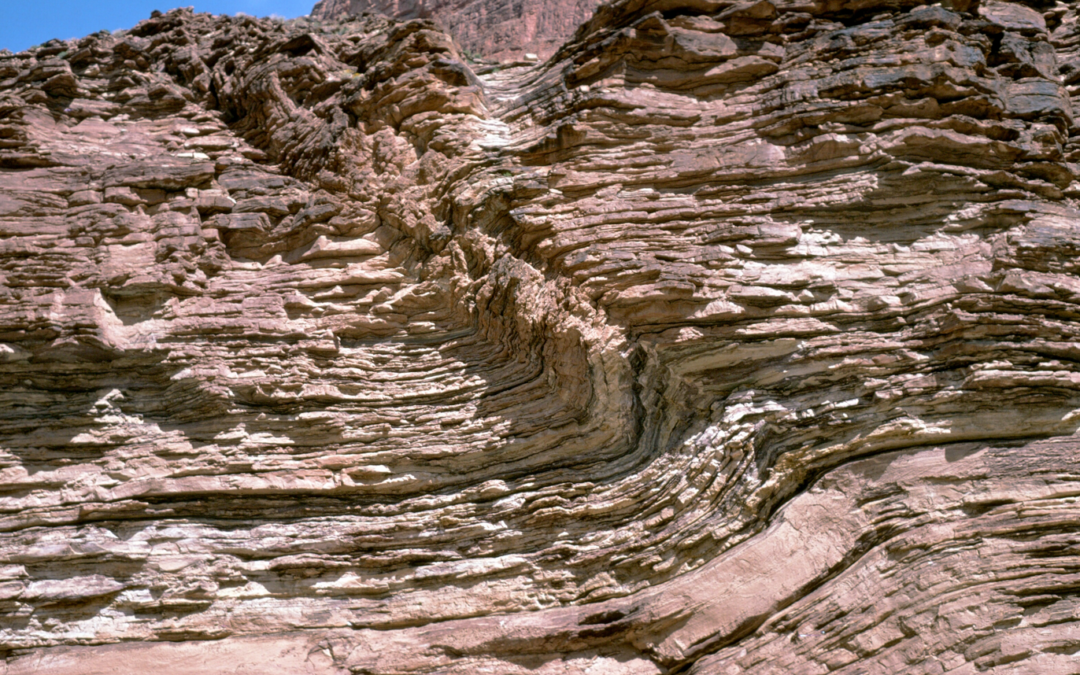
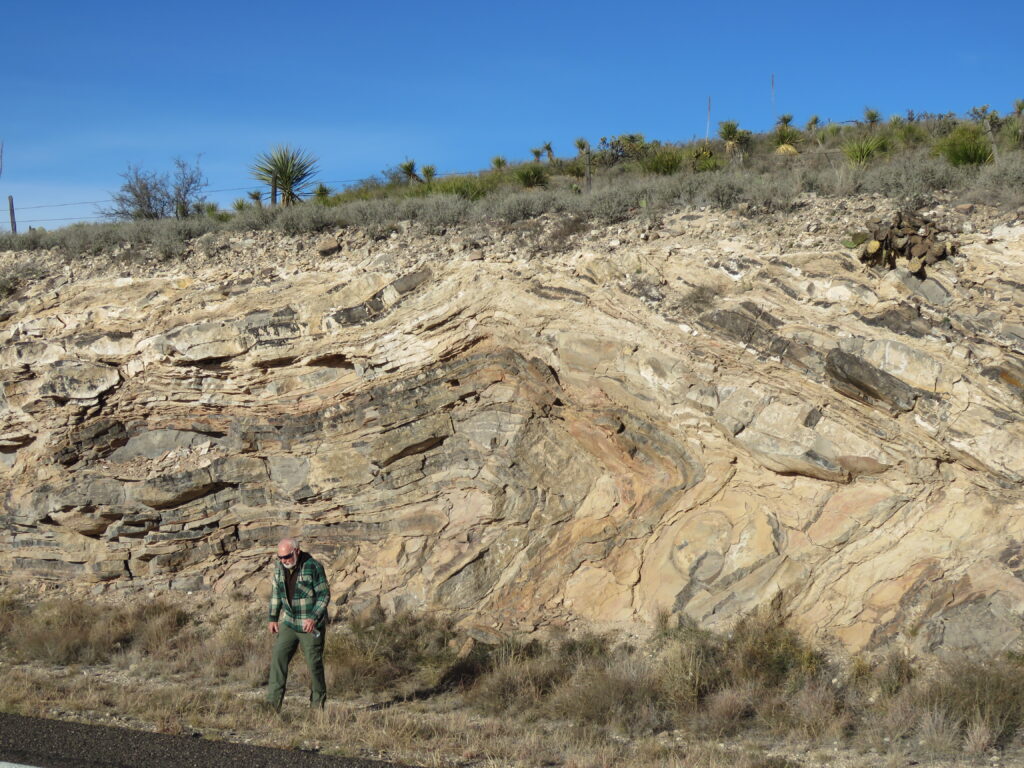
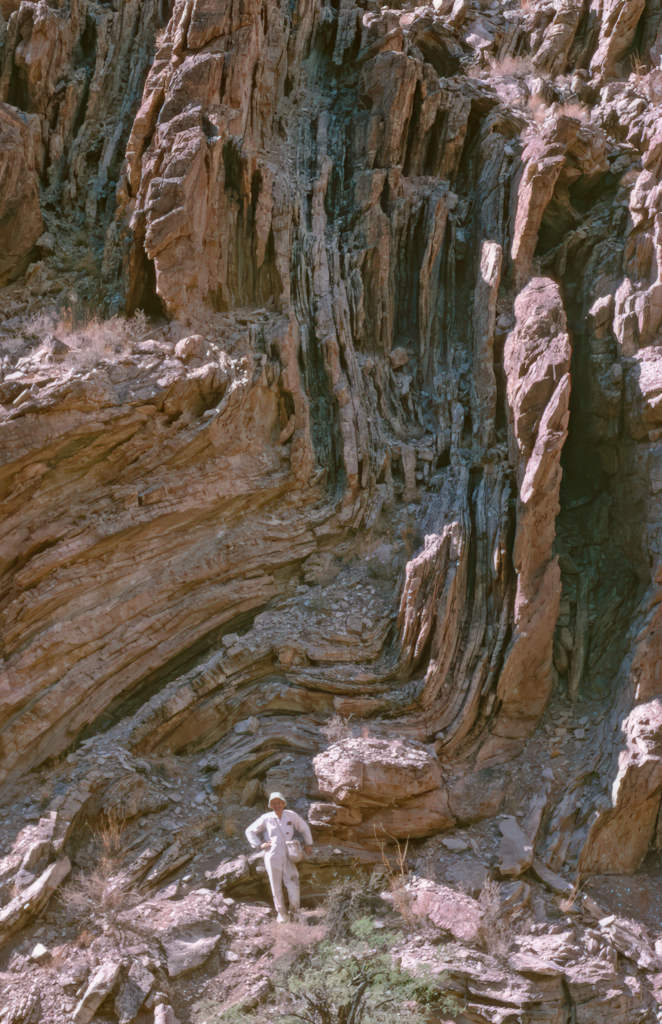 Carbon Canyon Fold in Tapeats Sandstone on east side of Butte Fault
(Billingsley, G.H., Goodwin, G., Nagorsen, S.E., Erdman, M.E., and Sherba, J.T., 2019, Geologic and related photographs of the Grand Canyon region (1967–2010): U.S. Geological Survey data release, accessed [Aug 05, 2026], at https://doi.org/10.5066/F7WS8SHW
https://www.sciencebase.gov/catalog/item/5c75a81fe4b0fe48cb4a5665 )
Upper image is the "Kink Fold" in the Tapeats Sandstone (Photo by Billingsley, 2019, https://www.sciencebase.gov/catalog/item/5c75a46be4b0fe48cb4a5071)
Reply to Part 3
The Tonto Deformation: Responding Again to “Peaceful Science” Critics
Since at least 2009, Dr. Snelling has been publishing that the folding of the Tonto Group, particularly the Carbon Canyon Fold, occurred while the sediments were soft and pliable, and that this proves that this deformation did not occur millions of years ago (Snelling 2009b). It is important to note that we and Dr. Snelling agree on some aspects of the Tonto deformation. For instance, we agree that the sampled folds in the Tonto Group all formed as a part of a major mountain forming event, known as the Laramide Orogeny. We agree that the folding in the Grand Canyon area involved older Precambrian normal faults. Regional compression caused large-scale reverse movement on them, as monoclines developed and the Colorado Plateau was uplifted. We agree that the folding took place after the deposition of thousands of feet of sediment above the Tonto Group. We also agree that the folding did not involve metamorphism.
We both also recognize that sediments can be folded both by soft-sediment deformation and by slow deformation of lithified sediments. Dr. Snelling recognized the slow alternative but stated, “Incremental strain over sustained periods of time is harder to differentiate. As noted above, it can also result in ductile deformation” (Snelling 2023c). Part of the challenge in classifying incremental strain is that we must all recognize that there is a continuum between soft sediment deformation and high pressure / high temperature metamorphic deformation. The evidence, in our view, is consistent with the Tonto deformation reflecting incremental strain over deep time at relatively low temperatures and pressures. Dr. Snelling has correctly pointed out that the units do not show significant evidence of features such as sub-grains, undulose extinction, deformation lamellae and deformation kink bands, all associated with higher grades of temperature and pressure, but he has not dealt with explaining when such features begin to develop along the continuum. The Tonto deformation, where sampled by Dr. Snelling, just did not reach the necessary temperatures and pressures for these to develop.
Dr. Snelling has built the case that, regardless of other characteristics that are found, only examination under the microscope can be used to distinguish between soft-sediment deformation vs. slow deformation of lithified sediments.
”However, field examination of these folds is insufficient to determine whether they were due to such ductile behavior of the lithified rocks under much later prolonged stress or due to soft sediment deformation soon after deposition. Detailed microscopic examination is thus absolutely necessary to document the character of the sandstone, specifically, the textural relationships between the constituent grains and the timing of the formation of the cement (lithification).” (Snelling 2023b, 3) Emphasis added.
In this light, it is interesting that Snelling published in 2009, as a fact, that in particular the Carbon Canyon Fold, was formed by soft-sediment deformation before he had examined any of the microscopic evidence that he now has.
Dr. Snelling’s 2026 response to our article on the Tonto deformation brings in familiar themes.
“They make this claim although no geologist has observed such claimed long-timescale folding. The long timescale has only been inferred based on uniformitarian assumptions. On the other hand, it should be emphasized that the folding of soft sediments has been observed in laboratory experiments, and those experiments demonstrate that fracturing can occur in soft-sediment deformation.” (Snelling 2026a)
Again, It is still true that none of us were there. As noted earlier, Dr. Snelling went looking for data that would support his particular interpretation of scripture. It is fair to say that my co-author and I were skeptical of his conclusions from the start, but we have tried to evaluate his data fairly to see if it proves his conclusions. Since we all bring in biases, we must assume that these do not invalidate the actual data that we consider. We tried to interpret all of the data available that has bearing on the questions at hand.
It is evident that this study was primarily designed to address the question of whether or not the Tonto units were metamorphosed. He didn’t systematically sample depositional facies or map bedding geometries, etc. to determine depositional environments. He also did not map fractures or faults that are evident in the outcrops. These aspects just were not a focus for him. He seems to remain convinced that rock deformation in lithified sediments could only be associated with metamorphism. Hence, he argues that if the Tonto Group had been lithified before the folding took place in the sampled folds, the rocks must, in his view, have been significantly metamorphosed if they were not folded while still soft.
Dr. Snelling is using a strawman argument because no one has argued that these rocks were metamorphosed in the Grand Canyon. Snelling can defeat the argument that the Tonto units were metamorphosed but that is not really at issue. No one argues that the rocks were buried and deformed by any combination of high temperature and pressure.
Temperature/Pressure vs. Metamorphism
Why do geologists agree that the Tonto units were never hot enough or under enough pressure for metamorphism? Several tools have been used to develop a history of temperature, the thermochronology, of the Grand Canyon. These include Zhe, a methodology that uses rations of uranium (²³⁸U, ²³⁵U) and thorium (²³²Th) vs. helium in zircon and other techniques such as apatite fission track measurement. Several estimates of the temperature history for the Paleozoic rocks of the Grand Canyon have been made. Here is one of the most recent:
“Good paths suggest that maximum Laramide reheating as high as 140 °C was achieved by ca. 80 Ma, followed by rapid cooling to ∼90 °C by 55 Ma, slow cooling from 55 to 20 Ma, and rapid cooling to near surface temperatures after 20–10 Ma” (Thurston et al. 2021)
Dr. Snelling also provided estimates in the following description:
“In conclusion, therefore, the consensus from all these estimation methods is that the Tapeats Sandstone prior to the Laramide deformation responsible for the Carbon Canyon fold would have been subjected to a burial temperature of 110–130°C. Then during the Kaibab uplift erosion caused the temperatures within the Tapeats Sandstone to decrease to <70°C." (Snelling 2023b)
Figure 15 shows the temperature and pressure range estimates for various forms of metamorphism that can be distinguished by their mineralogy (Zou 2013). The box shows the range over which quartz cementation would have formed in the Tonto. The right bottom corner represents the hottest and highest pressure experienced, just before the rocks were uplifted by the Laramide Orogeny and the uplift of the Colorado Plateau. Notice that the temperatures and pressures are all in the diagenetic domain, never reaching low grade metamorphism. It is worth noting that the P-T ranges for the various metamorphism grades are not uniform as different investigations use different ranges, but regardless, we did not identify any that would consider the range from the Tonto Group as being within even the low-grade region.
We would conclude that the temperature / pressure data, folding styles and thin sections agree that this deformation did not involve metamorphism. That does not mean that the rocks were deformed by soft-sediment deformation. The deformation here involved incremental strain over long periods of time. In addressing Dr. Snelling’s Part 3 response in more detail, first, we will address some of the specific statements that Dr. Snelling made that deserve replies. Some were addressed earlier in the introductory section, but need to be responded to more specifically here.
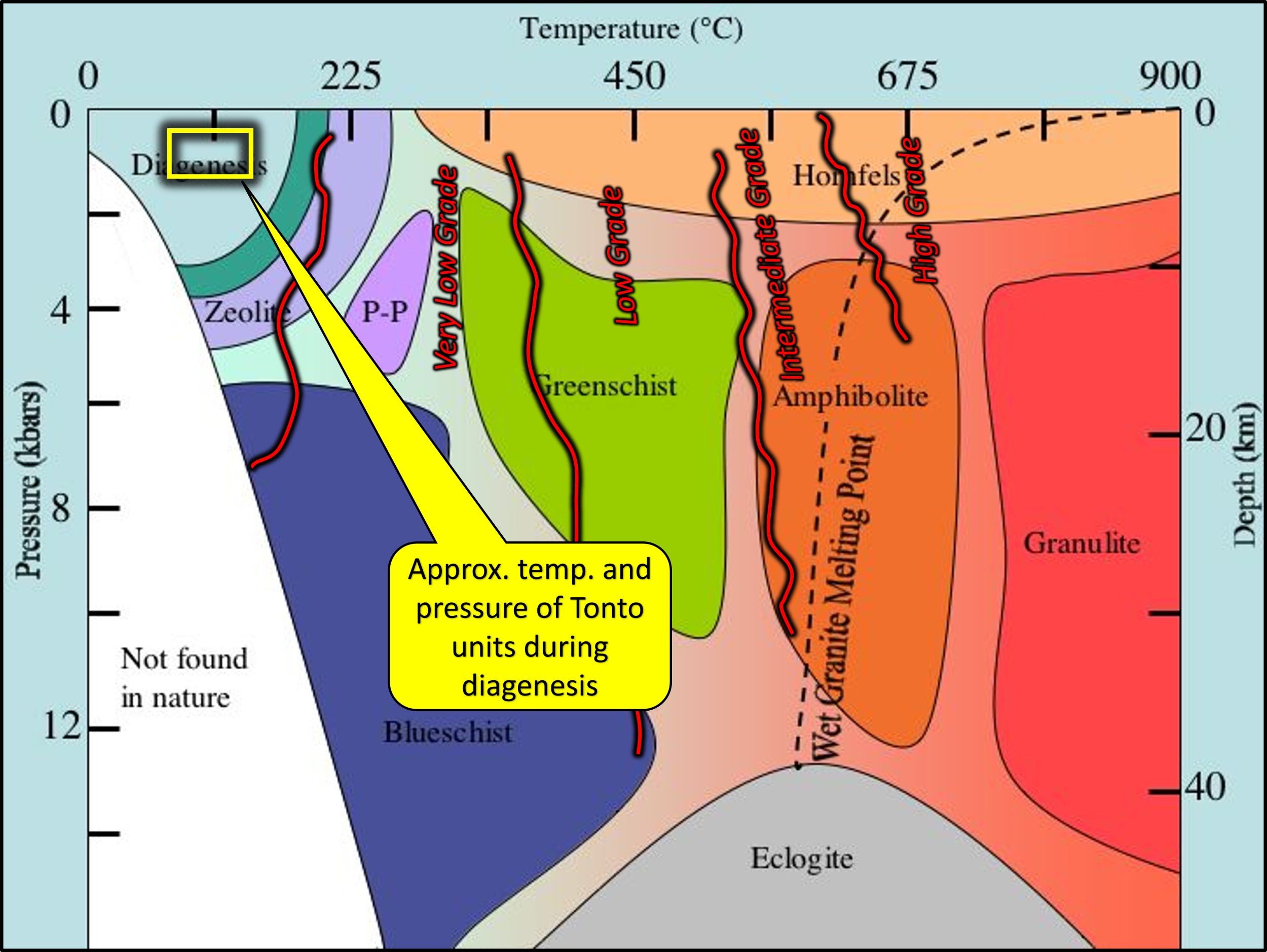
Figure 15. Diagram of metamorphic facies in regard to temperature and pressure. The labeled box shows approximately where the Tonto units would have fallen based on both hydrostatic and lithostatic pressures. The box partially obscures the word “Diagenetic”. Base figure: David Magrass, Public domain, via Wikimedia Commons; Metamorphic grades from: Regional Metamorphism by Zao, 2013.
Images used
One concern that Dr. Snelling points to is our use of figures. We presume that he provided the set of images of all of his slides to allow his work to be examined and potentially critiqued. As pointed out earlier, we were not free to use his images without his permission, and he did not respond to our request for permission. Many of his claims needed to be addressed by referring directly to his images. We had hoped to be able to show uninterpreted and interpreted versions adjacent to one another. Fortunately, we found images of some of the outcrops with folds that we were able to use, such as from USGS images which are in the public domain. In some cases, we did not find images that we could use online or in other literature. For example, on the Whitmore Helipad Fold and the Matkatamiba Fold, the only photographic images we found were in his reports. In these cases, we chose to present interpretations of his photographs. These were clearly labeled as interpretive line drawings. While Snelling may not have agreed with our interpretations, this was the only way to appropriately show the features that we recognized in the folds. We would encourage him to present his own interpretations of the fault and fracture patterns, perhaps classifying them in terms of those associated with the Laramide deformation vs. other causes.
Thin section images were more difficult, but given the interpretation presented by Dr. Snelling and his stated position that thin sections were the only means of distinguishing the timing of the lithification, these were critical. Simply describing slides as fractured would hardly have substituted. We again would encourage him to present his interpretation of the fracturing in his slides. No doubt he would have different interpretations, but we are comfortable with the interpretations that we presented. We examined all of his slides in all of the detail that we could, but could only give a few examples, those essential to making our points.
Dr. Snelling pointedly accused us of deceit on our Figure 24. Again, we find ours to be a reasonable interpretation. He wrote:
“The degree to which fractures cut through grains is also particularly difficult to observe in fine-grained rocks. Even so, Mitchell and Tillman feature the thin section shown in their Fig. 24, in which they highlight the dark rounded areas that they claim “were cemented before being cut by fractures with small amounts of offset.”129 However, the prominent offset along an interpreted fracture in their Fig. 24 was manufactured deceitfully by Mitchell and Tillman, as unsuspecting readers did not have my original photomicrograph of the actual thin section for comparison. So it is presented in my Fig. 13 here, which conclusively shows absolutely no offset of the sample along a fracture. If the fracture were there, it would be highlighted by the same blue-dye-colored epoxy resin that is evident in fractures in other photomicrographs, such as in my Fig. 12 (left) above and in the sample-preparation-induced wide fracture near the top of the photomicrograph in my Fig. 13. How can any of Mitchell and Tillman’s claims be trusted when such deceit is plainly evident?” (Snelling 2026a)
First, recognize that we did not claim that this is an open fracture. We see this as a linear healed zone of deformation. The dark rounded areas that we suggest could be concretions clearly have abrupt flat sides. These flat sides are bounded by a linear zone of fine-grained rock with what we recognize as a different texture than is found in most of the sample. The displacement that we suggested is probably just a few millimeters in strain, but still was the result of deformation. We would certainly have preferred to have had the ability to present the actual slide image with it, but that was not an option, since he did not respond to our request. In any case, we certainly engaged in no deliberate deceit!
Dr. Snelling criticized our interpretative line drawing of his slide MF-02 in our Figure 25 (Snelling 2026a). We all recognize that the blue tint along the slide is dye from the resin injection, but continue to interpret this as reflecting fine-scale deformation along a shear zone. His photograph shown of the location certainly appears to show deformation consistent with shearing, particularly the dark bed beneath the sampled bed that thickens and thins consistent with this (Snelling 2023a). His description of this slide includes the following:
“Some quartz grains exhibit undulose extinction. Along the edges of two huge (4.69 and 6.14 mm, ϕ = -2.12 and -2.36) quartz grains is what appears to be a zone of crushed and/or sheared quartz like “mylonite” made up of tiny-small irregular quartz fragments with different extinction angles but “blend” into one another as a cemented mass, that on their other sides also cuts off the corners of former K-feldspar laths. The same wide crushed quartz “mylonite” zone elsewhere cuts between two very large K-feldspar laths, cuts the edges of other quartz grains, or even includes an altered elongated K-feldspar grain, and a sheared “island” medium quartz grain with stress twinning in crossed polars and with an included long, thick, altered edge-on muscovite flake with frayed ends.” (Snelling 2023a) Emphasis added.
Snelling’s description seems quite consistent with moderate deformation at low temperature of sandstone that was at least partially lithified.
Sampling for structural analysis
In our critique of Dr. Snelling’s Tonto work, we suggested that the sampling and analysis were not really adequate to address some of the questions that need to be answered. This does not mean that the sampling was bad, but, as mentioned earlier, his study was not really designed to provide a structural analysis in any detail or to address other folding options. A study designed to address the possibility that the Tonto units were metamorphosed would not be expected to, for instance, explain the pattern and origin of fracture sets in the units.
Referring to our pointing out that his study did not collect the data required to answer our additional questions, Dr. Snelling described us as “pontificating” (Snelling 2026a). He is welcome to his opinion, but if he had wanted to deal in any detail with the fracturing that we all recognize to be present, he would have collected other data. The data available just do not allow us to separate fractures into different sets that might have been associated with deformation vs. compaction vs unroofing. Capturing all of the data desired would involve considerable time and effort, but it would allow the various fracture systems to be understood. An example of such work was published in a recent article by Dr. Xiaolong Sun, et al, where they were able to document four different fracture sets through rocks in Spain. (Sun et al. 2021). Similarly, such data could be collected for the Grand Canyon folds.
We pointed out that Dr. Snelling did not provide his own cross-sections. He rejected this, apparently misunderstanding what was meant by a cross-section. Neither his photographs, nor our interpretive line drawings constitute cross-sections. Projecting onto a single plane along a well-oriented line shows the bed interpretation and their structural relationships. By including faults and key fractures, a clear picture is communicated that shows what the interpreter believes to be the geologic picture. Zooming out enough to show the relationship with the key monoclinal faults, would clarify the timing and help explain how these sampled folds developed. Many examples are available, such as in Reches and Matthews (1978. p. 244, 245, and 248). Karlstrom and Timmons (2012, p. 105) show examples of interpretation over a photograph. Of course, if one doesn’t provide such basic displays, it could imply either a lack of understanding of the features or unwillingness to present data that might open up other interpretations. It is interesting that Snelling complains when the figures of the Carbon Canyon fold have been reversed, so as to orient them in the same direction that the vast majority of Colorado Plateau monocline cross-sections are drawn, including the one he included as Figure 4 in his Carbon Canyon Fold article (Snelling 2023b). The orientation we went with was clearly labeled on the figures.
Reference to the Palisades Fault
We included some discussion of the Palisades fault, because it provides additional data to help understand the deformation along the monoclines. The objection from Dr. Snelling is really surprising. He wrote,
“However, as I emphasized previously, what happened on the Palisades Fault is not relevant to the Carbon Canyon fold adjacent to the Butte Fault. In any case, the issue even with respect to the Palisades Fault is not the fault itself, but what happened adjacent to it.” (Snelling 2026a) Emphasis in original
This might sound like a serious objection, unless you understand where the Palisades fault is with respect to the Carbon Canyon fold. Figure 16 should clarify this. The Palisade fault is a branch of the same fault that the Carbon Canyon fold is developed along. Deformation along the same fault from the same overall forces is clearly relevant, especially when they relate to the same rock units.
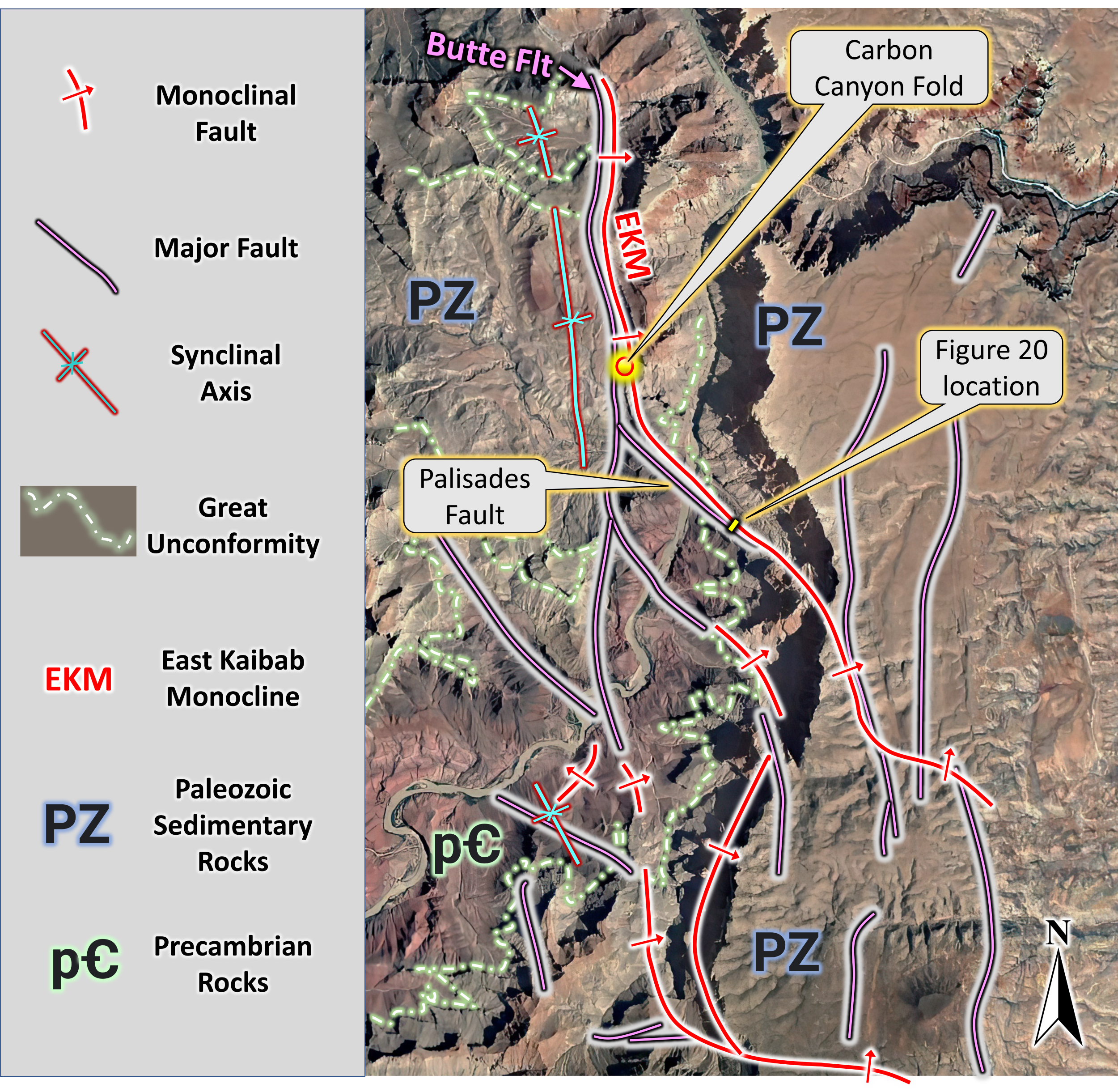
Figure 16. Location of Palisades fault relative to the Butte Fault and the Carbon Canyon Fold. (faulting from Reches and Matthews, 1978 over Google Maps image)
How does this help? Here are a few quotes from Reches and Matthews, 1978:
“The lowest structural level of the Palisades monocline is composed of both flexuring and faulting within the Dox Formation and the Tapeats Sandstone.” (Reches and Matthews 1978) Emphasis added.
“The monocline includes a sharp anticlinal bend with a radius of curvature of about 10 m (Fig. 11) [our figure 2] and a relatively open synclinal bend with a radius of curvature of about 150 m. The rocks in the anticlinal bend are intensely fractured, but the apparent displacements are small. The steeply dipping beds of the Bright Angel Shale and the overlying Muav Limestone are disturbed by small faults, by joints, and by small folds. The structural throw of the monocline is about 150 m.” (Reches and Matthews 1978) Emphasis added.
“Figure 11. The continuous anticlinal bend in the sandstone layers of the upper member of Tapeats Sandstone (sec. b-b, Fig. 12). Radius of curvature is 10 to 15 m. The rocks are brecciated, but the layers are continuous. The termination of the Palisades fault is about 10 to 15 m below this exposure.” (Reches and Matthews 1978)
What does this tell us? Here are three important observations.
- Both the Dox Formation and Tapeats Sandstone were involved in the flexuring.
Since Dr. Snelling agrees that Precambrian sedimentary layers were lithified prior to the Tapeats deposition, this means that the Precambrian lithified sediments were folded during the same Laramide event that caused all of the sampled folds. (Snelling 2026a) This was a process that did not happen over one year.
- The Tapeats formation was brecciated during the faulting and folding.
This means that it was lithified at least to some degree at the time. We don’t have exposure of the Butte fault zone adjacent to the Carbon Canyon fold, but it may have had the same brecciation. Regardless, for the Tapeats, this demonstrates that in at least some areas in the Grand Canyon region, it was not soft sediment during the Laramide deformation.
- Samples of calcite twinning were examined from the Muav Limestone.
Samples taken from close to the flexure had more twinning than those away from it. This is consistent with deformation of the whole area with uplift, but more intense stress closer to the fault zone. Calcite twinning occurs in the deformation of lithified limestones, not lime mud.
These three observations are all consistent with deformation of lithified Dox and Tonto units in the Palisade fault region.
Dr. Snelling described what would indicate that the Tapeats Sandstone was lithified at the time of deformation. He wrote, “These rock layers should have broken and shattered during the folding, unless the sediment was still relatively soft and pliable.” (Snelling 2009a). Breaking and shattering is exactly what is demonstrated at the Palisades fault. Brecciation has not been documented at Carbon Canyon, but the actual Butte fault zone is not exposed at this location. We also should recognize that the local stress relationships would have been different in the different folded areas. These observations from the Palisade fault are consistent with at least partially lithified sediments folded over deep time under varying stress conditions and this is reasonable for the Carbon Canyon Fold as well.
Fold morphology vs. modeling of soft-sediment deformation
In describing soft-sediment deformation in our article, we wrote, “The resulting folds commonly have a “soupy” appearance such as might develop in folding damp clay or mud with significant thickness changes and varying fold amplitudes and wavelengths.” We contrasted the “relatively planar limbs and fairly sharp hinges”, particularly evident in the Monument fold and the nearby kink fold, with the more fluid appearance so common in soft sediment deformation. Dr. Snelling responded:
"Of course, the sediment layers in these Grand Canyon folds obviously do not have a “soupy” appearance. But their morphology instead does match the features observed in laboratory-scale, experimental, soft-sediment-deformation simulations, including the relatively planar limbs and fairly sharp hinges seen in all four folds documented in my papers." (Snelling 2026a)
This is a bold statement. It is worth looking at the studies that he says document this. He describes these here:
“Some excellent relevant examples are the simulation experiments of Rettger (1935), Handin et al. (1976), Friedman et al. (1976), Weinberg (1979), and Friedman, Hugman and Handin (1980). These and other experiments involved confining pressures, and yet the dampened sand and/or clay layers when compressionally folded would appear to have faithfully simulated soft sediment deformation to produce folds similar and identical to those observed and classified as folding due to soft-sediment deformation in exposed outcrops of now lithified sedimentary layers elsewhere (for example, Waldron and Gagnon 2011, and Alsop et al. 2019). Even the folding of these Tapeats Sandstone beds have been simulated in these soft-sediment deformation experiments (fig. 10), along with the accompanying minor faulting, and the fractures and joints. (Snelling 2023c) Emphasis added.
Are these simulation experiments really demonstrating what Snelling believes they are? Let’s look at each of the five modeling papers:
Perhaps R.E. Rettger’s paper (1935), “Experiments on Soft-Rock Deformation” provides the most support. Rettger used physical modeling to deform sands and clays that he developed into layers. Interestingly, most of the deformation models do have the changes in thickness that we have described as “soupy”. Perhaps his Figure 13 shows something similar to a kink fold. It was formed by compressing dried sands that showed some strength as a result. Here are some observations that Rettger reported that can be useful in recognizing soft-sediment deformation.
-
- “Clays and sands which were deformed under water, or while still damp, never showed clean knife-edge breaks.” Certainly, at the outcrop scale, the Tonto photos show abrupt edges to faults.
- “It was further noticed that no cavities were produced which might later be filled with cementing material. In some cases, the sediment adjacent to the fault plane became considerably disrupted, forming something like fault-plane filling. This filling, however, usually showed blurred edges and some connection with the side-wall material.” Such filling is not noted in the Tonto folding.
- “Another point which might be mentioned as showing the condition of the rock at the time of deformation is the non-uniformity of the positions of the faults and the movements along them. Some of the faults show a displacement in one direction, while others show an opposite movement.” These type of faults and folds have not been noted in the Tonto group.
The second paper Snelling referenced is “Experimental folding of rocks under confining pressure: Part II. Buckling of multilayered rock beams.” It was published in 1976 by John Handin and other structural geologists (Handin et al. 1976). They describe their modeling: “Specimens composed of as many as five layers of various combinations of dry Coconino Sandstone (brittle) and Indiana Limestone (ductile) are folded at 1-kb confining pressure.” This is an important modeling paper, but it demonstrates deformation of lithified sediments of different strengths, not soft-sediment deformation.
The third paper cited is “Experimental folding of rocks under confining pressure: Part III. Faulted drape folds in multilithologic layered specimen”, published by Friedman (Friedman et al. 1976). Again, their physical modeling used lithified stone: limestone, sandstone, and rock salt. Their modeling says nothing about soft-sediment deformation.
The fourth paper continues this theme. In 1979, David Weinberg wrote “Experimental folding of rocks under confining pressure: Part VII, Partially scaled models of drape folds” (Weinberg 1979). Their physical modelling worked with chalk, dolomite, lead, limestone and sandstone. This allowed Weinberg to demonstrate ways that variable lithologies would impact deformation. The materials used were rocks and soft metal, not soft-sediment.
The last paper is “Experimental folding of rocks under confining pressure, Part VIII — Forced folding of unconsolidated sand and of lubricated layers of limestone and sandstone” by Dr. Melvin Friedman and two others, including John Handin (Friedman et al. 1980). As the title suggests, this paper does have some bearing on the deformation of unconsolidated sand, and it makes some useful observations regarding fractures in unconsolidated sediments. They reported,
“The deformed sand veneers clearly demonstrate that unconsolidated sand under confining pressure behaves in many respects like indurated sandstone. The microfracture patterns, which become more ordered with increasing confining pressure, show the same general stress trajectories as do similarly deformed indurated sandstones.” (Friedman et al. 1980)
Even if this is true, it is not clear from Friedman et al.’s text or their models that there are indications of relatively planar limbs or fairly sharp hinges being supported by their modeling. Dr. Snelling appears to be trying to stretch Friedman et al.’s findings beyond what they intended.
Dr. Snelling wrote, “Nabavi and Fossen (2021) have reviewed the history of such experiments, primarily undertaken in squeeze boxes with layers of dampened sand and/or clay, glass sides to the box and a crank handle for moving one end inwards towards the other fixed end so that the compressional folding of the dampened sediment layers can be simulated.” Nabavi and Fossen (2021) is a fine article on folding, but it really deals very little with physical modeling. They show one line drawing as an example of soft-sediment deformation and it clearly has what we would describe as a soupy appearance, without planar limps or sharp hinges. The figure is taken from “Folding during soft-sediment deformation” by G.I. Alsop, et al, (2020). The paper shows many examples from Israel of soft-sediment deformation, all with soupy appearance. We would argue that the figures in Waldron and Gagnon (2011) all show “soupy” deformation, not planar limbs and sharp hinges.
Davis (1978) did a great job of modeling monoclines similar to those on the Colorado Plateau. He used kaolinite and modeling clay but apparently did not try to use materials with characteristics that were scaled to represent what either lithified or non-lithified materials would have had. This just was not the focus of his work.
To summarize, Dr. Snelling’s objection that “laboratory-scale, experimental, soft-sediment-deformation simulations” show the planar limbs and sharp hinges has not been demonstrated. We are still quite comfortable that the regional and outcrop scale observations of the Tonto folds are best explained by deformation of at least partially lithified sediments over deep time.
Ubiquitous deformation at microscopic scale
If the Tonto units had been metamorphosed by temperature increases from deep burial and pressure, the samples collected would have documented this, but no one would have expected this. Dr. Snelling spent considerable effort in each of his reports describing microstructures that provide information about the deformation of sedimentary rocks. He describes features like kink bands, deformation lamellae, deformation bands and undulose extinction. We would not have been surprised to have seen more examples of such microstructures in Snelling’s slides. By the same token, the lack of these is not troubling.
Why would that be? We supplied at least a major part of the answer in our article quoted here:
“Folding of lithified sediments, in contrast, takes hundreds of thousands to millions of years. Of course, unlithified and well lithified sediments are end members on a continuum and deformation rates and mechanisms will depend on the lithologies involved and the degree of lithification. For simplicity, let’s first consider these end members, but recognize that the Tonto units are not at the extremes, either in terms of the degree of lithification or the amount of deformation evidenced.” (Mitchell and Tillman 2024b)
This means that the range of microstructural features that result from this deformation would not all be present. The degree to which they should be expected depends on several factors, including: the degree of lithification (at the time of the deformation), the amount of deformation, and the rate it occurs at. First, we should agree that these are not as tightly folded as many sediments are, such as in orogenic belts. Folding is often much more intense in the cores of mountain ranges. These are not even as intensely deformed as rocks along the Palisades fault as evidenced by the amount of brecciation there. (Reches and Matthews 1978; Orofino 2005) .
Dr. Snelling reported, “Thus, the only definitive method for distinguishing between slow ductile deformation of lithified sandstone layers and soft-sediment deformation of unlithified sandstone layers is microscopic examination of the minerals and textures within those sandstone layers, which is exactly what was done in my investigations.” (Snelling 2026a) Notice that he describes this as a discrete, all-or-nothing situation, without dealing with the reality of the continuum that we know exists in nature. His response to us never really dealt with at what point along the continuum, microstructural features appear.
A critical component of this understanding is the timing of diagenesis and that will be discussed next. For now, it is enough to recognize that we don’t know the exact timing of the quartz cementation that is so extensive today.
We described the sediments as having been pervasively deformed, as that is what folding does. The rocks did not simply slide along brittle faults, but every portion experienced some deformation, though clearly not all experienced equal amounts. We see that in the fracturing in the slides that Snelling prepared. The grain scale deformation is dependent on factors that include the strength and thickness of the beds, the temperature, the rate of deformation and the specific geometries involved. Laboratories have certainly been able to reproduce the various deformational features that Snelling described, but we simply don’t know when they would have begun and how extensive they would have been, particularly in specific settings, such as in the Grand Canyon folds.
Dr. Snelling accused us of “cherry picking” the slides that we used in our article. (Snelling 2026a) We obviously wanted to show important features and selected examples that reflected points that we wanted to illustrate. Extensive fracturing often cuts through quartz grains. This is particularly evident in the Monument fold samples where we saw this in virtually every slide. It is likely that this degree of fracturing and almost brecciation is related to the observation that the weaker recessive beds are thinner on this fold than on the Carbon Canyon fold. The finer grained Bright Angel shale also shows evidence of deformation at the scale of thin sections (Snelling 2021a). We interpret some of the deformation to show as thin zones of disturbed grains, though as Snelling observed, “The degree to which fractures cut through grains is also particularly difficult to observe in fine-grained rocks” (Snelling 2026a). Fracturing is evident in the Muav samples, particularly MFML-05, as is also evident in the photo of the sample location (Snelling 2024a). In many cases, the most heavily fractured slides were made from samples in the most heavily deformed portions of the folds. Perhaps more extensive sampling, including looking at cuts in different direction would show areas that show more extensive grain deformation. Nevertheless, grain deformation is observed in the thin section slides and it impacted fracture development.
Diagenesis
Both we and Dr. Snelling agree that the folding found in the Tonto formations could not have happened since Noah’s flood if the rocks were as cemented and hardened as they are today. The processes that occurred to transform loose sands, mud and lime into various sandstones, shales and limestones are called “diagenesis”. As we noted in our article, it is difficult to determine when the quartz cementation took place that lends most of the strength to the rocks that we see today. We cannot radiometrically date it and Dr. Snelling would not accept the results if we could.
Snelling’s timeline demands that quartz cementation took place very rapidly.
“Yet they persist in claiming without justification that “these temperatures will not allow noticeable cementation in a few hundred years.” This claim is entirely refuted by observational and experimental evidence.” (Snelling 2026a)
Temperature is just one problem. It is a misconception that just a small amount of water passing through the pore space between sediment particles is needed to cement the grains together.
To support his claim of rapid quartz cementation, Dr. Snelling cites an article by Akahane, et al. (2004) where these authors describe relatively rapid precipitation of opal on wood in hot springs. Opal is hydrated silicon dioxide, not crystalline quartz, and its precipitation on wood is very different than that of quartz from connate waters in sedimentary rocks. Even if opal were somehow rapidly precipitated through the Grand Canyon formations regionally, the opal would still have to be very rapidly converted to the crystalline quartz we see today.
In the abstracts for each of his Tonto structural articles, Dr. Snelling makes this type of statement: “However, if the Tapeats Sandstone had been deposited at 507–508 Ma, after ~450 million years it should have been fully cemented and lithified.” (Snelling 2023b, 2023c, 2024c, 2024b). While we certainly agree that the lapsed time provided by deep time models allowed adequate time for quartz cementation, this is not the only requirement. Other requirements include that rocks were heated to adequate temperatures and that significant fluid movement took place to deliver enough cementing silica ions.[1] Were these requirements met in the Tonto units? The burial history with the extrapolated thicknesses of section that are now eroded should have provided for the temperature increase required for quartz cementation over deep time. The box in Figure 15 shows the P/T range over which the sediments would have passed during quartz pore filling diagenesis. Assuming a maximum depth of burial of 15,000 ft., as both we and Dr. Snelling have seen as reasonable, two different pressures are relevant. The lithostatic pressure, that pressure due to the overburden of the rocks plus fluids above the Tonto, is estimated to be 1.034 kbar (15,000 psi). This pressure is relevant to the compaction of the units. Snelling estimated that the hydrostatic pressure, the pressure due to the connected fluid column, would be ~0.3–0.4 kbar (~4,300–5,900 psi) (Snelling 2026a). This would be the pressure more relevant to the chemical reactions during diagenesis. Over time, the section would have progressed from the cooler, upper left corner of Figure 15 to the bottom right corner, at which point it began to cool because the Colorado Plateau was uplifted.
The temperatures and pressures present in these figures would have permitted quartz cementation and other diagenetic effects over deep time. What about in just a few hundred years? The temperatures do limit the amount of quartz that can be deposited in a short time. Dr. Earle McBride, a well-respected petrologist, summarizes the conclusions of research on quartz cementation:
“In rapidly subsiding basins, like the Gulf Coast and North Sea basins, most quartz cement is precipitated by cooling, ascending formation water at burial depths of several kilometers where temperatures range from 60º to 100º C. Cementation proceeds over millions of years, often under changing fluid compositions and temperatures. Sandstones with more than 10% imported quartz cement pose special problems of fluid flux and silica transport. If silica is transported entirely as H4SiO4, convective recycling of formation water seems to be essential to explain the volume of cement present in most sandstones. Precipitation from single-cycle, upward-migrating formation water is adequate to provide the volume of cement only if significant volumes of silica are transported in unidentified complexes. Modeling suggests that quartz cementation of sandstones in intracratonic basins is effected by advecting meteoric water, although independent petrographic, isotopic or fluid inclusion data are lacking.” (McBride 1989) Emphasis added.
Notice that Dr. McBride pointed out that the silica within the original pores would not have been adequate to account for heavily cemented sandstones. He states: “Most calculations yield values in the range of 10 4 to 105 pore volumes (i.e., pre-cement pore volumes) of water necessary to introduce 5 to 15% cement in each cubic centimeter of rock”. Sources can be postulated without resorting to any cataclysmic processes. Over deep time, there is no reason to resort to cataclysmic or miraculous processes, but this would not be true for cementation over a few years. Dr. Snelling would probably say that McBride is biased by his “uniformitarian geology”, but the proposals by Snelling are short of support. He proposed that hyper-rapid cementation can occur regionally at the temperatures that he provides but so far has not given evidence of this.
It is reasonable to hypothesize that some quartz cementation took place over the 44 to 64 million years that elapsed after the Laramide folding and before erosion exposed the Tonto Group. The SEM images shown by Dr. Snelling can be interpreted to support this hypothesis. We agree that they do not demonstrate deformation prior to the formation of quartz crystal faces, though such deformation need not have been ubiquitous over all regions. The photograph in his Figure 9d (Snelling 2026a) is much like that in Figure 41 in McBride et al (2002) described as “incipient overgrowths of quartz”. This is consistent with diagenesis that continued after the folding event.
It is interesting that Dr. Snelling rejected the paragenesis (the order in which minerals were formed) in the Muav limestone that we outlined from our interpretation of his slides and his descriptions, without providing any other interpretation. The order we outlined was based on cross-cutting relationships that are evident in slides like MFML-05, our Figure 22.
What do we conclude about diagenesis? We find it consistent that much cementation took place before the Laramide event when the rocks were heated to their maximum temperature. Cementation may have continued after the deformation, but that is uncertain. However, we do not see a scenario where the regional quartz cementation could have occurred in the extremely short timeframe proposed by Dr. Snelling.
[1] Can we find an example where sand was deposited but not extensively cemented, despite burial for a very long period of time? One example is the Cambrian Hickory Sandstone that was deposited on the Great Unconformity in what is now Central Texas. Dr. McBride wrote:
“Despite its great age, the Hickory remains friable where it was never buried more than 1500 ft (~1 km), notably along the flanks of the Llano Uplift. The slight induration shown by most beds is the product of incipient quartz overgrowth development plus trivial suturing of grains at pressure solution contacts. Because of its poorly cemented nature, the Hickory has been a source of industrial sand for several decades.” (McBride 2013)
This is further documented in McBride et al. (2002) and Kyle and McBride (2014). Recognize that where the Hickory Sandstone was buried deeper, more lithification took place. Diagenesis was not uniform and different regions could have been affected differently in the Grand Canyon units as well. The Hickory Sandstone shows how important temperature history is in diagenesis. In the Hickory Sandstone example, a history of shallow burial would have been important if quartz overgrowth development was limited. How hot did the Hickory get? Estimates vary. McBride wrote:
“The thermal history of the Hickory and overlying rocks is controversial. According to the burial history shown in figure 8 and assuming a geothermal gradient of 30° C/km, basal Hickory beds in shallow cores did not exceed 50° C. Beds in deep cores reached at least 84° C and probably reached 95°C. Sparse vitrinite-reflectance data from overlying Pennsylvanian shale (Ro ~0.3 to 0.5 = ~45° to 65° C; Wiggins (1982)) agree with the low temperature estimate. Much higher temperatures (to 210° C) were reported for homogenization temperatures of fluid inclusions from overlying Ordovician and Carboniferous carbonate rocks (Young and Jackson, 1981) and from sulfur isotopes in the Cap Mountain Limestone (70° to 200° C. Smith (1981).” (McBride et al. 2002) Emphasis added.
As you can tell, there is a range in uncertainty for the Hickory Sandstone, but relatively low temperatures are consistent with the low degree of cementation present. Thus analogously, for the Tonto folds, even if the Cambrian folds had demanded far less cemented sands, that still would not negate deep time options. If the units had been less cemented at the time of deformation, further cementation could have taken place over the next 44 to 64 million years, before the carving of the Grand Canyon about 6 million years ago, or even later by the time the Tapeats would have been exposed with erosion by the Colorado River. That also would have been enough time for upwelling of meteoric waters to cool and deposit further quartz.
Diagenesis
Both we and Dr. Snelling agree that the folding found in the Tonto formations could not have happened since Noah’s flood if the rocks were as cemented and hardened as they are today. The processes that occurred to transform loose sands, mud and lime into various sandstones, shales and limestones are called “diagenesis”. As we noted in our article, it is difficult to determine when the quartz cementation took place that lends most of the strength to the rocks that we see today. We cannot radiometrically date it and Dr. Snelling would not accept the results if we could.
Snelling’s timeline demands that quartz cementation took place very rapidly.
“Yet they persist in claiming without justification that “these temperatures will not allow noticeable cementation in a few hundred years.” This claim is entirely refuted by observational and experimental evidence.” (Snelling 2026a)
Temperature is just one problem. It is a misconception that just a small amount of water passing through the pore space between sediment particles is needed to cement the grains together.
To support his claim of rapid quartz cementation, Dr. Snelling cites an article by Akahane, et al. (2004) where these authors describe relatively rapid precipitation of opal on wood in hot springs. Opal is hydrated silicon dioxide, not crystalline quartz, and its precipitation on wood is very different than that of quartz from connate waters in sedimentary rocks. Even if opal were somehow rapidly precipitated through the Grand Canyon formations regionally, the opal would still have to be very rapidly converted to the crystalline quartz we see today.
In the abstracts for each of his Tonto structural articles, Dr. Snelling makes this type of statement: “However, if the Tapeats Sandstone had been deposited at 507–508 Ma, after ~450 million years it should have been fully cemented and lithified.” (Snelling 2023b, 2023c, 2024c, 2024b). While we certainly agree that the lapsed time provided by deep time models allowed adequate time for quartz cementation, this is not the only requirement. Other requirements include that rocks were heated to adequate temperatures and that significant fluid movement took place to deliver enough cementing silica ions.[1] Were these requirements met in the Tonto units? The burial history with the extrapolated thicknesses of section that are now eroded should have provided for the temperature increase required for quartz cementation over deep time. The box in Figure 15 shows the P/T range over which the sediments would have passed during quartz pore filling diagenesis. Assuming a maximum depth of burial of 15,000 ft., as both we and Dr. Snelling have seen as reasonable, two different pressures are relevant. The lithostatic pressure, that pressure due to the overburden of the rocks plus fluids above the Tonto, is estimated to be 1.034 kbar (15,000 psi). This pressure is relevant to the compaction of the units. Snelling estimated that the hydrostatic pressure, the pressure due to the connected fluid column, would be ~0.3–0.4 kbar (~4,300–5,900 psi) (Snelling 2026a). This would be the pressure more relevant to the chemical reactions during diagenesis. Over time, the section would have progressed from the cooler, upper left corner of Figure 15 to the bottom right corner, at which point it began to cool because the Colorado Plateau was uplifted.
The temperatures and pressures present in these figures would have permitted quartz cementation and other diagenetic effects over deep time. What about in just a few hundred years? The temperatures do limit the amount of quartz that can be deposited in a short time. Dr. Earle McBride, a well-respected petrologist, summarizes the conclusions of research on quartz cementation:
“In rapidly subsiding basins, like the Gulf Coast and North Sea basins, most quartz cement is precipitated by cooling, ascending formation water at burial depths of several kilometers where temperatures range from 60º to 100º C. Cementation proceeds over millions of years, often under changing fluid compositions and temperatures. Sandstones with more than 10% imported quartz cement pose special problems of fluid flux and silica transport. If silica is transported entirely as H4SiO4, convective recycling of formation water seems to be essential to explain the volume of cement present in most sandstones. Precipitation from single-cycle, upward-migrating formation water is adequate to provide the volume of cement only if significant volumes of silica are transported in unidentified complexes. Modeling suggests that quartz cementation of sandstones in intracratonic basins is effected by advecting meteoric water, although independent petrographic, isotopic or fluid inclusion data are lacking.” (McBride 1989) Emphasis added.
Notice that Dr. McBride pointed out that the silica within the original pores would not have been adequate to account for heavily cemented sandstones. He states: “Most calculations yield values in the range of 10 4 to 105 pore volumes (i.e., pre-cement pore volumes) of water necessary to introduce 5 to 15% cement in each cubic centimeter of rock”. Sources can be postulated without resorting to any cataclysmic processes. Over deep time, there is no reason to resort to cataclysmic or miraculous processes, but this would not be true for cementation over a few years. Dr. Snelling would probably say that McBride is biased by his “uniformitarian geology”, but the proposals by Snelling are short of support. He proposed that hyper-rapid cementation can occur regionally at the temperatures that he provides but so far has not given evidence of this.
It is reasonable to hypothesize that some quartz cementation took place over the 44 to 64 million years that elapsed after the Laramide folding and before erosion exposed the Tonto Group. The SEM images shown by Dr. Snelling can be interpreted to support this hypothesis. We agree that they do not demonstrate deformation prior to the formation of quartz crystal faces, though such deformation need not have been ubiquitous over all regions. The photograph in his Figure 9d (Snelling 2026a) is much like that in Figure 41 in McBride et al (2002) described as “incipient overgrowths of quartz”. This is consistent with diagenesis that continued after the folding event.
It is interesting that Dr. Snelling rejected the paragenesis (the order in which minerals were formed) in the Muav limestone that we outlined from our interpretation of his slides and his descriptions, without providing any other interpretation. The order we outlined was based on cross-cutting relationships that are evident in slides like MFML-05, our Figure 22.
What do we conclude about diagenesis? We find it consistent that much cementation took place before the Laramide event when the rocks were heated to their maximum temperature. Cementation may have continued after the deformation, but that is uncertain. However, we do not see a scenario where the regional quartz cementation could have occurred in the extremely short timeframe proposed by Dr. Snelling.
[1] Can we find an example where sand was deposited but not extensively cemented, despite burial for a very long period of time? One example is the Cambrian Hickory Sandstone that was deposited on the Great Unconformity in what is now Central Texas. Dr. McBride wrote:
“Despite its great age, the Hickory remains friable where it was never buried more than 1500 ft (~1 km), notably along the flanks of the Llano Uplift. The slight induration shown by most beds is the product of incipient quartz overgrowth development plus trivial suturing of grains at pressure solution contacts. Because of its poorly cemented nature, the Hickory has been a source of industrial sand for several decades.” (McBride 2013)
This is further documented in McBride et al. (2002) and Kyle and McBride (2014). Recognize that where the Hickory Sandstone was buried deeper, more lithification took place. Diagenesis was not uniform and different regions could have been affected differently in the Grand Canyon units as well. The Hickory Sandstone shows how important temperature history is in diagenesis. In the Hickory Sandstone example, a history of shallow burial would have been important if quartz overgrowth development was limited. How hot did the Hickory get? Estimates vary. McBride wrote:
“The thermal history of the Hickory and overlying rocks is controversial. According to the burial history shown in figure 8 and assuming a geothermal gradient of 30° C/km, basal Hickory beds in shallow cores did not exceed 50° C. Beds in deep cores reached at least 84° C and probably reached 95°C. Sparse vitrinite-reflectance data from overlying Pennsylvanian shale (Ro ~0.3 to 0.5 = ~45° to 65° C; Wiggins (1982)) agree with the low temperature estimate. Much higher temperatures (to 210° C) were reported for homogenization temperatures of fluid inclusions from overlying Ordovician and Carboniferous carbonate rocks (Young and Jackson, 1981) and from sulfur isotopes in the Cap Mountain Limestone (70° to 200° C. Smith (1981).” (McBride et al. 2002) Emphasis added.
As you can tell, there is a range in uncertainty for the Hickory Sandstone, but relatively low temperatures are consistent with the low degree of cementation present. Thus analogously, for the Tonto folds, even if the Cambrian folds had demanded far less cemented sands, that still would not negate deep time options. If the units had been less cemented at the time of deformation, further cementation could have taken place over the next 44 to 64 million years, before the carving of the Grand Canyon about 6 million years ago, or even later by the time the Tapeats would have been exposed with erosion by the Colorado River. That also would have been enough time for upwelling of meteoric waters to cool and deposit further quartz.
Carving the Grand Canyon
It is important to contrast the timing of the diagenesis that we suggest with the proposals that Dr. Snelling makes for the Grand Canyon rocks. He views the carving of the Grand Canyon to have occurred over a few hundred years following Noah’s flood and yet after the lithification of the units by some hyper-fast process that occurred after the flood. Dr. Snelling at times reported that his interpretation of geologic events, such as diagenesis, represents those of all flood geologists, but we have not found that to be the case. For instance, Snelling wrote:
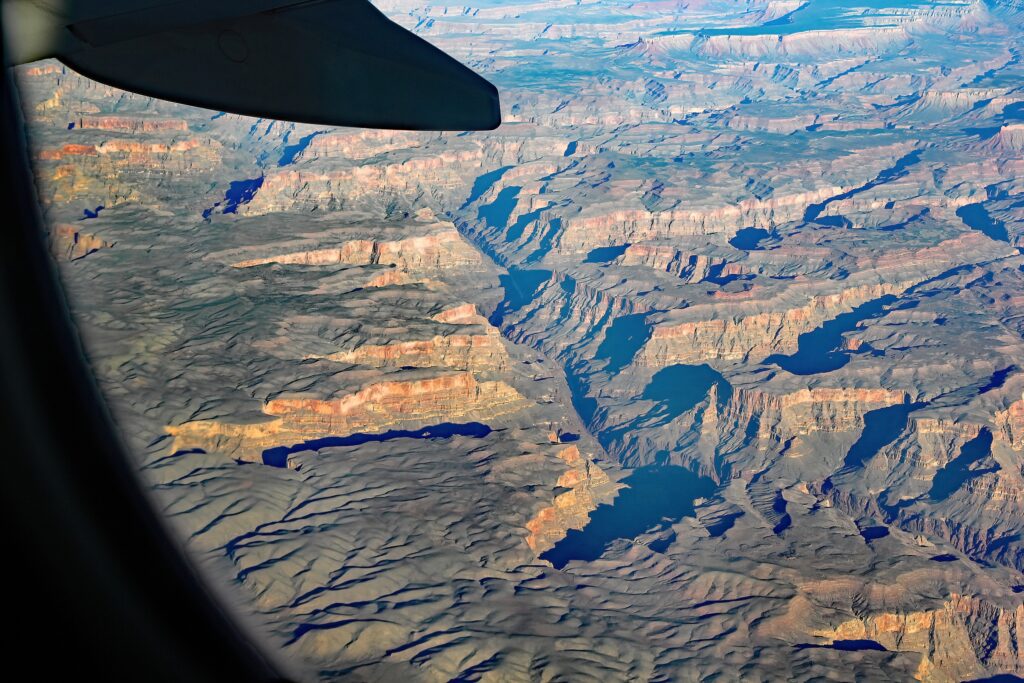 The Grand Canyon from 30,000 ft.
“However, that is a proverbial red herring because no creationist geologist claims the Precambrian sedimentary layers were unlithified at the time of Laramide folding. If Mitchell and Tillman had read my paper on the Tapeats Sandstone, they would know that creationist geologists agree the Precambrian sedimentary layers were lithified when they were eroded before the Tapeats Sandstone was unconformably deposited on them, well before the Laramide folding.” (Snelling 2026a) Emphasis added.
Perhaps it is true that most flood geologists consider the Precambrian rocks in the Grand Canyon to have been lithified prior to the flood, but it is not true that Precambrian rocks are globally considered pre-flood and potentially lithified. For instance, Dr. Tas Walker published a geological column that shows early flood deposits going back through the Proterozoic and possibly into the Archean. (T. Walker 2020). Michael Oard, the person most young earth leaders (including those at Answers in Genesis) cite as their expert on a post-Flood ice age, classified Precambrian sedimentary rocks like the Grand Canyon Supergroup as Flood deposits (Oard and Froede Jr 2008). We are not “lampooning” YEC, but recognizing that there are different opinions among leading flood geology authors and we are not assuming that Dr. Snelling speaks for all of them.
By the same token, Dr. Snelling writes as if flood geology presents the united view that the Grand Canyon was carved after the flood through hardened rocks. While this does represent the view of many flood geologists, others present the view that the canyon was carved largely during the late stages of the flood. (Scheele 2010; Oard 2021; T. Walker 2012; Clarey 2026)
What carved the Grand Canyon? Dr. Snelling wrote,
“The Colorado River carved the present-day Grand Canyon through the hard lithified strata. [Actually, there are also secular uniformitarian geologists who agree with Flood geologists that the Colorado River did not carve the Grand Canyon. Instead, the uplifted Kaibab Plateau impounded a system of huge lakes that catastrophically breached that dam and rapidly carved the canyon within days.” (Snelling 2026a)
This is partially true. While there are several proposals for how the Grand Canyon reached its depth today, it is doubtful that many, if any, non-flood geologists believe that the canyon was carved within days or even a few hundred years. Most would support Dr. Karl Karlstrom’s conclusion that, while the Grand Canyon may have had precursors, it was largely integrated and carved over the last 5-6 million years (Karl E. Karlstrom et al. 2014). It is also true however that a recent report used radiometric dating of zircons to support the proposal that spillover from a large lake in the Bidahochi basin was important in erosion of the Grand Canyon. This erosion began around 6.6 million years ago (He et al. 2026). Predictably, flood geologists see this as support for their version of the spillover hypothesis (Clarey 2026). Given that He et al.’s support for the hypothesis is radiometric dating, this would be problematic (Duff 2026). Using data that you don’t support to support your model is contradictory. He, et al. proposes that the spillover could explain how the Colorado River came to be integrated, but does not suggest any cataclysmic carving episode.
Casting further doubt on the lake spillover hypothesis misused by Dr. Snelling is a new paper by Karlstrom et al. (2026). The authors of the new study argue that detrital sanidine tracer grains and fish phylogeny data indicates that “…multiscale mantle-driven uplift, rather than lake spillover, was the primary driver for integration of the proto-Colorado River through Grand Canyon.” No doubt work will continue understanding canyon development over the last few million years.
Dr. Snelling continues to believe that “Diagenesis would have to occur within a few decades to a few hundred years” (Snelling 2026a). He is right that our article did not go through his explanations for how that might have taken place. It is also true, as he wrote, “few if any petrologists would support the time frame reported in my quoted comments” (Snelling 2026a) He writes:
“However, in their abbreviated version of my hypothesis, they neglected to explain the Flood geology model in which much of the waters for the biblical global Flood cataclysm were expelled from the upper mantle as mineral-laden superheated steam (when “the fountains of the great deep burst forth” [Genesis 7:11]). Then, during subsequent deposition of the sediment layers right across the continents over thousands of square miles, those mineral-laden hot waters would have become trapped in the pore spaces within the sediments where the minerals would have precipitated as the pore waters rapidly cooled, thus achieving lithification rapidly. Furthermore, many observational data have been presented to support this Flood geology model, including support from the secular uniformitarian literature.” (Snelling 2026a)
We are not sure what he considers his support from secular literature. His proposal of superheated steam is interesting. Perhaps this is why he proposes that “the beds dried and were cemented and lithified to sandstone” (Snelling 2023b). Why would the rocks have dried out? The pore space in buried rocks is typically filled with interstitial water until exposed to air, such as the exposure due to carving by a canyon. It is hard to understand where the water would have gone. It would not have evaporated away. Wouldn’t superheated steam have heated the sands higher than what Dr. Snelling says the rocks were heated to?
Silica deposition from superheated, pressurized steam has been studied by Bordvik et al. (2023). It can be a real phenomenon but considering it a plausible scenario for regional diagenesis in 15,000 feet (or more) of Flood-deposited strata is not possible, even in Snelling’s miracle-rich mode. Silica can be deposited, such as in pipes, from hydrothermal water supplies, as gas becomes supersaturated, precipitating due to a sudden drop in pressure. The deposits studied consisted of soft, porous deposits, that could be removed with compressed air, presumably composed of hydrated silica (opal-A). In tests across a number of pipes, they found that 74% of the silica formed solid particles by the second pipe. They observed precipitation beginning at 500º C! It is expected that such deposition would be found around hydrothermal vents, but not in the Tonto Group, especially at a basin scale. It is also important that, like in the opal described by Akahane, et al. (2004), opal would have to be converted to quartz to reflect the cementing agent in the Tonto Group. Applying this to regional columns of sediment, such as at the Grand Canyon, is not something that should be considered feasible. Even if such steam were generated, it would have deposited quickly in the first permeable layers the base of the Tapeats. In the Grand Canyon, quartz cementation needs to be explained up through the column, including higher levels, such as in the Coconino Sandstone. This would also mean that the silicic acid would have passed through the limestone units without leaving evidence. Genesis 7:11 refers to “the fountains of the great deep” (NASB), but it takes a lot of interpretation to transform this into mineral-laden superheated steam from the mantle. Such a hypothesis is interesting but can hardly be taken seriously.
Later Metamorphism in other areas
In our article on the deformation, we pointed out that Young Earth flood interpretations do not just have problems in the Grand Canyon. A global flood explanation for the rock record has to explain it all. One of the issues comes from the fact that late metamorphism is documented in many places in layers supposedly laid down after the Noah’s flood, particularly given Snelling’s interpretation of the top of the flood deposits. Here is Snelling’s reference to an example we gave:
“They also cited an example of a study of the deformation of Eocene and Oligocene sediments in the Taiwan fold-and-thrust Slate Belt. Thus, they state correctly that in ‘Snelling’s age model’ these sediments ‘would have been deposited about 4000 years ago over a period of at most a few hundred years’ (actually, I would say over just a few decades). Yet in that Taiwan study, Tillman and Byrne supposedly documented that the sediments were lithified and metamorphosed as “lower greenschist facies” at relatively high temperatures, now demonstrated to have ranged from ~300–500°C. Of course, young-earth creationists agree that at those temperatures the rocks become plastic and are able to be readily deformed by ductile processes, which is also the case for the deformation observed in metamorphic rocks all around the globe. Thus, ‘This deposition, burial, metamorphism, and erosion had to take place at incredible rates in any YEC model.’ Precisely! But have they not read the young-earth n creationist literature that provides the details of how these processes happened rapidly during the biblical global Flood cataclysm and its catastrophic aftermath, with supporting documentation from the secular uniformitarian literature that Tillman and Mitchell are so fond of citing?” (Snelling 2026a) Emphasis added
The geologic descriptions of the deformation of the Taiwan Slate Belt have been documented several times. (Mitchell and Tillman 2024b; Sibuet and Hsu 2004; Chen et al. 2019). It is interesting to see that he confirms the incredible timeline that this requires for flood geology. He says that “processes happened rapidly during the global flood cataclysm and its catastrophic aftermath”, but the flood geology scenario really can’t apply to features like this. In the Dr. Snelling timeline, this is all taking place after the flood. First, we know that in this area, sedimentary rocks were deposited on top of layers that were supposedly flood layers. Dr. Snelling obviously has no problem seeing these rocks deposited in a few days after the flood, but can’t use cataclysmic flood deposition to do so. Many events are recorded globally during the Eocene and Oligocene epochs. For example, in the Gulf of Mexico, we find deltas, thick slope deposits, and even small reefs. (see this article for more information: What happened geologically between Noah’s flood and Abraham?) This deposition took far longer than the entire time that Dr. Snelling suggests for all of the events. Depositing the Eocene to Oligocene sediments that were metamorphosed is just a small part of the issue though. In order to metamorphose the shales to slate, another eight km or more of sediments had to have buried the Pilushan Formation that is slate today. We can’t use internal clues to quantify how long it took for the rocks to be deformed into the folds that we find today. The limiting factor would have been the rate at which plates were moving, rather than the viscosity of the heated rocks. Flood geologists must remember that calling on miraculous rates of plate movement might be a hypothesis for during the flood, but this happened later. Additional deformation was required to bring the deeply buried rocks up from the great depths to the surface and into today’s mountains. The rocks that covered them had to be eroded away and there is no justification to call on the cataclysmic earthquakes or tsunamis that were hypothesized for the early part of the Flood. Not surprisingly, flood geologists, such as Dr. Snelling, see these factors as not being a problem.
Taiwan is just one example of what Snelling would have as major post-flood deposition that was deeply buried, metamorphosed and then exposed by erosion. Others include the Alps (Engi et al. 2004; Vaughan-Hammon et al. 2022; Hoinkes et al. 1999) and the Zagros Mountains (Karim and Al-Bidry 2020; Boutoux et al. 2021).
Naturally, metamorphism and deformation of hardened rock examples can come from much closer to the Grand Canyon. In fact, we find clear evidence that metamorphic rocks were faulted and folded in the nearby Catalina metamorphic core complex, southeastern Arizona (Favorito and Seedorff 2021; Ducea et al. 2020; Spencer 2023; G. H. Davis 2025). Deformation there took place just south of the Colorado Plateau, during the Cenozoic Laramide Orogeny, approximately while the Grand Canyon monoclinal folding took place and also even later in the Cenozoic. In the Catalina complex, unlike in the Grand Canyon, rocks were deeply buried enough to be metamorphosed in some areas, as evidenced by strong foliation. Figure 6 of Favorito and Seedorff (2021) shows great examples. They report that the style is consistent with burial 6-8 km deep. Folded rocks extend from Precambrian to Cretaceous. We find sedimentary rocks, folded and metamorphosed. Also, igneous granites were emplaced during the period after Snelling interprets Noah’s flood to have occurred. The granites and metamorphics cooled and solidified and later were uplifted and eroded. Dr. Snelling will say that he has explained these, but geologists find his evidence weak.
Dr. Snelling questioned our ability to provide examples where it is “well documented that the rocks were lithified at the time of deformation” (Snelling 2026a). He is quite right that most of the time, geologists working deformed rocks typically consider the reality of deep time settled science and don’t really consider the idea that deeply buried sediments were folded as soft-sediment deformation. I (Steve) have published one particular example where the rocks provide a clear demonstration that they were lithified prior to a major folding event. In the Marathon fold belt in West Texas, the Caballos Novaculite contains clear evidence that it was lithified before folding. (See Bent Rock Layers and Deep Time). In this case, pressure dissolution features, called styolites, developed prior to the folding, parallel to the original bedding. Styolites in siliceous novaculite are definitive evidence that these were competent, lithified beds before they were folded over deep time.
We have cited examples of metamorphism, folding and igneous intrusions that occurred well after Dr. Snelling’s proposed one year long global flood. Rock supposedly produced during the claimed global flood have already cooled and are often now exposed at the Earth’ surface. The examples that we cited are younger and yet they also have cooled and been deeply eroded and are exposed at the surface. One possible answer would be that these rocks that are dated as younger were all dated wrong and the events all happened earlier, such as during the flood, but the relative dating of the events is, in most cases, well documented. Another idea would be that miraculous deformation continued around the world after the flood. If that were the case, then the question would be: when did all of these rapid paced effects cease? The Biblical record gives no hint that the world was geologically extremely violent after the flood. God’s promise was: “As long as the earth endures, seedtime and harvest, cold and heat, summer and winter, and day and night will not cease.” Genesis 8:22 CSB. This sounds as though the processes returned to normal over whatever area was affected by the flood. There is no Biblical reason to suggest that God chose to protect the area where Noah and his seed lived, while the rest of the earth was still being disturbed by the geologic chaos triggered by the flood.
Part 3 summary
We have read all of the articles by Dr. Snelling on the folds that he sampled in the Grand Canyon and, of course, his responses to our papers. We fully admit that we were not there when the folding occurred. We rely on physical evidence from this region and other areas to understand the processes and assess the timing. We find that the best explanation for all of the observations is that the rocks were at least partially lithified before the Laramide orogeny and were folded slowly during this event. We agree with Dr. Snelling that the Phanerozoic rocks in the Grand Canyon were not metamorphosed, though they were metamorphosed in the Catalina region, south of the Grand Canyon. The structural folding we observe in the Tonto Group (such as the Carbon Canyon Fold) is a direct result of the Laramide Orogeny, a massive mountain-building event caused by tectonic plate collisions. This was not a sudden, rapid squishing of soft mud during a flood year. Instead, just like the slow, grinding tectonic forces currently pushing up the Himalayas and the Alps, this continental collision slowly warped miles of solid, previously lithified rock. Snelling's hyper-compressed timeline simply does not allow for the millions of years of slow heat and immense, sustained pressure required to fold solid rock on a continental scale.
Some lithification of the Tonto is consistent with these observations:
- Associated folding of Precambrian lithified units along the Palisades Fault. a fault that developed with the Butte fault along which the Carbon Canyon folding developed.
- Brecciation of the Tonto units in the same area.
- Planar limbs and sharp hinges in the Tonto folds, including the kink fold near the Monument fold
- Fracturing associated with the folding, often cutting through grains and often most intense in the more tightly folded portions of the folds.
- Timing of overall diagenesis, given the temperature and pressure constraints.
Dr. Snelling made the claim that the lithification of the sediments that are now stone in the Grand Canyon could have all taken place in a very brief time. His associated hypotheses just don’t have any technical support. They fail because they need to explain the diagenesis of vast volumes of sediment hardened by many different types of diagenesis. For example, euhedral quartz crystals forming in many different temperature and pressure situations speak to long time periods, time that just doesn’t fit the YEC model.
The entrenched meanders of the Colorado Plateau provide evidence of the gradual uplift of the region, especially given that we both agree that the sediments were lithified prior to the carving of the Grand Canyon. Rapid carving would not preserve the meandering morphology. It is entirely possible that some form of spillover contributed to the reorganization, but we see no data to support this having occurred over the timeframe that Dr. Snelling predicts.
Dr. Snelling seems to believe that if his proposal for soft-sediment deformation folding is true in the Grand Canyon, that would prove that flood geology is valid and that the Earth is young. We used a number of examples to point out that deformation over deep time is confirmed over and over. Much of the metamorphism would be considered post-flood in any published young earth model. It is not reasonable to propose that post-flood sediments were deposited, buried, metamorphosed and then uplifted and then much was eroded away in a few hundred years, after any of the YEC models for when Noah’s flood occurred.
Final Comments:
No, neither we nor Dr. Snelling were there when the Grand Canyons were there. In fact, neither was Moses. God was, but His account does not describe the geologic effects of Noah’s flood, let alone in what is now the Grand Canyon region. YEC make their case based on three anchors:
- The Bible can only be interpreted faithfully as demanding creation less than ten thousand years ago.
- The abundant fossil record around the world has to be interpreted largely to be the result of a global cataclysmic flood a few thousand years ago.
- The scientific data can and should be interpreted to fit these proposals.
Regarding the first anchor, we find that many Christians around the world seek to hold the Bible to be the inerrant Word of God, but do not believe that it teaches, much less demands that the Earth was created such a short time ago. It is far beyond the scope of our writings here to delve into how these views work and which are more correct, but suffice to say here, that we would urge grace as we deal with those who disagree with our interpretations.
Regarding the third anchor, YEC organizations, such as AIG, have devoted much effort and resources to attempt to demonstrate this point. We find that this has not been successful, and this study is a case in point.
This discussion revolves around the second anchor and its application to the Cambrian rocks in the Grand Canyon and largely in the American Southwest. Flood geology has a tremendous number of events to explain occurring within the one-year long event that they interpret to have been global.
Could the Cambrian sediments have been deposited within the early part of Noah’s flood? We continue to find that there is no evidence to support this. If deposited by a cataclysmic flood, the Cambrian units should be dominated by thick chaotic units deposited by high velocity flows. We found beds that look very much like normal beds from modern day marine, tidal and fluvial processes. The timeline proposed by flood geology dictates that deposition was almost continuous through the flood, but we saw evidence of many pauses in sedimentation. There were many examples that could be pointed to, but the many layers of algal stromatolites that formed reefs in the Cambrian period are particularly clear.
All agree that if the sediments in the geologic record were hardened prior to the folding that is so common in rock formations, then more time was required than YEC proposals have for the entire of Earth’s record. Dr. Snelling proposed that the folding developed in the Grand Canyon provides an example where the folding interpreted as slow incremental strain over deep time can be conclusively demonstrated to have occurred within the one-year long flood interval, while the sediments were soft and pliable. We found that the characteristics here support folding over deep time. We also pointed out that the burial, metamorphism, subsequent exposure and erosion of many units of Cenozoic age which are typically characterized as “post-flood,” also do not fit within flood geology timelines.
We can understand that many people will continue to hold their understandings of a young earth and a global flood. Some will hold to this, believing that someday, explanations will be found that support these positions. That is a faith decision and can be respected as such. That is quite different than claiming that today’s evidence and current findings support positions, when in fact they do not.
Acknowledgements
This reply benefited greatly from contributions from Tim Helble and Jeff Reichman, both geologists and Christians. They have helped both in terms of the technical strength of the article and in making it more readable.
References cited:
Ahr, Wayne M. 1971. “Paleoenvironment, Algal Structures, and Fossil Algae in the Upper Cambrian of Central Texas.” Journal of Sedimentary Research 41 (1): 205–16. https://doi.org/10.1306/74D72225-2B21-11D7-8648000102C1865D
Akahane, Hisatada, Takeshi Furuno, Hiroshi Miyajima, Toshiyuki Yoshikawa, and Shigeru Yamamoto. 2004. “Rapid Wood Silicification in Hot Spring Water: An Explanation of Silicification of Wood during the Earth’s History.” Sedimentary Geology 169 (3): 219–28. https://doi.org/10.1016/j.sedgeo.2004.06.003
Alshakr, Ahmed, Mohamed Sultan, Mustafa Kemal Emil, et al. 2026. “Hyperspectral Fingerprinting of Dune Sediments Across the Arabian Peninsula: Insights Into Sediment Provenance and Transport Pathways From NASA’s EMIT Data.” Geophysical Research Letters 53 (12): e2025GL121122. https://doi.org/10.1029/2025GL121122
Alsop, G. I., R. Weinberger, S. Marco, and T. Levi. 2020. “Folding during Soft-Sediment Deformation.” Geological Society, London, Special Publications 487 (1): 81–104. https://doi.org/10.1144/SP487.1
Arizona Geological Survey. 2021. “Fossil Trackway, Moenkopi Formation – Flagstaff, Arizona | e-Magazine of the AZ Geological Survey.” Arizona Geology E-Magazine, April 13. https://blog.azgs.arizona.edu/blog/2021-04/fossil-trackway-moenkopi-formation-flagstaff-arizona
Austin, Steven A. 1994. Grand Canyon: Monument to Catastrophe. Institute for Creation Research.
Baldwin, Christopher T., P. K. Strother, J. H. Beck, and Eben Rose. 2004. “Palaeoecology of the Bright Angel Shale in the Eastern Grand Canyon, Arizona, USA, Incorporating Sedimentological, Ichnological and Palynological Data.” Geological Society, London, Special Publications 228 (1): 213–36. https://doi.org/10.1144/GSL.SP.2004.228.01.11
Barnhart, W. R. 2011. “A Hydrodynamic Interpretation of the Tapeats Sandstone Part I: Basal Tapeats.” Creation Research Society Quarterly. https://www.semanticscholar.org/paper/A-Hydrodynamic-Interpretation-of-the-Tapeats-Part-Barnhart/0d4169b9ec04d5440629df2cad59ee3e3c3db874
Barnhart, W. R. 2012. A Hydrodynamic Interpretation of the Tapeats Sandstone Part II: Middle and Upper Tapeats. https://www.semanticscholar.org/paper/A-Hydrodynamic-Interpretation-of-the-Tapeats-Part-Barnhart/7ad0fbc4b9ebba660304c959d0c82bdec2aeca9a
Baumgardner, John. 2018a. “Numerical Modeling of the Large-Scale Erosion, Sediment Transport, and Deposition Processes of the Genesis Flood.” Answers Research Journal 11.
Baumgardner, John. 2018b. “Understanding How the Flood Sediment Record Was Formed: The Role of Large Tsunamis.” Proceedings of the International Conference on Creationism 8 (1). https://doi.org/https://doi.org/10.15385/jpicc.2018.8.1.29
Baumgardner, John R., and Evan Novarro. 2023. “The Role of Large Tsunamis in the Formation of the Flood Sediment Record.” Proceedings of the International Conference on Creationism 9. https://doi.org/10.15385/jpicc.2023.9.1.22
Benaafi, Mohammed, and Osman Abdullatif. 2015. “Sedimentological, Mineralogical, and Geochemical Characterization of Sand Dunes in Saudi Arabia.” Arabian Journal of Geosciences 8 (12): 11073–92. https://doi.org/10.1007/s12517-015-1970-9
Bentley, Callen. 2014. “The Great Unconformity in the Franklin Mountains.” Mountain Beltway, March 26. https://mountainbeltway.all-geo.org/2014/03/26/the-great-unconformity-in-the-franklin-mountains/
Berthault, G. 2004. “Sedimentological Interpretation of the Tonto Group Stratigraphy (Grand Canyon Colorado River)1.” Lithology and Mineral Resources 39 (5): 480–84. https://doi.org/10.1023/B:LIMI.0000040737.85572.4c
Berthault, Guy. 2000. “Experiments in Stratification | The Institute for Creation Research.” ICR, October 1. https://www.icr.org/content/experiments-stratification
Billingsley, George H., Gregory Goodwin, Sarah E. Nagorsen, Monica E. Erdman, and Jason T. Sherba. 2019. Geologic Field Photograph Map of the Grand Canyon Region, 1967–2010. U.S. Geological Survey General Information Product No. 119. General Information Product. https://pubs.usgs.gov/publication/gip189
Blakey, Ronald C. 2018. “Deep Time MapsTM - Maps of Ancient Earth.” https://deeptimemaps.com/
Boggs, Sam Jr. 2009. Petrology of Sedimentary Rocks. 2nd edition. Cambridge University Press.
Bordvik, Silje, Titus S. van Erp, Seniz Ucar, and Erling Næss. 2023. “Predicting Silica Deposition from Superheated, Pressurized Steam Using Numerical Modeling of Nucleation, Agglomeration and Deposition.” Energies 16 (19): 6906. https://doi.org/10.3390/en16196906
Borsch, K., John Whitmore, Raymond Strom, and George Hartree. 2018. “The Significance of Micas in Ancient Cross-Bedded Sandstones.” The Proceedings of the International Conference on Creationism 8 (January): 306–26. https://doi.org/10.15385/jpicc.2018.8.1.30
Boutoux, Alexandre, Arthur Briaud, Claudio Faccenna, Paolo Ballato, Federico Rossetti, and Eric Blanc. 2021. “Slab Folding and Surface Deformation of the Iran Mobile Belt.” Tectonics 40 (6): e2020TC006300. https://doi.org/10.1029/2020TC006300
Bowring, Samuel A., and Mark D. Schmitz. 2003. “High-Precision U-Pb Zircon Geochronology and the Stratigraphic Record.” Reviews in Mineralogy and Geochemistry 53 (1): 305–26. https://doi.org/10.2113/0530305
Brookfield, ME, and TS Ahlbrandt, eds. 2000. Eolian Sediments and Processes. Developments in Sedimentology. Elsevier. https://shop.elsevier.com/books/eolian-sediments-and-processes/brookfield/978-0-444-42233-0
Carling, Paul. 2017. “Catastrophic Deposition of Gravel from Outbreak Floods.” In Gravel-Bed Rivers: Process and Disasters. https://doi.org/10.1002/9781118971437.ch11
Carling, Paul A., and Xuanmei Fan. 2020. “Particle Comminution Defines Megaflood and Superflood Energetics.” Earth-Science Reviews 204: 103087.
Carling, Paul A., Mauricio Perillo, Jim Best, and Marcelo H. Garcia. 2017. “The Bubble Bursts for Cavitation in Natural Rivers: Laboratory Experiments Reveal Minor Role in Bedrock Erosion.” Earth Surface Processes and Landforms 42 (9): 1308–16. https://doi.org/10.1002/esp.4101
Chafetz, Henry S. 1973. “Morphological Evolution of Cambrian Algal Mounds in Response to a Change in Depositional Environment.” Journal of Sedimentary Research 43 (2): 435–46. https://doi.org/10.1306/74D7278E-2B21-11D7-8648000102C1865D
Chakravorty, Adityarup. 2019. “Did Global Glaciation Cause the Great Unconformity?” Eos, April 9. https://eos.org/articles/did-global-glaciation-cause-the-great-unconformity
Chen, Chih-Tung, Yu-Chang Chan, Olivier Beyssac, et al. 2019. “Thermal History of the Northern Taiwanese Slate Belt and Implications for Wedge Growth During the Neogene Arc-Continent Collision.” Tectonics 38 (9): 3335–50. https://doi.org/10.1029/2019TC005604
Chivas, Alan R., T. Torgersen, and H. A. Polach. 1990. “Growth Rates and Holocene Development of Stromatolites from Shark Bay, Western Australia.” Australian Journal of Earth Sciences 37 (June): 113–21. https://doi.org/10.1080/08120099008727913
Clarey, Dr Timothy. 2018. “Sixtymile Formation Part of Genesis Flood.” ICR News, July 10. https://www.icr.org/content/sixtymile-formation-part-genesis-flood
Clarey, Dr Timothy. 2020. Carved in Stone: Geologic Evidence of the Worldwide Flood. ICR Institute for Creation Research.
Clarey, Dr Timothy. 2026. “Grand Canyon Carved by Flood Runoff, Not Lake Spillover.” April 27. https://www.icr.org/article/15902
Corsetti, Frank A., and James W. Hagadorn. 2000. “Precambrian-Cambrian Transition: Death Valley, United States.” Geology, April. https://www.eps.mcgill.ca/~courses/c341/Death_Valley/CorsettiHagadorn00.pdf
Coulson, Ken. 2016. “The Growth and Ecology of Upper Cambrian Microbialite Biostromes from the Notch Peak Formation in Utah.” Loma Linda University. https://scholarsrepository.llu.edu/etd/367
Coulson, Ken P. 2021. “Using Stromatolites to Rethink the Precambrian-Cambrian Pre-Flood/Flood Boundary.” Answers Research Journal 14: 81–123.
Coulson, Ken P., Leonard Brand, and Arthur V. Chadwick. 2016. “Microbialite Elongation by Means of Coalescence: An Example from the Middle Furongian (Upper Cambrian) Notch Peak Formation of Western Utah.” Facies 62 (3): 20. https://doi.org/10.1007/s10347-016-0469-5
D’alessandro, A., and R. G. Bromley. 1986. “Trace Fossils in Pleistocene Sandy Deposits from Gravina Area Southern Italy.” Rivista Italiana Di Paleontologia Stratigrafia 92 (1). https://doi.org/10.54103/2039-4942/13289
Dalrymple, G. Brent. 1991. The Age of the Earth. Stanford University Press. https://www.sup.org/books/science/age-earth
Dalrymple, G. Brent. 2000. “Radiometric Dating Does Work!” National Center for Science Education. https://ncse.ngo/radiometric-dating-does-work
Davies, Peter J., B. Bubela, and James Ferguson. 1978. “The Formation of Ooids.” Sedimentology 25 (5): 703–30. https://doi.org/10.1111/j.1365-3091.1978.tb00326.x
Davis, George H. 1978. “Monocline Fold Pattern of the Colorado Plateau.” In Laramide Folding Associated with Basement Block Faulting in the Western United States. GSA Memoir 151. https://doi.org/https://doi.org/10.1130/MEM151
Davis, George H. 2025. “Field Guide to Metamorphic Core-Complex Geology, Catalina and Rincon Mountains, Tucson, Arizona.” Journal of the Southwest 67 (2): 186–218
Davis, Richard A., and Robert W. Dalrymple, eds. 2012. Principles of Tidal Sedimentology. Springer Netherlands. https://doi.org/10.1007/978-94-007-0123-6
Dehler, Carol, Frederick Sundberg, Karl Karlstrom, et al. 2024. “The Cambrian of the Grand Canyon: Refinement of a Classic Stratigraphic Model.” GSA Today 34 (11): 4–11. https://doi.org/10.1130/GSATG604A.1
Dhungana, Santosh, and Nicolas Flament. 2026. “The Deep Earth Origin of the Great Unconformity.” Research Square (Preprint), January 13, 42. https://doi.org/https://doi.org/10.21203/rs.3.rs-8246233/v1
Dionne, Jean-Claude. 1974. “Mud Cracks and Polygons on Ice Push Ridges, in Tidal Flats of the St. Lawrence Estuary.” Canadian Journal of Earth Sciences 11 (3): 489–94. https://doi.org/10.1139/e74-042
Ducea, Mihai N., Antoine Triantafyllou, and Jordan Krcmaric. 2020. “New Timing and Depth Constraints for the Catalina Metamorphic Core Complex, Southeast Arizona.” Tectonics 39 (8): e2020TC006383. https://doi.org/10.1029/2020TC006383
Duff, Joel. 2026. “What a New Grand Canyon Study Really Says—and Why Creationists Will Misrepresent It.” Naturalis Historia, April 23. https://thenaturalhistorian.com/2026/04/23/what-a-new-grand-canyon-study-really-says-and-why-creationists-will-misuse-it/
Elston, Donald P. 1989. “Correlations and Facies Changes in Lower and Middle Cambrian Tonto Group, Grand Canyon, Arizona.” In Geology of Grand Canyon, Northern Arizona (with Colorado River Guides): Lee Ferry to Pierce Ferry, Arizona, edited by Donald P. Elston, Billingsley, Georghe H., and Young, Richard A. American Geophysical Union (AGU). https://doi.org/10.1029/FT115p0131
Elston, Donald Parker. 1979. “Late Precambrian Sixtymile Formation and Orogeny at Top of the Grand Canyon Supergroup, Northern Arizona.” In Professional Paper, No. 1092. U.S. Govt. Print. Off.,. https://doi.org/10.3133/pp1092
Engi, Martin, Romain Bousquet, and Alfons Berger. 2004. “Explanatory Notes to the Map: Metamorphic Structure of the Alps, Central Alps.” Mitteilungen Der Österreichischen Mineralogischen Gesellschaft 149 (January). https://opac.geologie.ac.at/ais312/dokumente/149_113-227.pdf
Favorito, Daniel A., and Eric Seedorff. 2021. “Cenozoic Structural Evolution of the Catalina Metamorphic Core Complex and Reassembly of Laramide Reverse Faults, Southeastern Arizona, USA.” Geosphere 17 (6): 1928–71. https://doi.org/10.1130/GES02313.1
Fedo, C. M., and A. R. Prave. 1991. “Extensive Cambrian Braidplain Sedimentation: Insights from the Southwestern Cordillera, U. S. A.” AAPG Bulletin (American Association of Petroleum Geologists); (United States) 75:2 (February): CONF-9103128-. https://www.osti.gov/biblio/5142087
Flowers, Rebecca M., Francis A. Macdonald, Christine S. Siddoway, and Rachel Havranek. 2020. “Diachronous Development of Great Unconformities before Neoproterozoic Snowball Earth.” PNAS 117 (19): 10172–80. https://doi.org/10.1073/pnas.1913131117
Friedman, M., J. Handin, J. M. Logan, K. D. Min, and D. W. Stearns. 1976. “Experimental Folding of Rocks under Confining Pressure: Part III. Faulted Drape Folds in Multilithologic Layered Specimens.” GSA Bulletin 87 (7): 1049–66. https://doi.org/10.1130/0016-7606(1976)87%3C1049:EFORUC%3E2.0.CO;2
Friedman, M., R. H. H. Hugman III, and J. Handin. 1980. “Experimental Folding of Rocks under Confining Pressure, Part VIII—Forced Folding of Unconsolidated Sand and of Lubricated Layers of Limestone and Sandstone.” GSA Bulletin 91 (5): 307–12. https://doi.org/10.1130/0016-7606(1980)91%3C307:EFORUC%3E2.0.CO;2
Halley, Robert B. 1975. “Peritidal Lithologies of Cambrian Carbonate Islands, Carrara Formation, Southern Great Basin.” In Tidal Deposits: A Casebook of Recent Examples and Fossil Counterparts. Springer. https://doi.org/10.1007/978-3-642-88494-8_32
Handin, J., M. Friedman, K. D. Min, and L. J. Pattison. 1976. “Experimental Folding of Rocks under Confining Pressure: Part II. Buckling of Multilayered Rock Beams.” Geological Society of America Bulletin 87 (7): 1035. https://doi.org/10.1130/0016-7606(1976)87%3C1035:EFORUC%3E2.0.CO;2
Hardy, Joseph Kirk. 1986. “Stratigraphy And Depositional Environments Of Lower And Middle Cambrian Strata In The Lake Mead Region, Southern Nevada And Northwestern Arizona.” University of Nevada, Las Vegas. https://digitalscholarship.unlv.edu/rtds/6
He, John J. Y., Ryan S. Crow, John Douglass, et al. 2026. “Late Miocene Colorado River Arrival in the Bidahochi Basin Supports Spillover Origin of Grand Canyon.” Science 392 (6795): 289–95. https://doi.org/10.1126/science.adz6826
Helble, Timothy. 2024. “Flood Geology and Conventional Geology Face Off Over the Coconino Sandstone.” Perspectives on Science and Christian Faith 76 (2): 86–106. https://doi.org/10.56315/PSCF9-24Helble
Helble, Timothy K. 2026. “First Response to Whitmore and Garner: ‘Helble’s Critique of Creationist Research on the Coconino Sandstone Fails.’” Academia.edu. https://www.academia.edu/164825321/First_Response_to_Whitmore_and_Garner_Helbles_Critique_of_Creationist_Research_on_the_Coconino_Sandstone_Fails_
Hereford, Richard. 1977. “Deposition of the Tapeats Sandstone (Cambrian) in Central Arizona.” GSA Bulletin 88 (2): 199–211. https://doi.org/10.1130/0016-7606(1977)88%3C199:DOTTSC%3E2.0.CO;2
Hill, Carol. 2016. “The Grand Canyon, Monument to an Ancient Earth: Can Noah’s Flood Explain the Grand Canyon?” Perspectives on Science and Christian Faith 68 (4): 268–71
Hill, Carol, Gregg Davidson, Tim Helble, and Wayne Ranney, eds. 2016. The Grand Canyon, Monument to an Ancient Earth: Can Noah’s Flood Explain the Grand Canyon? Kregel Publications.
Hoinkes, Georg, Friedrich Koller, Gerd Rantitsch, et al. 1999. “Alpine Metamorphism in the Eastern Alps.” Schweizerische Mineralogische Und Petrographische Mitteilungen 79 (January): 155–81.
Hopson, Heath H., André W. Droxler, Pankaj Khanna, et al. 2025. “Controls on the Evolution of Large Upper Cambrian Microbial Buildups in Mason County, Texas, USA: Bridging the Gaps between Scales from Microbes to Large Buildup Architecture.” GSA Bulletin 137 (11–12): 5381–402. https://doi.org/10.1130/B38255.1
Hubbard, Bernard E., Donald M. Hooper, Federico Solano, and John C. Mars. 2018. “Determining Mineralogical Variations of Aeolian Deposits Using Thermal Infrared Emissivity and Linear Deconvolution Methods.” Aeolian Research 30 (February): 54–96. https://doi.org/10.1016/j.aeolia.2017.12.001
Isaac, Randy. 2007. “Assessing the RATE Project.” Perspectives on Science & Christian Faith, June, 143–46.
Karim, Kamal Haji, and Mayssaa Al-Bidry. 2020. “Zagros Metamorphic Core Complex: Example from Bulfat Mountain, Qala Diza Area, Kurdistan Region, Northeast Iraq.” Jordan Journal of Earth and Environmental Sciences.
Karlstrom, K. E., M. T. Heizler, A. Aslan, et al. 2026. “Tectonically Driven Integration of the 4.8 Ma Colorado River USA Tracked with Detrital Sanidine and Fish Genetics.” Nature Communications, ahead of print, July 1. https://doi.org/10.1038/s41467-026-75006-8
Karlstrom, K. E., M. T. Mohr, M. D. Schmitz, et al. 2020. “Redefining the Tonto Group of Grand Canyon and Recalibrating the Cambrian Time Scale.” Geology 48 (5): 425–30.
Karlstrom, Karl E. 2019. “Parsing Grand Canyon’s Great Unconformity-- Composite Erosion Surface From at Least Three Episodes Between 1,350 and 508 MA.” Paper presented at GSA Annual Meeting in Phoenix, Arizona, USA - 2019. September 24. https://gsa.confex.com/gsa/2019AM/webprogram/Paper332195.html
Karlstrom, Karl E., John P. Lee, Shari A. Kelley, et al. 2014. “Formation of the Grand Canyon 5 to 6 Million Years Ago through Integration of Older Palaeocanyons.” Nature Geoscience 7 (3): 239–44
Karlstrom, Karl E., and J. Michael Timmons. 2012. “Faulting and Uplift in the Grand Canyon Region.” Grand Canyon Geology: Two Billion Years of Earth’s History Geological Society of America Special Paper 489: 93.
Karlstrom, Karl, James Hagadorn, George Gehrels, et al. 2018. “Cambrian Sauk Transgression in the Grand Canyon Region Redefined by Detrital Zircons.” Nature Geoscience 11 (6): 438–43.
Keller, C. Brenhin, Jon M. Husson, Ross N. Mitchell, et al. 2019. “Neoproterozoic Glacial Origin of the Great Unconformity.” Proceedings of the National Academy of Sciences 116 (4): 1136–45. https://doi.org/10.1073/pnas.1804350116
Kennedy, Elaine G., Ray Kablanow, and Arthur V. Chadwick. 1997. “Evidence for Deep Water Deposition of the Tapeats Sandstone, Grand Canyon, Arizona.” Proceedings of the Third Biennial Conference of Research on the Colorado Plateau U.S. Department of the Interior, National Park Service, Transactions and Proceedings Series NPS/NRNAU/NRTP-97/12
Kenny, Ray. 2017. “Oxygen and Hydrogen Isotope Ratios of Chert from the Sixtymile Formation in Grand Canyon National Park, USA: A Warm Palaeoclimate, Freshwater Deposit.” Acta Geochimica 36 (2): 250–59. https://doi.org/10.1007/s11631-016-0138-y
Khanna, Pankaj, Michael Pyrcz, Andre Droxler, Heath Hopson, Paul Harris, and Daniel Lehrmann. 2020. “Implications for Controls on Upper Cambrian Microbial Build-Ups across Multiple-Scales, Mason County, Central Texas, USA.” Marine and Petroleum Geology 121 (July): 104590. https://doi.org/10.1016/j.marpetgeo.2020.104590
Korolev, Viacheslav Sergeevich. 1997. “Sequence Stratigraphy, Sedimentology, and Correlation of the Undifferentiated Cambrian Dolomites of the Grand Canyon and Lake Mead Area.” MS Thesis, University of Nevada, Las Vegas. https://digitalscholarship.unlv.edu/rtds/3332
Krynine, Paul Dimitri. 1935. “Formation and Preservation of Desiccation Features in a Humid Climate.” American Journal of Science s5-30 (176). https://doi.org/10.2475/ajs.s5-30.176.96
Kyle, J., and Earle F. McBride. 2014. “Geology of the Voca Frac Sand District, Western Llano Uplift, Texas.” January 1. https://www.researchgate.net/publication/288993369_Geology_of_the_Voca_Frac_Sand_District_western_Llano_Uplift_Texas
Lasemi, Z., and P. A. Sandberg. 1984. “Transformation of Aragonite-Dominated Lime Muds to Microcrystalline Limestones.” Geology 12 (7): 420–23. https://doi.org/10.1130/0091-7613(1984)12%3C420:TOALMT%3E2.0.CO
Leckie, Dale A., and Roger G. Walker. 1982. “Storm-and Tide-Dominated Shorelines in Cretaceous Moosebar-Lower Gates Interval—Outcrop Equivalents of Deep Basin Gas Trap in Western Canada1.” AAPG Bulletin 66 (2): 138–57. https://doi.org/10.1306/03B59A53-16D1-11D7-8645000102C1865D
Lee, Jeong-Hyun, Min-Kyu Oh, and Taejin Choi. 2021. “Recognition of the ‘Great Unconformity’ in the Eastern Sino-Korean Block: Insights from the Taebaek Group, Korea.” Precambrian Research 364: 106363.
Loechelt, Gary H. 2020. “Accelerated Nuclear Decay in the Light of New Experimental Data.” Perspectives on Science and Christian Faith 72 (1): 37–50.
Macintyre, Ian G., R. Pamela Reid, and Robert S. Steneck. 1996. “Growth History of Stromatolites in a Holocene Fringing Reef, Stocking Island, Bahamas.” Journal of Sedimentary Research 66 (1). https://archives.datapages.com/data/sepm/journals/v66-67/data/066/066001/0231.htm
Marković, Rastko, Zoran Perić, Milivoj Gavrilov, et al. 2024. “Aeolian Dynamics at the Northern Edge of Deliblato (Banat) Sand Sea, Vojvodina, Serbia, at the Time of the Last Deglaciation.” Quaternary Research 121 (May): 59–72. https://doi.org/10.1017/qua.2024.13
Mata, Scott A., Cara L. Corsetti, Frank A. Corsetti, Stanley Awramik, and David J. Bottjer. 2012. “Lower Cambrian Anemone from the Upper Member of the Wood Canyon Formation, Death Valley Region United States: Paleoecological and Paleoenvironmental Significance.” PALAIOS 27 (9): 594–606. https://doi.org/10.2110/palo.2012.p12-016r
McBride, Earle F. 1989. “Quartz Cement in Sandstones: A Review.” Earth-Science Reviews 26 (1): 69–112. https://doi.org/10.1016/0012-8252(89)90019-6
McBride, Earle F. 2013. “Abstract: Geology of the Late Cambrian Hickory Sandstone in the Voca Frac Sand District, Western Llano Uplift, Texas.” South-Central Section - 47th Annual Meeting, April. https://gsa.confex.com/gsa/2013SC/webprogram/Paper217446.html
McBride, Earle F., Antar A. Abdel-Wahab, and Kitty L. Milliken. 2002. Petrography and Diagenesis of a Half-Billion-Year-Old Cratonic Sandstone (Hickory), Llano Region, Texas. Report of Investigations No. 264. The University of Texas at Austin, Bureau of Economic Geology. https://www.beg.utexas.edu/publications/petrography-and-diagenesis-half-billion-year-old-cratonic-sandstone-hickory-llano
McKee, Edwin Dinwiddie. 1945. Stratigraphy and Ecology of the Grand Canyon Cambrian: Part 1. Cambrian History of the Grand Canyon Region. Vol. 1. Carnegie Institution of Washington. https://books.google.com/books?hl=en&lr=&id=ptVOAQAAIAAJ&oi=fnd&pg=PA1&dq=mckee+grand+canyon&ots=lZcOmysh9h&sig=AQoe9mvRgXhhQvZwFszwoIOIT4g
Middleton, L.T. and Elliott, D.K. 1990. “Tonto Group, Chap. 6.” In Grand Canyon Geology. Oxford University Press.
Midwest Creation Fellowship. 2023. Dr. Andrew Snelling - Significance of Folds in Tapeats Sandstone at Grand Canyon. 01:06:34. https://www.youtube.com/watch?v=a-ntSuEi-wY
Mitchell, Stephen. 2018. A Texas- Sized Challenge to Young Earth Creation and Flood Geology: A Christian Geologist Looks for Answers. Christian Faith Publishing, Inc.
Mitchell, Stephen, and Kennen S. Tillman. 2024a. “Examining Young Earth Creation Claims About the Grand Canyon.” Peaceful Science, ahead of print, August 15. https://doi.org/10.54739/tyet
Mitchell, Stephen, and Kennen S. Tillman. 2024b. “The Tonto Deformation.” Peaceful Science, ahead of print, August 15. https://doi.org/10.54739/k1y8
Mitchell, Stephen, and Kennen S. Tillman. 2024c. “Tonto Depositional Processes and Rates.” Peaceful Science, ahead of print, August 15. https://doi.org/10.54739/giu8
Muhs, Daniel R., and James R. Budahn. 2019. “New Geochemical Evidence for the Origin of North America’s Largest Dune Field, the Nebraska Sand Hills, Central Great Plains, USA.” Geomorphology 332 (May): 188–212. https://doi.org/10.1016/j.geomorph.2019.02.023
Munnecke, Axel, V. Paul Wright, and Theresa Nohl. 2023. “The Origins and Transformation of Carbonate Mud during Early Marine Burial Diagenesis and the Fate of Aragonite: A Stratigraphic Sedimentological Perspective.” Earth-Science Reviews 239 (April): 104366. https://doi.org/10.1016/j.earscirev.2023.104366
Myrow, Paul M., Robert R. Gaines, and Michael P. Lamb. 2025. “Low Sinuosity Meandering Rivers before Vascular Plants: Cambrian Tapeats Formation, Arizona, USA.” GSA Bulletin 138 (1–2): 809–22. https://doi.org/10.1130/B38336.1
Nabavi, Seyed Tohid, and Haakon Fossen. 2021. “Fold Geometry and Folding – a Review.” Earth-Science Reviews 222 (November): 103812. https://doi.org/10.1016/j.earscirev.2021.103812
National Park Service. nd. “Missing Time at Grand Canyon National Park.” https://www.nps.gov/articles/000/grcatime-missing-time.htm
Nielson, R. LaRell, and Chris Barker. 2016. “Geology of the Northern Llano Uplift, Junction to Llano, Texas.” Paper presented at Texas Academy of Science, 2016 Field Trip. March 6. https://scholarworks.sfasu.edu/geology/15
Noffke, N., and S. M. Awramik. 2013. “Stromatolites and MISS—Differences between Relatives.” GSA Today 23 (9): 4–9. https://doi.org/10.1130/GSATG187A.1
Noffke, Nora, and Kenneth C. Gass. 2026. “Microbial Mat Facies in Cambrian Tidal Flats and Implications for the Trace Fossil Record (Elk Mound Group, Wisconsin, USA).” PALAIOS 41 (2): 74–90. https://doi.org/10.2110/palo.2025.042
Oard, Michael J. 2021. “A Dam Breach Unlikely for the Origin of Grand Canyon.” Creation Research Society Quarterly, 17.
Oard, Michael J., and Carl R. Froede Jr. 2008. “Where Is the Pre-Flood/Flood Boundary?” Creation Research Society Quarterly 45 (1). https://crsq.creationresearch.org/id/eprint/1051/
Orofino, James Cory. 2005. “Structural Fabric of the Palisades Monocline: A Study of Positive Inversion, Grand Canyon, Arizona.” MS Thesis, Texas A&M University. https://core.ac.uk/download/pdf/4269479.pdf
Palmer, Allison R., and Robert B. Halley. 1954. “Physical Stratigraphy and Trilobite Biostratigraphy of the Carrara Formation (Lower and Middle Cambrian) in the Southern Great Basin.” In Professional Paper, USGS Prof. Paper 1047. Bureau of Economic Geology. https://doi.org/10.3133/pp1047
Plummer, P. S., and V. A. Gostin. 1981. “Shrinkage Cracks; Desiccation or Synaeresis?” Journal of Sedimentary Research 51 (4): 1147–56. https://doi.org/10.1306/212F7E4B-2B24-11D7-8648000102C1865D
Prothero, Donald, and Fred Schwab. 2013. Sedimentary Geology. Third edition. W. H. Freeman.
Pruss, Sara. n.d. “Sara Pruss on the First Reef Builders.” Geology Bites. Accessed April 6, 2026. https://www.geologybites.com/sara-pruss
Pruss, Sara B., Martha L. Slaymaker, Emily F. Smith, Andrey Yu. Zhuravlev, and David A. Fike. 2021. “Cambrian Reefs in the Lower Poleta Formation: A New Occurrence of a Thick Archaeocyathan Reef near Gold Point, Nevada, USA.” Facies 67 (2): 14. https://doi.org/10.1007/s10347-021-00623-2
Pruss, Sara B., Emily F. Smith, Olivia Leadbetter, Rhiannon Z. Nolan, Melissa Hicks, and David A. Fike. 2019. “Palaeoecology of the Archaeocyathan Reefs from the Lower Cambrian Harkless Formation, Southern Nevada, Western United States and Carbon Isotopic Evidence for Their Demise.” Palaeogeography, Palaeoclimatology, Palaeoecology 536 (December): 109389. https://doi.org/10.1016/j.palaeo.2019.109389
Purdom, Georgia, and Andrew A. Snelling. 2020. “Survey of Microbial Composition and Mechanisms of Living Stromatolites of the Bahamas and Australia: Developing Criteria to Determine the Biogenicity of Fossil Stromatolites.” International Conference on Creationism Proceedings (Survey of Microbial Composition). https://cedarville.tind.io/record/21078
Purtill, Matthew P., J. Steven Kite, and Steven L. Forman. 2019. “Geochronology and Depositional History of the Sandy Springs Aeolian Landscape in the Unglaciated Upper Ohio River Valley, United States.” Frontiers in Earth Science 7 (December). https://doi.org/10.3389/feart.2019.00322
Reches, Ze’ev, and Vincent Matthews III. 1978. “Development of Monoclines: Part I. Structure of the Palisades Creek Branch of the East Kaibab Monocline, Grand Canyon, Arizona.” In Laramide Folding Associated with Basement Block Faulting in the Western United States, vol. 151. Geological Society of America. https://doi.org/10.1130/MEM151-p235
Resser, Charles E. 1945. Cambrian History of the Grand Canyon Region: Part I. Stratigraphy and Ecology of the Grand Canyon Cambrian; Part II. Cambrian Fossils of the Grand Canyon. Carnegie Institute of Washington Publication 563. Carnegie Institute of Washington.
Retallack, Gregory J. 2025. “Ediacaran-Cambrian Paleosols of Nevada and California.” PLOS One 20 (6): e0325547. https://doi.org/10.1371/journal.pone.0325547
Rettger, R. E. 1935. “Experiments on Soft-Rock Deformation.” AAPG Bulletin.
Rose, Eben C. 2006. “Nonmarine Aspects of the Cambrian Tonto Group of the Grand Canyon, USA, and Broader Implications.” Palaeoworld, The Fourth International Symposium on the Cambrian System, vol. 15 (3): 223–41. https://doi.org/10.1016/j.palwor.2006.10.008
Roth, Ariel A. 1998. Origins: Linking Science and Scripture. Review and Herald Publishing Assn.
Rowland, Stephen M., Slava Korolev, James W. Hagadorn, and Kaushik Ghosh. 2023. “Frenchman Mountain Dolostone: A New Formation of the Cambrian Tonto Group, Grand Canyon and Basin and Range, USA.” Geosphere 19 (3): 719–47. https://doi.org/10.1130/GES02514.1
Sandberg, Philip A. 1975. “New Interpretations of Great Salt Lake Ooids and of Ancient Non-Skeletal Carbonate Mineralogy.” Sedimentology 22 (4): 497–537. https://doi.org/10.1111/j.1365-3091.1975.tb00244.x
Santucci, Vincent, and Justin Tweet. 2020. Grand Canyon National Park: Centennial Paleontological Resource Inventory.
Scheele, Peter. 2010. “A Receding Flood Scenario for the Origin of the Grand Canyon.” Journal of Creation. https://dl0.creation.com/articles/p075/c07573/j24_3_106-116.pdf
Scholle, Peter A., and Darwin Spearing. 1982. Sandstone Depositional Environments. https://pubs.geoscienceworld.org/aapg/books/book/1420/Sandstone-Depositional-Environments
Scotese, Christopher R. 2021. “Paleomap Project.” Paleomap Project. http://www.scotese.com/
Shahkarami, Setareh, Luis A. Buatois, M. Gabriela Mángano, James W. Hagadorn, and John Almond. 2020. “The Ediacaran–Cambrian Boundary: Evaluating Stratigraphic Completeness and the Great Unconformity.” Precambrian Research 345: 105721
Sibuet, Jean-Claude, and Shu-Kun Hsu. 2004. “How Was Taiwan Created?” Tectonophysics 379 (1): 159–81. https://doi.org/10.1016/j.tecto.2003.10.022
Smith, G. E. 1981. “Episodic Introduction of Pennsylvanian-Age Mineralization into Cambrian Sediments, Hog Thief Bend, Central Texas (Abs).” Abstracts with Programs 13.
Snelling, Andrew A. 2005. “Fission Tracks in Zircons: Evidence for Abundant Nuclear Decay.” In Radioisotopes and the Age of the Earth: Results of a Young-Earth Creationist Research Initiative, edited by Larry Vardiman, Andrew A. Snelling, and Eugene F. Chaffin. Institute for Creation Research.
Snelling, Andrew A. 2009a. Earth’s Catastrophic Past. Institute for Creation Research. http://isgenesishistory.s3.amazonaws.com/digital%20downloads/earth-catastrophic-past-1-preview.pdf
Snelling, Andrew A. 2009b. “Radiometric Dating: Problems with the Assumptions.” Answers in Genesis, October 1. https://answersingenesis.org/geology/radiometric-dating/radiometric-dating-problems-with-the-assumptions/
Snelling, Andrew A. 2010. “Doesn’t the Order of Fossils in Rock Record Favor Long Ages?” Answers in Genesis, September 9. https://answersingenesis.org/fossils/fossil-record/doesnt-order-of-fossils-in-rock-favor-long-ages/
Snelling, Andrew A. 2021a. “Bright Angel Supplement.” Answers in Genesis. https://assets.answersresearchjournal.org/doc/articles/arj/v14/bright-angel-formation-supplement.pdf
Snelling, Andrew A. 2021b. “The Petrology of the Tapeats Sandstone, Tonto Group, Grand Canyon, Arizona.” Answers Research Journal 14. https://assets.answersingenesis.org/doc/articles/pdf-versions/arj/v14/petrology_tapeats_sandstone.pdf
Snelling, Andrew A. 2022. “The Petrology of the Muav Formation, Tonto Group, Grand Canyon, Arizona.” Answers Research Journal 15: 139–262.
Snelling, Andrew A. 2023a. “Appendix – Locations and Petrographic Descriptions of Tapeats Sandstone Samples, Monument Fold.” Answers in Genesis. https://assets.answersresearchjournal.org/doc/v16/monument_fold_appendix.pdf
Snelling, Andrew A. 2023b. “The Carbon Canyon Fold, Eastern Grand Canyon, Arizona.” Answers Research Journal 16. https://answersresearchjournal.org/geology/carbon-canyon-fold-arizona/
Snelling, Andrew A. 2023c. “The Monument Fold, Central Grand Canyon, Arizona.” Answers Research Journal, August 9. https://answersingenesis.org/geology/monument-fold-grand-canyon/
Snelling, Andrew A. 2024a. Appendix – Locations and Petrographic Descriptions of Muav Formation Samples. 44.
Snelling, Andrew A. 2024b. “The Matkatamiba Fold, Central Grand Canyon, Arizona.” Answers Research Journal 17 (September): 479–611.
Snelling, Andrew A. 2024c. “The Whitmore Helipad Fold, Western Grand Canyon, Arizona | Answers Research Journal.” Answers Research Journal. https://answersresearchjournal.org/geology/whitmore-helipad-fold/
Snelling, Andrew A. 2025. “Responding to ‘Peaceful Science’ Critics on Grand Canyon Evidence.” Answers in Depth, November 7. https://answersingenesis.org/geology/rock-layers/grand-canyon-critic-response-1/
Snelling, Andrew A. 2026a. “The Tonto Deformation: Responding Again to ‘Peaceful Science’ Critics.” Answers in Depth, February 1. https://answersingenesis.org/geology/rock-layers/grand-canyon-critic-response-3/
Snelling, Andrew A. 2026b. “Tonto Depositional Processes and Rates: Responding Again to ‘Peaceful Science’ Critics.” Answers in Depth, January 9. https://answersingenesis.org/geology/rock-layers/grand-canyon-critic-response-2/
Spencer, Jon. 2023. “A Brief Field Guide to the Geology of a Metamorphic Core Complex as Seen along the Catalina Highway, Tucson Area, Arizona.” Paper presented at Geodaze 2023 Field Guide. https://static1.squarespace.com/static/5e75334092b04e44f321939b/t/641cbecaff5933518766fc04/1679605452973/2023+GeoDaze+Field+guide%2C+Catalina+Highway+v2.pdf
Sturrock, C. P., R. M. Flowers, and F. A. Macdonald. 2021. “The Late Great Unconformity of the Central Canadian Shield.” Geochemistry, Geophysics, Geosystems 22 (6): e2020GC009567. https://doi.org/10.1029/2020GC009567
Sun, Xiaolong, Enrique Gomez-Rivas, Juan Alcalde, et al. 2021. “Fracture Distribution in a Folded Fluvial Succession: The Puig-Reig Anticline (South-Eastern Pyrenees).” Marine and Petroleum Geology 132 (October): 105169. https://doi.org/10.1016/j.marpetgeo.2021.105169
Taylor, R. E., John R. Southon, and Guaciara M. Santos. 2018. “Misunderstandings Concerning the Significance of AMS Background 14C Measurements.” Radiocarbon 60 (June): 727–49. https://doi.org/10.1017/RDC.2018.15
Thurston, Olivia G., William R. Guenthner, Karl E. Karlstrom, Jason W. Ricketts, Matthew T. Heizler, and J. Michael Timmons. 2021. “Zircon (U-Th)/He Thermochronology of Grand Canyon Resolves 1250 Ma Unroofing at the Great Unconformity and <20 Ma Canyon Carving.” Geology 50 (2): 222–26. https://doi.org/10.1130/G48699.1
Vahrenkamp, Volker, Viswasanthi Chandra, Elisa Garuglieri, et al. 2024. “Discovery of Modern Living Intertidal Stromatolites on Sheybarah Island, Red Sea, Saudi Arabia.” Geology 52 (May): 347–51. https://doi.org/10.1130/G51793.1
Vardiman, Larry, Steven A. Austin, John R. Baumgardner, et al. 2005. Summary of Evidence for a Young Earth from the RATE Project. Radioisotopes and the Age of the Earth: Results of a Young-Earth Creationist Research Initiative. Institute for Creation Research. https://www.icr.org/i/pdf/technical/RATE2-Summary.pdf
Vardiman, Larry, Andrew A. Snelling, and Eugene F. Chaffin, eds. 2000. Radioisotopes and the Age of the Earth: A Young-Earth Creationist Research Initiative. Institute for Creation Research ; Creation Research Society. https://www.icr.org/i/pdf/research/rate-all.pdf
Varela, Augusto N., Sebastián Richiano, and Daniel G. Poiré. 2011. “Tsunami vs. Storm Origin for Shell Bed Deposits in a Lagoon Environment: An Example from the Upper Cretaceous of Southern Patagoia, Argentina.” Latin American Journal of Sedimentology and Basin Analysis 18: 63–85.
Vaughan-Hammon, Joshua D., Lorenzo G. Candioti, Thibault Duretz, and Stefan M. Schmalholz. 2022. “Metamorphic Facies Distribution in the Western Alps Predicted by Petrological-Thermomechanical Models of Syn-Convergent Exhumation.” Geochemistry, Geophysics, Geosystems 23 (8): e2021GC009898. https://doi.org/10.1029/2021GC009898
Verde, Mariano, Martín Ubilla, Juan J. Jiménez, and Jorge F. Genise. 2007. “A New Earthworm Trace Fossil from Paleosols: Aestivation Chambers from the Late Pleistocene Sopas Formation of Uruguay.” Palaeogeography, Palaeoclimatology, Palaeoecology 243 (3): 339–47. https://doi.org/10.1016/j.palaeo.2006.08.005
Waldron, John W. F., and Jean-François Gagnon. 2011. “Recognizing Soft-Sediment Structures in Deformed Rocks of Orogens.” Journal of Structural Geology, Flow of Rocks, vol. 33 (3): 271–79. https://doi.org/10.1016/j.jsg.2010.06.015
Walker, Roger G., Noel P. James, and Geological Association of Canada. 1992. Facies Models: Response to Sea Level Change. Geological Association of Canada.
Walker, Tas. 2012. “Grand Canyon, USA, Was Carved by Receding Floodwaters – Biblical Geology.” Biblical Geology, May. https://biblicalgeology.net/blog/grand-canyon-carved-by-receding-flood
Walker, Tas. 2020. “The Geology Transformation Tool.” Creation.Com, September 3. https://creation.com/en/articles/geology-transformation-tool
Wanless, Harold R. 1973. “Cambrian of the Grand Canyon–A Reevaluation.” AAPG Bulletin 57 (4): 810–11. https://doi.org/10.1306/83D90D18-16C7-11D7-8645000102C1865D
Weinberg, David M. 1979. “Experimental Folding of Rocks under Confining Pressure: Part VII. Partially Scaled Models of Drape Folds.” Tectonophysics 54 (1): 1–24. https://doi.org/10.1016/0040-1951(79)90109-4
Whitmore, John H. 2009. “Do Mud Cracks Indicate Multiple Droughts During the Flood.” In Rock Solid Answers: The Biblical Truth Behind 14 Geologic Questions. Creation Research Society Books.
Wiens, Roger C. 2002. “Radiometric Dating.” American Scientific Affiliation. https://www.asa3.org/ASA/resources/wiens.html
Wiens, Roger C. 2016. “So Just How Old Is That Rock?” In The Grand Canyon, Monument to an Ancient Earth; Can Noah’s Flood Explain the Grand Canyon?, edited by Carol A. Hill, Gregg Davidson, Timothy Helble, and Wayne Ranney. Kregel Publications.
Wiggins, W. D. 1982. “Depositional History and Microspar Development in Reducing Pore Water, Marble Falls Limestone (Pennsylvanian) and Barnett Shale (MIssissippian), Central Texas.” PhD Dissertation, University of Texas at Austin.
Williamson, Thomas E., and Spencer G. Lucas. 1996. “Mammal Footprints from the Miocene-Pliocene Ogallala Formation, Eastern New Mexico.” New Mexico Geology 18 (1): 1–5. https://doi.org/10.58799/NMG-v18n1.1
Woodmorappe, John. 2006. “Are Soft-Sediment Trace Fossils (Ichnofossils) a Time Problem for the Flood?” Journal of Creation, 10.
Yang, Byongcheon, Robert W. Dalrymple, and Seungsoo Chun. 2006. “The Significance of Hummocky Cross-Stratification (HCS) Wavelengths: Evidence from an Open-Coast Tidal Flat, South Korea.” Journal of Sedimentary Research 76 (1): 2–8. https://doi.org/10.2110/jsr.2006.01
Young, L. M., and D. H. Jackson. 1981. “Fluid-Inclusion Temperature Study of Paleozoic Carbonates, Llano Uplift, Texas.” Gulf Coast Association of Geological Societies Transactions 31: 421–25.
Zhu, Bing-Qi, Jia-Xing Zhang, and Chun Sun. 2021. “Physiochemical Characteristics, Provenance, and Dynamics of Sand Dunes in the Arid Hexi Corridor.” Frontiers in Earth Science 9 (August). https://doi.org/10.3389/feart.2021.728202
Zou, Caineng. 2013. “Regional Metamorphism - an Overview.” Science Direct: Topics in Earth and Planetary Sciences. https://www.sciencedirect.com/topics/earth-and-planetary-sciences/regional-metamorphism
Plate Descriptions
This section presents a set of plates (I to XI) featuring photographs Steve took during a trip in April 2026 and one additional plate (XII). Steve’s visit provided a better opportunity than any of his earlier trips to focus on the Cambrian section. Although the plates support useful observations, they are not part of a systematic study and should not be treated as a substitute for one. The plates start with broader regional views and progress to increasingly detailed images. He did not have permission to collect samples and was also unable to observe any Laramide folding, including the ones that Dr. Snelling sampled.
Plate XII was taken by Timothy K. Helble and used with his permission.
Plate XIII was taken by Dr. G.H. Billingsley of the USGS and as published on that website is available in the public domain.
Plate I.
Regional view from Navajo Point on the South Rim showing the Cambrian Strata. The angularity of the Great Unconformity is clear between the formations of the Precambrian Supergroup below and the Tapeats Sandstone above.
Plate II.
Regional view showing the formations of the Tonto Group separated from the Precambrian Vishnu Schist by the Great Unconformity.
Plate III.
Closer view of the Tapeats Sandstone over the Vishnu Schist. The zoom in shows more clearly the Tapeats onlapping a local paleohigh on the Great Unconformity.
Plate IV.
Tapeats Sandstone above the Dox Formation. In this area, the formation can be split into three units, a massive unit at the base, a thinner bedded middle package and a more massive unit at the top. The upper unit thins to the west. The Tapeats is cut by several small faults, the largest of which is labeled. The faults do not extend into the Bright Angel Formation very far, if at all. The Tapeats is also cut by vertical fractures (joints) as well.
Plates V, VI, and VII.
These plates show various views of the Tapeats Sandstone outcrops showing the sand geometries. Observe bedding with alternating resistant and recessive beds. Individual resistant beds do not extend across the outcrop. They are consistent with small channel fills that at times amalgamated. Vertical fractures (joints) are again present, particularly evident on Plate V.
Plates VIII to XI
This series of photos show the upper part of the Tapeats Sandstone where it outcrops along the Bright Angel Trail, north of the Havasupai Gardens.
Plate VIII
Set of beds in the upper Tapeats Sandstone.
Unit A: Lower beds as seen in Plate VIIIb are poorly sorted, trough cross-stratified sands about 30 cm thick. The bed is actually an amalgamation of three different beds.
- Bed 1 is a reddish unit with trough cross-strata deposited from right to left. It had many clasts, presumably mudrock, that are now weathered out.
- Bed 2 is a trough cross-stratified, poorly sorted sandstone with the basal parts consisting of coarse-grained lags. The sandstone has fewer and smaller weathered clast holes. The unit cuts down into Bed 1 to the left.
- Bed 3 is a trough cross-stratified bed that thickens to the right. Cross-strata show deposition right to left.
To the right of the enlargement, this is part of a cut and fill package with trough cross-strata laterally accreted right to left. Thickening and thinning is indicative of some sinuosity in system.
Unit B: A set of compensationally-stacked sandstones. Resistant beds have cut and fill bases. Recessive beds are finer grained, including some black recessive beds presumably mudrock.
Unit C: Thicker fine-grained, recessive package that includes thin, black, finely laminated mudrock. (Plate VIIIa) This possibly fills in a shallow erosional channel. Discontinuous sand lenses separate some mudrock packages.
Unit D: Fine-grained sandy unit with irregular laminations and some coarser grains. (Plate VIIIa)
Unit E: On left of the outcrop two sand bodies are shown that amalgamate into one, as the upper one cut into the lower one (green line). The amalgamated sand is about 140 cm thick. The lower sand is cross stratified, filling to the left. The upper is one trough cross-stratified unit, filling and thickening to the right.
Plate IX:
Closeup of trough cross-stratified sand showing coarser bases and mudrock clasts. It is worth noting that there are a few vertical fractures extending partially through the bed.
PlateX:
Side view of outcrop shown in Plates VIII to XI.
Plate XI:
Nearby top of weathered sandstone bed. With the finer grained material weathered away, the quartz pea-sized pebbles weathered out in relief. The quartz grains are well-rounded, milky “bull” quartz such as commonly weather out of granite and veins in igneous rocks. Such rounding and sorting is indicative of transport and abrasion by water transport. Such a process would have entailed at least thousands of years.
Plate XII:
Tapeats Sandstone beds as seen in the south wall of Carbon Canyon, downstream from where the fold is located. The lower sandstone beds are often amalgamated.
As interpreted on the image below, a channel package is preserved. The erosional channel was filled with three smaller sand packages. Triangles show thinning upwards cycles (fining upwards?). 2The lowest unit is darker, possibly due to glauconite.
Photo from Timothy K. Helble.
Plate XIII:
Carbon Canyon Fold in Tapeats Sandstone on east side of Butte Fault (figure not reversed). Notice the different fold axis in the fold as highlighted by Tapp and Wolgemuth in Chapter 12 of “The Grand Canyon: Monument to an Ancient Earth”, p. 125. Photo taken in 1989 by Dr. G.H. Billingsley of the USGS. (Billingsley, G.H., Goodwin, G., Nagorsen, S.E., Erdman, M.E., and Sherba, J.T., 2019, Geologic and related photographs of the Grand Canyon region (1967–2010): U.S. Geological Survey data release, accessed [Aug 05, 2026], at https://doi.org/10.5066/F7WS8SHW
Outcrop overall depositional observations:
- Poorly sorted, trough cross-bedded sandstones, often with coarse bottom lags.
- Cut and fill channel geometries of various
- Thinner mudrock beds
- Indications of sinuous bodies with lateral accretion filling.
- Rounding of quartz grains and pebbles
- Sand grains are moderately sorted.
All observations are consistent with fluvial deposition in a position not far from the source. The outcrop described from the Bright Angel Trail is from the upper part of the Tapeats. It compares well with Figure 3 published by Dr. Eben C. Rose in his 2006 paper, “Nonmarine aspects of the Cambrian Tonto Group of the Grand Canyon, USA, and broader implications”. (Rose 2006). Plate V here also compares well, though his figure does not show the apparent grain size difference between the resistant vs. recessive beds that the photo highlights.
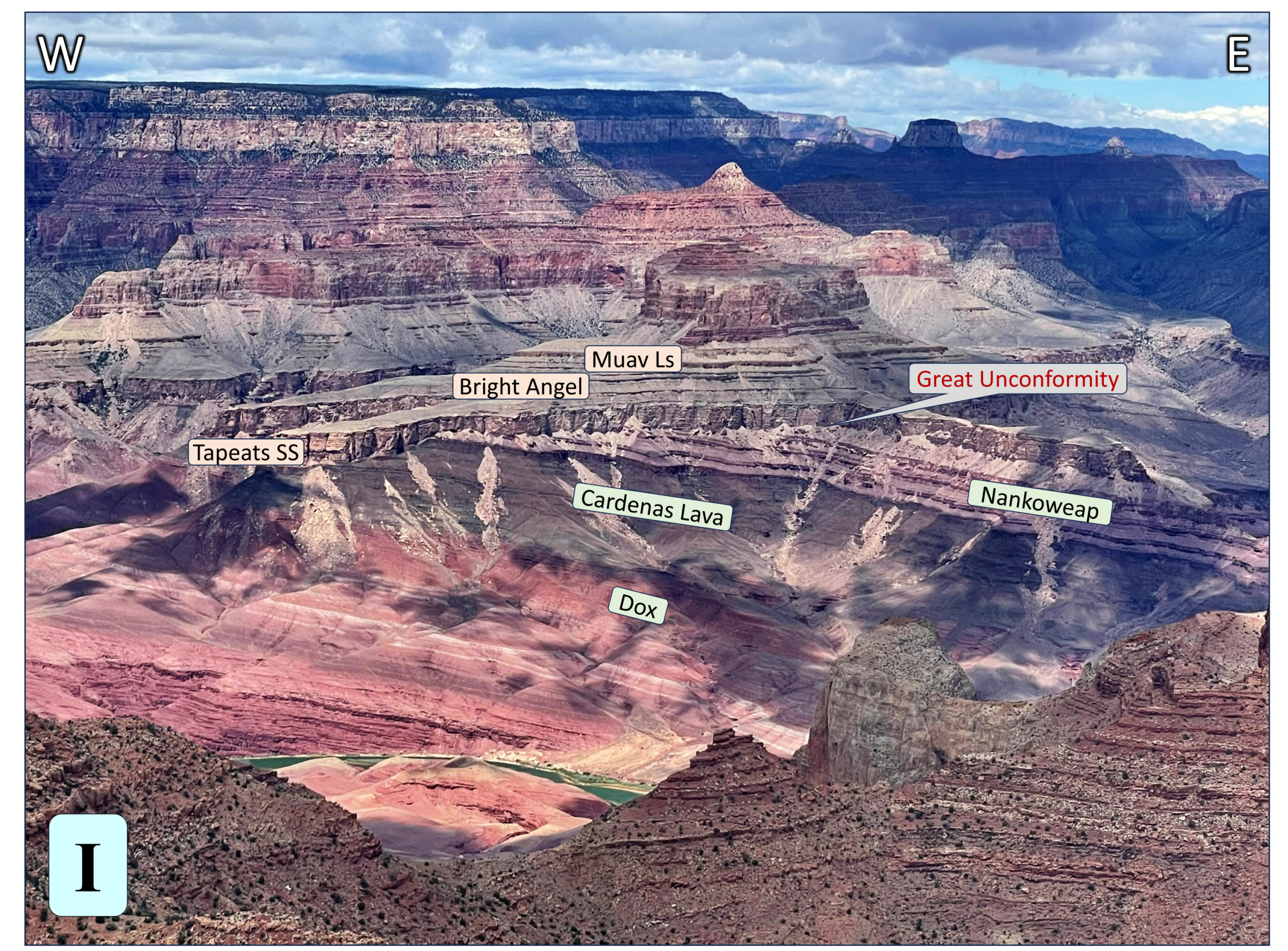
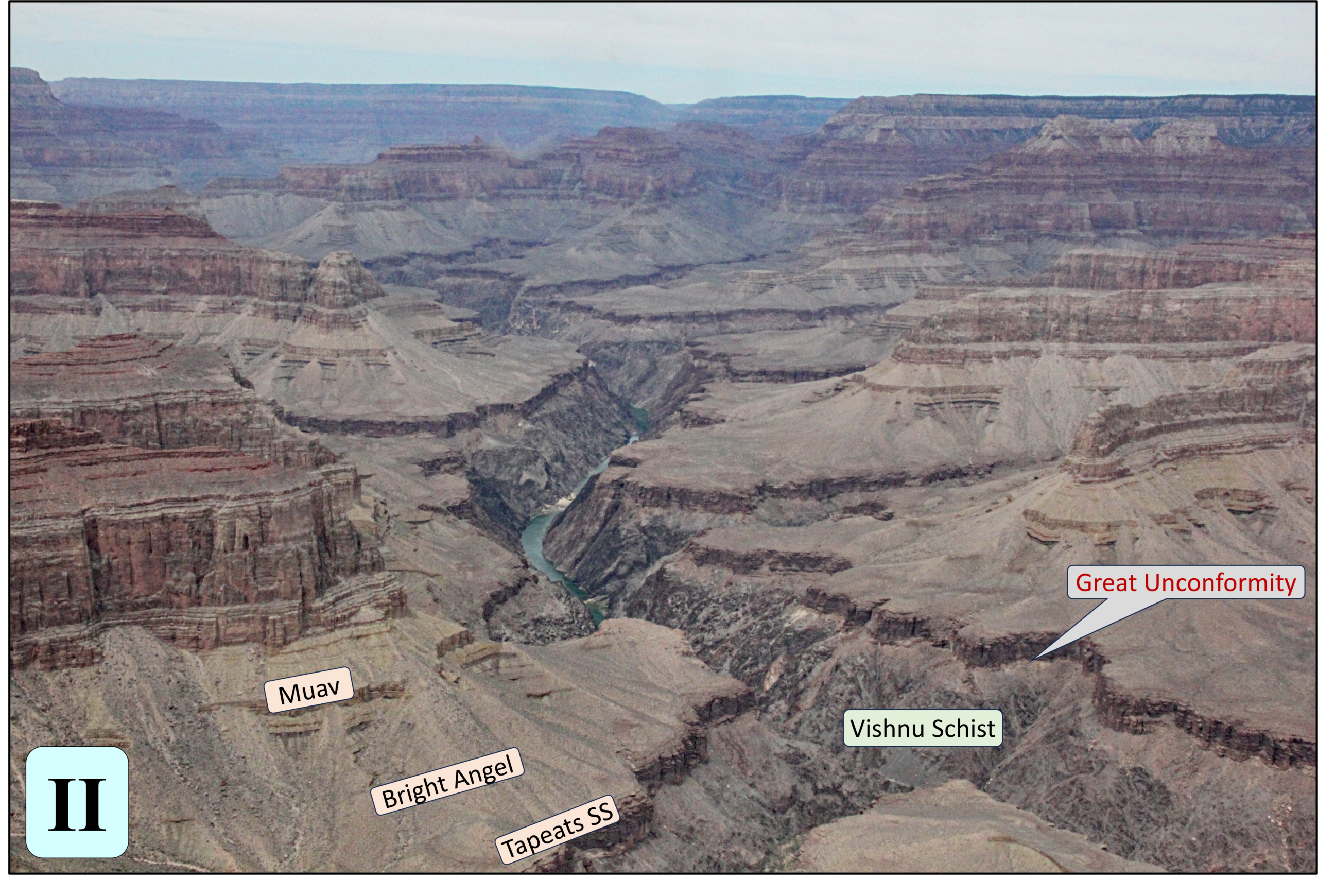
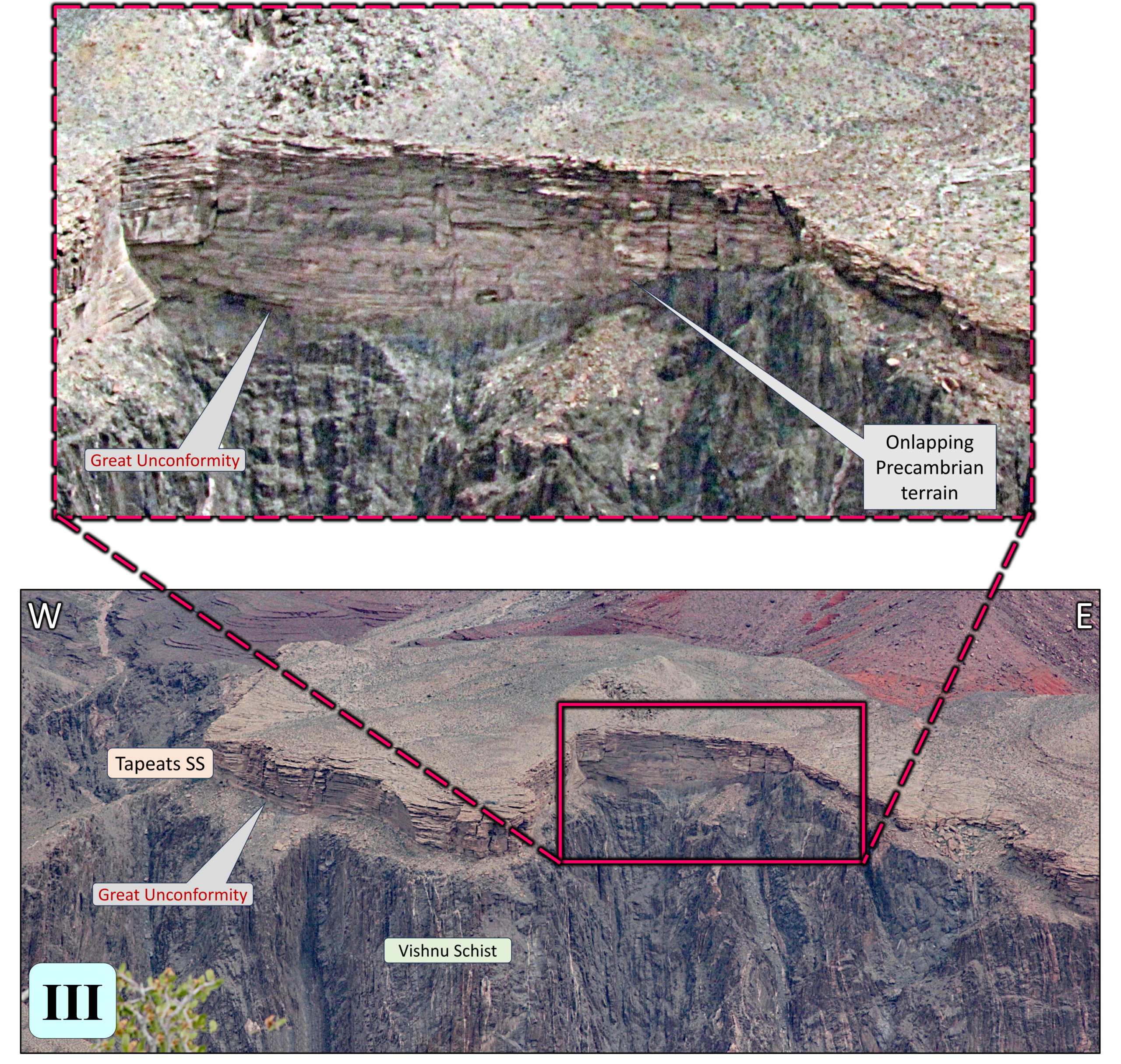
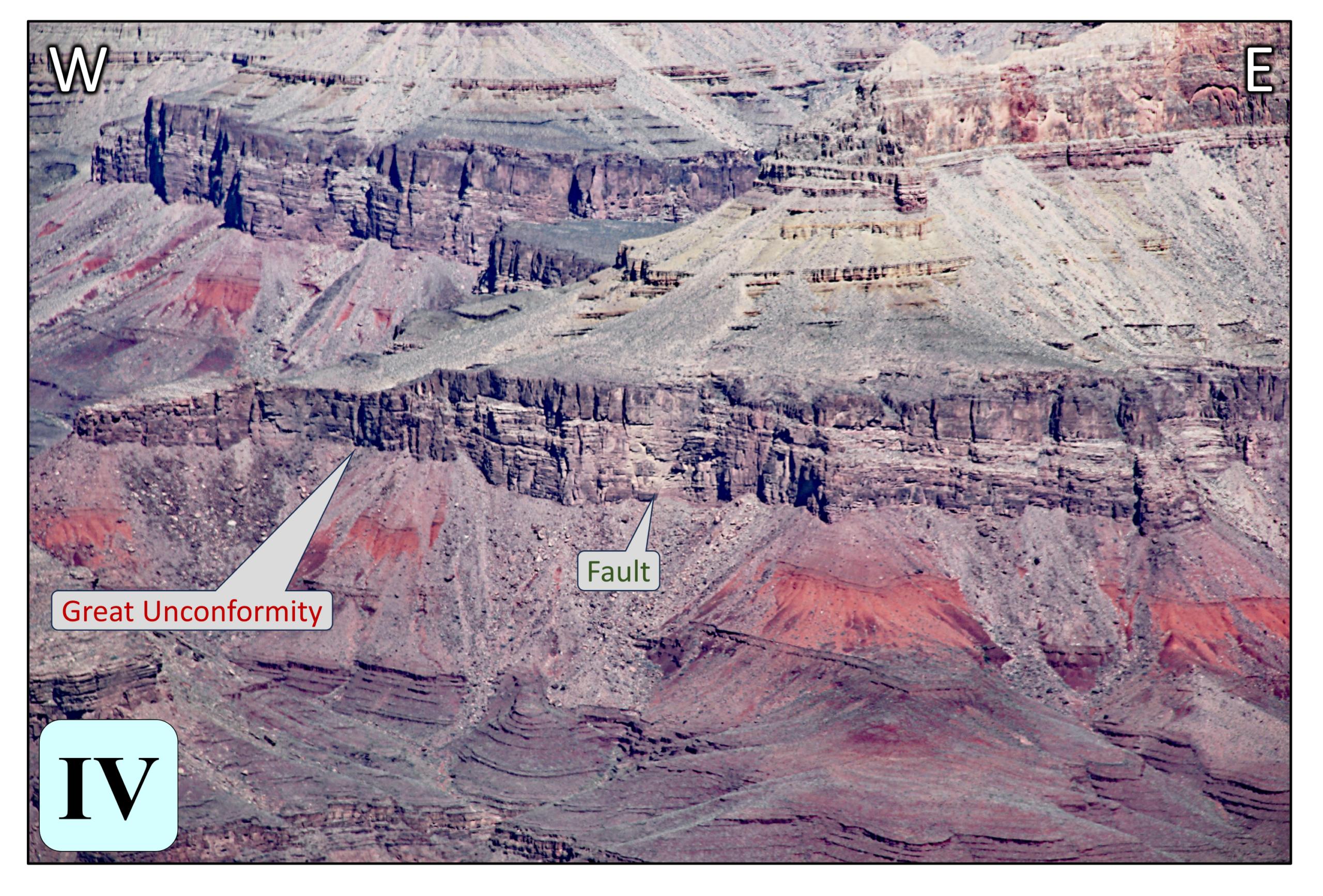
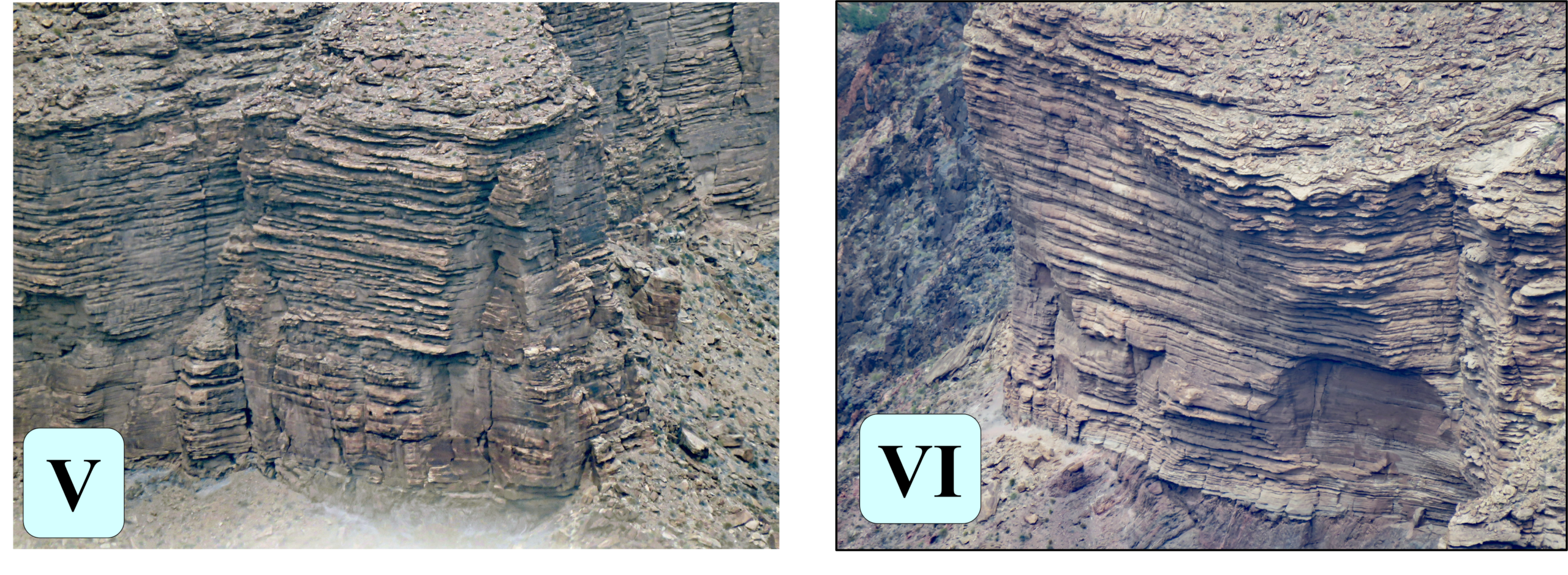
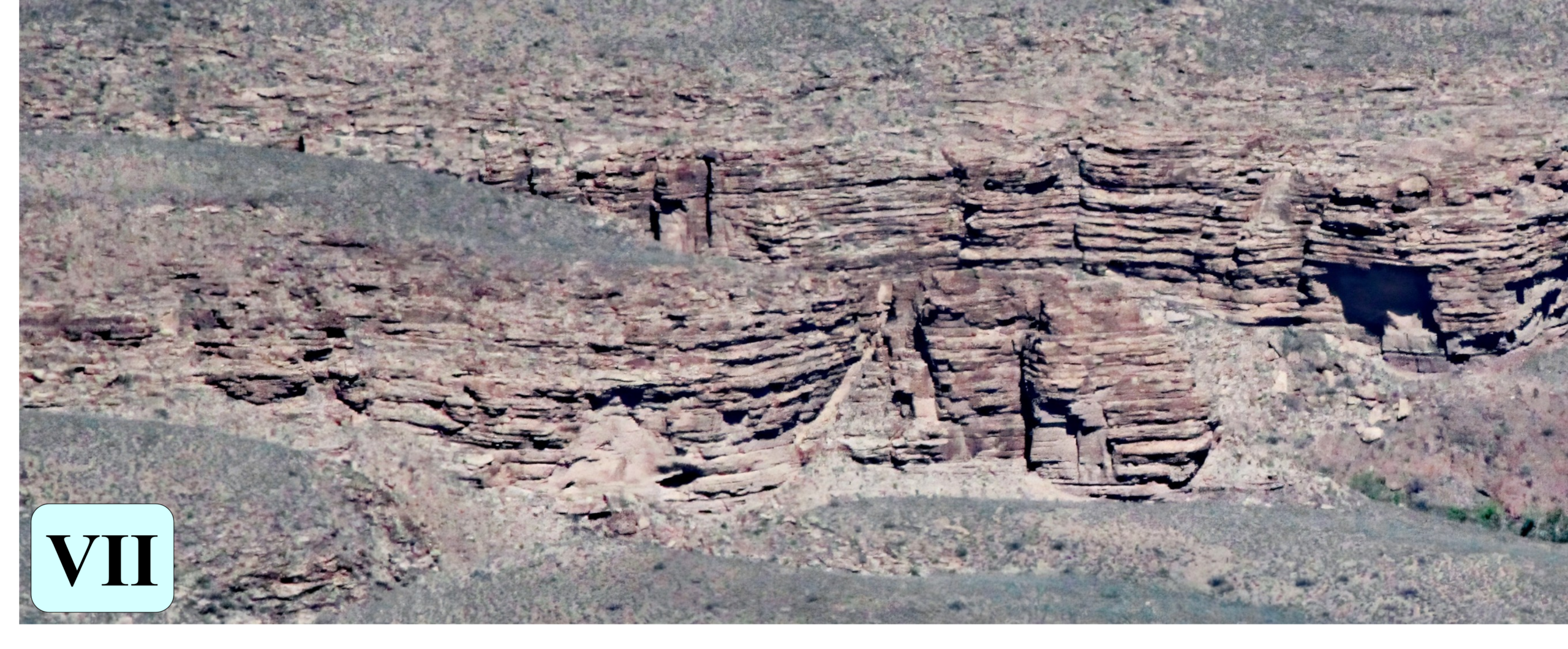
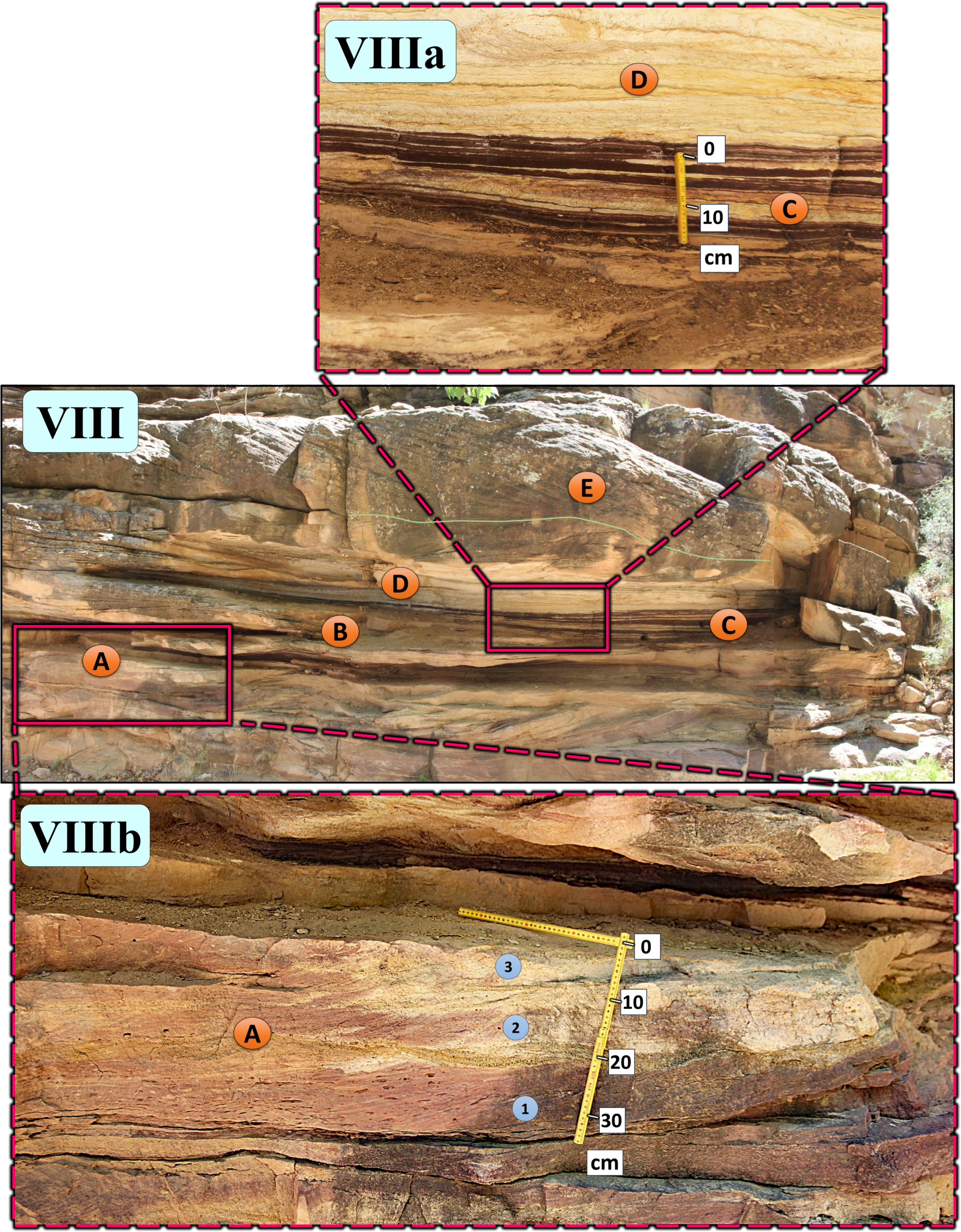
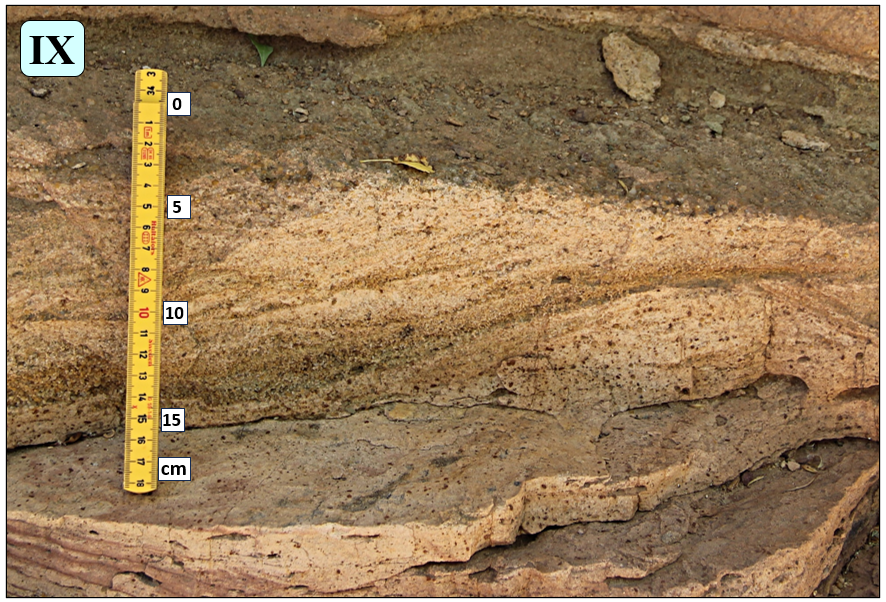
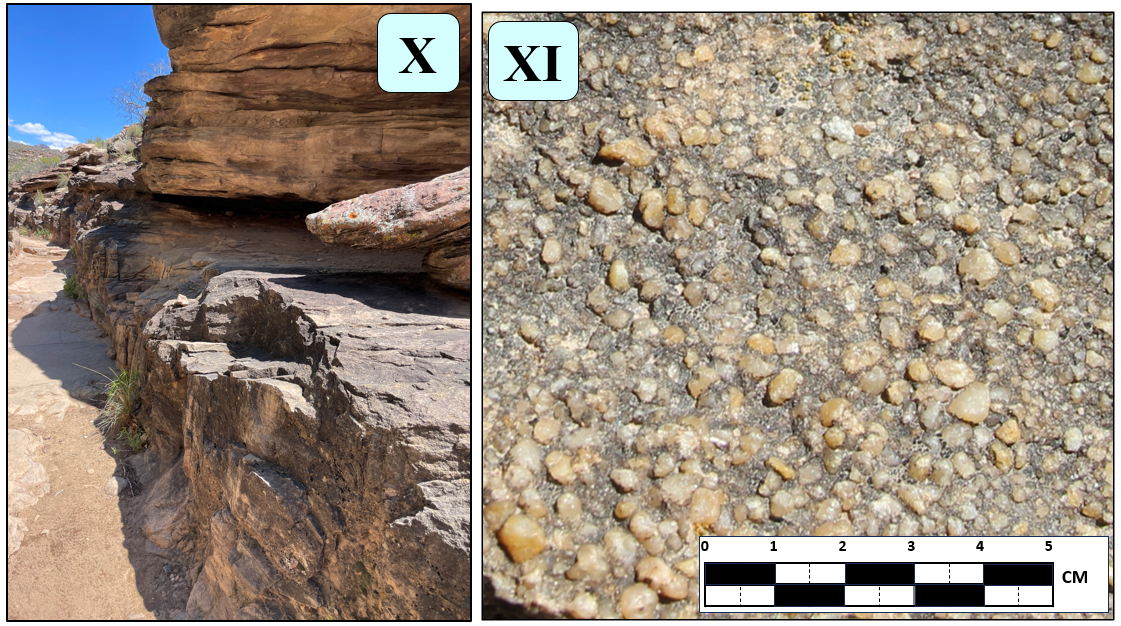
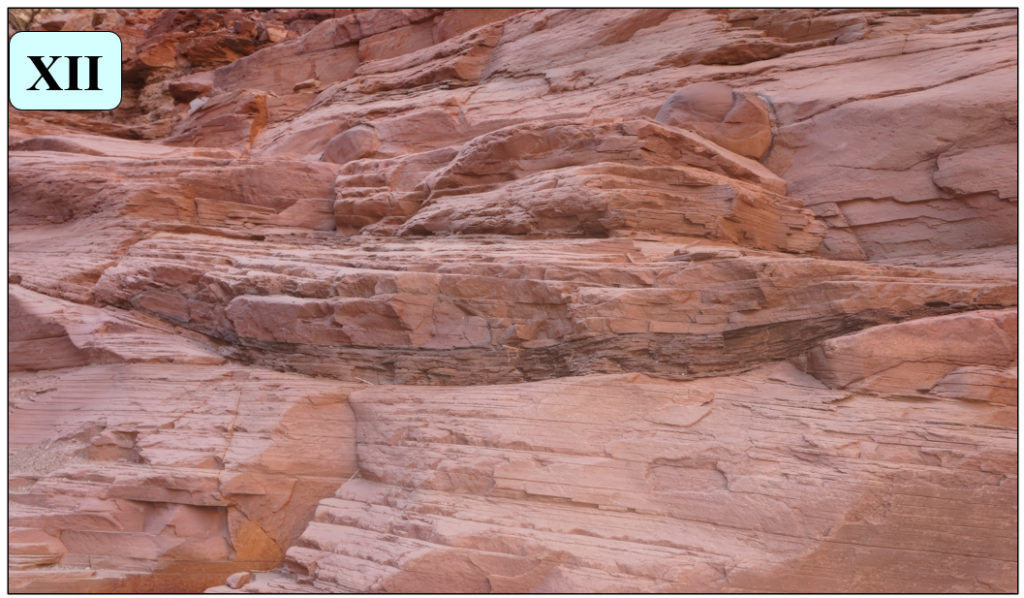
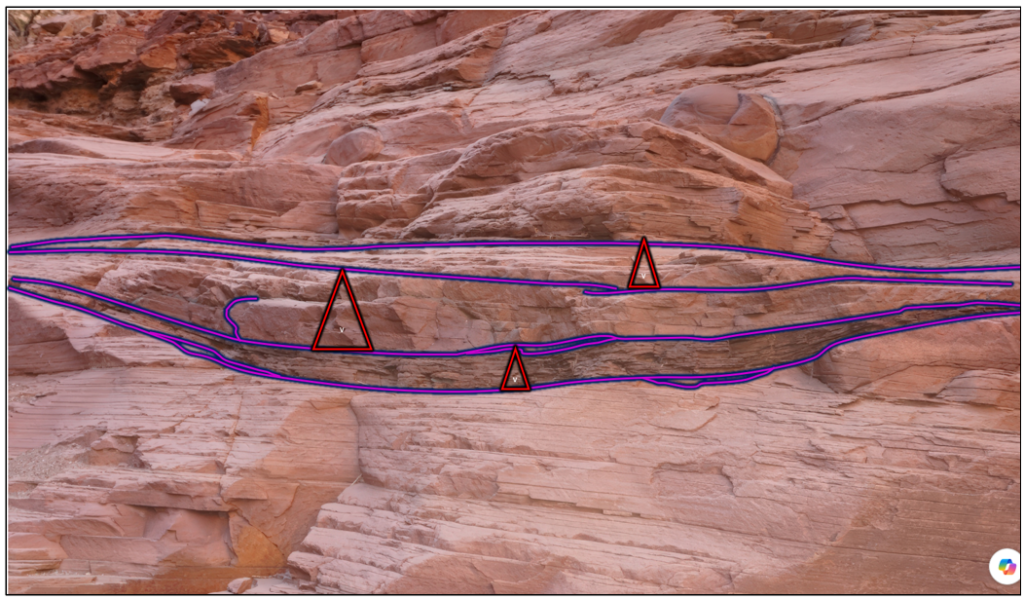
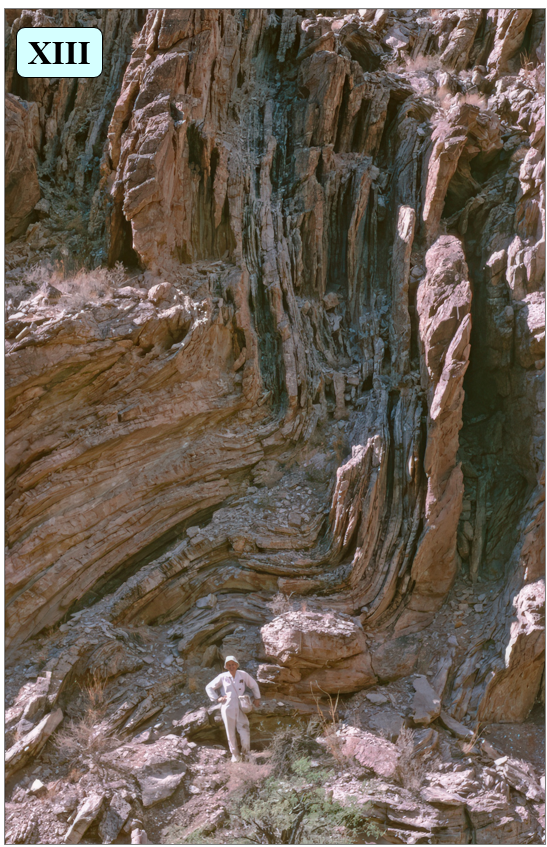
Recent Comments