
Does Flood Geology explain the rocks in the Grand Canyon?
Reply to Dr. Snelling’s Response, Part 1
Overview
Stephen Mitchell and Kennen Tillman
Introduction
Christians have different interpretations of the Biblical doctrine of creation and how to integrate our understandings of scripture and scientific data. As part of that discussion, in 2024, we published a three-part critique of Dr. Andrew A Snelling’s papers that proposed to explain the Cambrian-aged Tonto Group in the Grand Canyon as having formed and deformed during Noah’s flood (Mitchell and Tillman 2024a, 2024c, 2024b). (Link to critique.) Dr Snelling has now published his response, also in three parts in “Answers in Depth”, a publication by Answers in Genesis (AIG). Links to his response articles are here:
Responding to “Peaceful Science” Critics on Grand Canyon Evidence, Part 1
Tonto Depositional Processes and Rates: Responding Again to “Peaceful Science” Critics, Part 2
The Tonto Deformation: Responding Again to “Peaceful Science” Critics, Part 3
In turn, we here will provide readers with a reply to this response. We hope to clarify a number of misconceptions and misrepresentations and let the readers make up their own minds.
Table of Contents
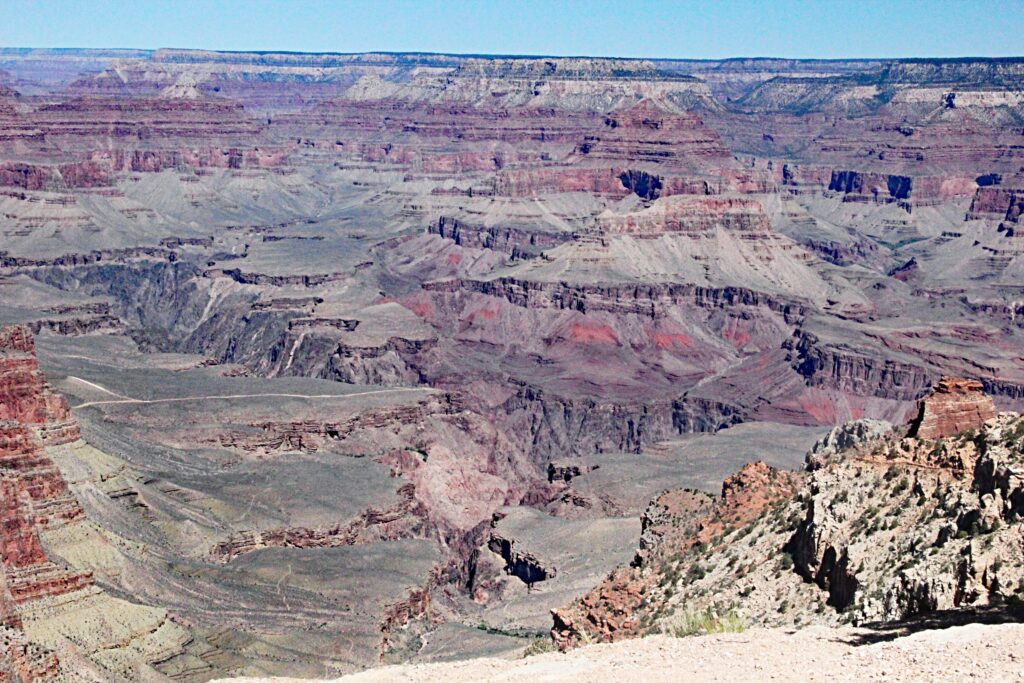
Dr. Snelling has written over 1200 pages in his reports on the Tonto units, including significant appendixes that document his observations and his interpretations. This is one of the most complete efforts to collect scientific data and place it into a flood geology context. We recognize that he has put considerable effort into this project. As Answers in Genesis’ director of research and editor-in-chief of the online Answers Research Journal, he has devoted considerable resources to his effort. While his articles include large amounts of repetition, they do provide a strong effort to document both his observations and his interpretation. He has presented his results in many forums, including several that are available online, e.g. Grand Canyon Folds. As far as we are aware, he has not presented his work at any non-YEC forum. He devoted significant effort to going through our articles and we want to present a response that is meaningful. We will not respond to every assertion that he made but will address many of his comments. We will try to avoid character attacks and ad hominem.
Our response to Dr. Snelling’s articles was in three parts, as was his reply. This counter response also has three sections. First, we reply to his Part 1, in particular to: 1. concerns about who we are, 2. his interpretation of the Great Unconformity, and 3. Radiometric dating, a topic only briefly discussed in our articles.
As we reply to his Part 2, we will look again at the deposition of the Tonto units and Dr. Snelling’s proposal that they were deposited over a matter of days in the early part of Noah’s flood. In Part 3, we will look at the objections to our article on the deformation of the Tonto group and his interpretation that the rocks were folded while soft and that they hardened very quickly before the Grand Canyon was carved. We contend that Dr. Snelling has a steep hill to climb because he must show that the data actually support that the rocks were deposited and folded within a one-year long catastrophic global flood, and also that the sediments hardened quickly and then that the Grand Canyon was carved before humans came along. The hardening and canyon carving, in his proposal, all would have happened within a period of no more than 450 years. We find that the geological data do not support these claims. In our articles, we have focused on the technical geologic details and interpretations, not the Biblical interpretation. We believe that the Bible is the inerrant Word of God, but that it does not tell us how old the Earth is or what the geological effects of Noah’s flood were.
Reply to Part 1
About ourselves
Dr. Snelling’s Part 1 article suggests that we should have begun our article with biographical information about ourselves. Scientific articles are not written that way, any more than Snelling’s articles begin with such. Admittedly, we are not as well-known as he is. He quoted the information that we provided on the “Peaceful Science” website about ourselves and we are quite happy to be known as Christian geologists and are glad that Dr. Snelling makes that clear. Our disagreements on the age of the Earth and flood geology are between believers.
Why were our articles published on “Peaceful Science”? We appreciate Dr. Swamidass’ eagerness to engage in discussions on science and faith. A different option would have been to publish them on Steve’s website, Jesus in History and Science, but we hoped for a site with more readership to make it more available. The proposal for the papers was submitted to Reasons to Believe (RTB) but after not hearing back from them, we proposed it to Dr. Swamidas and he was quite receptive. He also has indicated that he is perfectly willing to publish articles from a young earth perspective, including responses from Dr. Snelling.
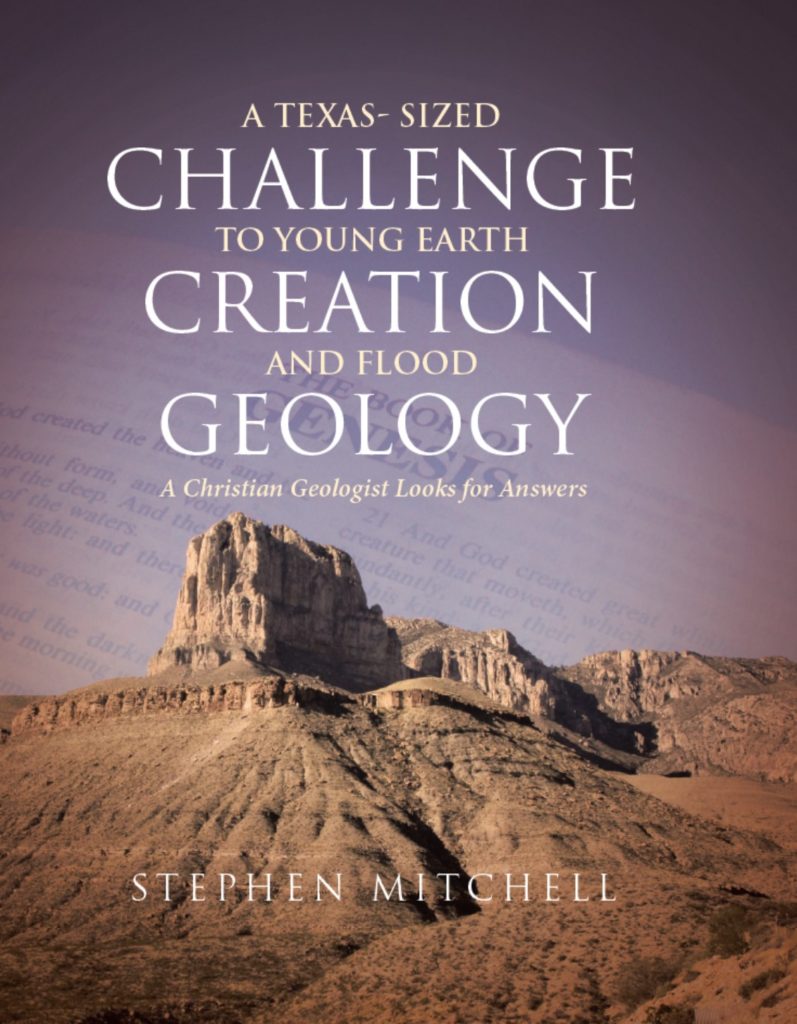
Dr. Snelling writes, “Dr. Josh Swamidass, Stephen Mitchell and Kennen Tillman profess to be Christian evolutionists. They also wholeheartedly embrace conventional uniformitarian geology.” (Snelling 2025). It is true that Dr. Swamidas considers God to have worked through what we see as evolution to populate the Earth with life. Steve considers himself an Old Earth Creationist and has written extensively on this both in his book, A Texas-Sized Challenge to Young Earth Creation and Flood Geology (free download available here: Link) and on his website: Jesus in History and Science. He recognizes that many times God probably worked through natural selection and mutation, but believes that God worked more directly at times, particularly in events such as the origin of life and human beginnings with Adam and Eve. Ken believes that God created the universe and the world over deep time, but the details of neither geologic nor life’s history are revealed in the Bible. Ken particularly believes that the focus in faith should be on sharing the gospel of Jesus. Christians should focus on countering the philosophy of naturalism, the view that only natural processes work in nature, to the exclusion of supernatural actions, such as actions by the God of the Bible.
How do our perspectives shape our conclusions?
Dr. Snelling’s phrase “conventional uniformitarian geology” (Snelling 2025) could be used to explain our understanding of Earth’s history, but the word “uniformitarian” can be misleading. Conventional geology, over at least the last hundred years, has not held that Earth’s past as shown in rocks is just a record of the same processes and rates that we observe today. It recognizes that catastrophic events have taken place and that rates have varied tremendously at times in the past.
It is important to recognize that both mainstream geologists and young earth creationists (YEC), such as Dr. Snelling, use data from the present to try to explain how rocks formed in the past. Sometimes it is used as a contrast, such as to say that we see such and such a rate now, but it must have been different in the past, based on the physical characteristics of both. In his 2009 book, Earth’s Catastrophic Past, Dr. Snelling uses things like modern examples of flood deposits, rapid deposition after the eruption of Mount St Helens and floating forests of Spirit Lake as keys to understanding the past (Snelling 2009a). He uses publications of current rates of river salt and sediment flux to extrapolate into the past, though we would argue inappropriately.[1] Repeatedly he points out that modern wind deposits typically have little mica as “a present is the key to the past” example to argue that ancient sands were not formed by eolian (wind-driven) processes.[2] Clearly, he believes that the present is a key to the past at times.
Dr. Snelling writes:
“At its core is the belief that only natural processes “must be” used to explain the earth’s past history. God is not involved, only nature operates according to the processes and their rates that we observe today, only “the present is the key to the past.” Since we have never observed a global Flood cataclysm, then one never happened.” (Snelling 2025) Emphasis in the original.
Snelling has assumed the assumptions we used. Assumptions are important. Steve has reviewed the assumptions which he makes in assessing the age of the Earth and flood geology, both in his book and in this blog post: Comparing Assumptions for the Age of the Earth and Deep Time. If the claims are that the Earth’s rocks are less than 6,000 years old and that Noah’s flood was a one-year-long global catastrophic event, resulting in strata such as the Tonto group, then it is important to test that without using circular logic. We are accused of this, but the assumption that the YEC interpretation of Genesis is the only viable option and that the rock record must fit into it is equally concerning. Dr. Snelling writes:
“Put bluntly, were these geologists present to observe the deposition of these sediments in question? For example, did they observe mud cracking? Or the slow preservation of traces left by animals? No! Instead, they interpret features such as purported mud cracks and trace fossils as requiring slow depositional processes with pauses in sedimentation because that is what we supposedly observe today. What they claim are “data” is actually a mixture of observations of rocks and fossils and interpretations of that evidence, based on uniformitarian assumptions.” (Snelling 2025) Emphasis in the original.
Snelling makes this type of statement several times. It works both ways. What we have are observations that we try to explain. We have to try to examine the data fairly that is reported to see if they support the interpretations given. In this case, we compare the data presented by Snelling and other investigations to see if they support Snelling’s timeline and the processes that his interpretation demand. No, we were not there and neither was he. We cannot assume that the Earth is old and he cannot assume that his interpretation of Genesis is true in order to prove his case.
Through these responses, several times Dr. Snelling complains that we have compromised our commitment to scripture and sold out to “uniformitarian geology”. For example, he states,
“Now that we have established the a priori and anti-biblical commitment of Christian geologists Stephen Mitchell and Kennen Tillman to the modern uniformitarian geological interpretation of earth’s past history, it is easy to understand their claimed critique of young-earth creation geologists’ claims about the Grand Canyon.” (Snelling 2025)
It is certainly true that we have concluded that the Young Earth Creation (YEC) interpretations of both Genesis and of the Earth’s geology are invalid. In our response to him, we tried to evaluate the geologic data that Dr. Snelling reported. Of course, we bring in our experience and knowledge. Does Dr. Snelling find what he is looking for because he begins with his conclusion? Here is a statement from Snelling available on YouTube, recorded while he was on the expedition to sample the folds in the Grand Canyon:
“As a Christian, I believe that God’s word is a record, and eyewitness account of what happened, and therefore as a scientist, I can expect that the evidence in God’s world will confirm what we have already read in God’s word.” (Midwest Creation Fellowship 2023)
This confirms that he was not unbiased. Dr. Snelling went looking specifically for data that could be shown as fitting his firmly held interpretation. This does not invalidate his observations, but does say that he can be biased in his interpretation. The question that we continue to address is: did he actually find it?
Two other general complaints that Dr. Snelling makes are: 1) That we have not detailed all of the alternative explanations that YEC writers have made to explain the various features that he describes in the Tonto, and 2) that neither Ken nor Steve have personally visited and studied the outcrops that he describes. First, regarding the various explanations that YEC have given, we have read YEC literature extensively and will deal a bit more with it in this response. As a generalization, it is worth pointing out that just because an explanation has been proposed does not make it adequate or valid. We will look at some examples where in our opinion, the explanations fail. Flood geology still needs to explain the observations in geology more effectively.
Regarding the second complaint, he is, of course, right that this is a bit of “armchair geology” as he terms it. We bring to bear our experience in other areas. We can also draw on the cumulative expertise of many other researchers in the well-developed fields of structural geology, sedimentology and stratigraphy. Of course, we would like to have the time and funding to do our own onsite investigation. We are trying to assess – did Snelling prove his case? He has provided many photographs of the described folds in his various articles and in most cases, other photographs are available. Many key characteristics are visible. We can, as he does, leverage many studies of the Grand Canyon geology that have been done. Dr. Snelling provided photographs of the samples that he collected. He should not complain that we have studied these photographs. We sent Dr. Snelling a request to use his actual photographs in our articles but never heard from him. We would like to have used his photographs to show interpreted and uninterpreted versions of the folds and slides. Without that permission, we chose to provide our interpretation of folds where we did not have access to photos and interpretations of a selection of the thin-section slides. We shortened and reduced the number of images several times, trying to keep our articles as short as we could, in order to hopefully expand the number of people who would actually read them. We also offered to provide him with a copy of our papers before they were published, but apparently this did not interest him at that time.
The articles that Dr. Snelling wrote and ours deal at times with detailed geologic data. We expect that some non-geologists will see these as technical details that may not really be that important. These are not small details. Here is an analogy. When a car’s wheel rim is damaged, it must be replaced. However, not just any rim will do. It must be the right size and beyond that, the holes must line up. Otherwise, it just won’t work. This is just like the situation with the deposition and folding of the Tonto units. The holes just don’t line up. Table 1 illustrates this.
[1] Discussions of these YEC claims are found here: The Salty Sea and Deep Time and Ocean sediments and Deep Time
[2] We agree that micas, such as muscovite and biotite, are less common in eolian sand dunes. It is not true that they are never found in eolian dune deposits (Alshakr et al. 2026; Benaafi and Abdullatif 2015; Hubbard et al. 2018; Marković et al. 2024; Muhs and Budahn 2019; Purtill et al. 2019; Zhu et al. 2021). (Zhu et al. 2021; Muhs and Budahn 2019; Alshakr et al. 2026; Purtill et al. 2019; Marković et al. 2024; Hubbard et al. 2018). Consistent with flood geologist reports from ancient units interpreted as eolian dunes, muscovite percentages are small and the size of the flakes found are small. We find that the assertion that mica proves that sediment was deposited by water to be disproven (Borsch et al. 2018; T. Helble 2024; T. K. Helble 2026).
 Age of the Earth Section
Below is Table 1, as shown in our article, but with some remarks updated (Mitchell and Tillman 2024a). This summarizes our findings and shows the sharp contrast in our perspectives on the units in question. We find that the interpretation, the holes just do not line up with the data using the flood geology interpretations.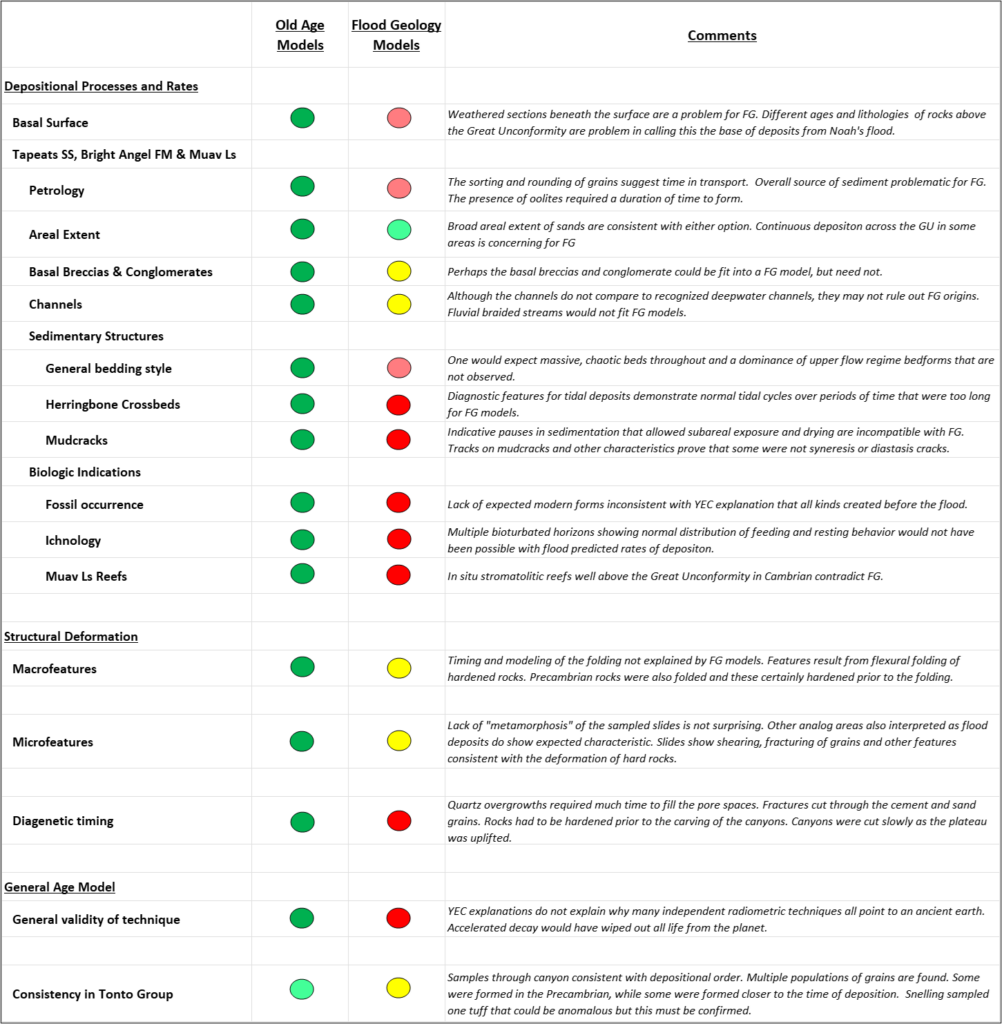
Table 1: Updated with new comments from our article. Comparison of strength of models: Green symbols reflect that the data is consistent with the model. Red lights are given when the data are not consistent with the model. Yellow lights reflect some uncertainty, suggesting that there could be scenarios that might fit. Some are light red or light green suggesting that there is overall agreement or disagreement, but some data has not been completely resolved. (FG=flood geology)
Great Unconformity
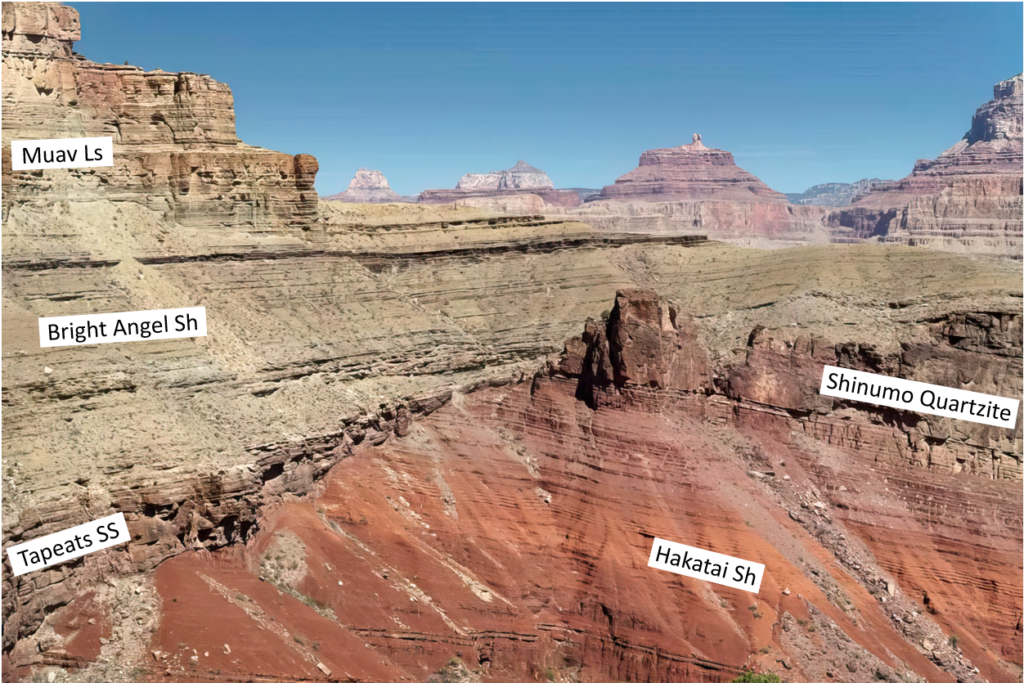
Dr. Snelling takes exception to our characterization of the basal surface, the Great Unconformity as a green dot on Table 1 of Part 1 of our articles. He reports:
“However, they never mention its areal extent, nor the areal extant of the Tapeats Sandstone and its equivalents. Even in the conventional uniformitarian literature, the Great Unconformity is documented as an almost global erosion surface. Then sitting on top of that Great Unconformity erosion surface is the Tapeats Sandstone and its equivalents, which can be traced in outcrops and drill holes right across North America across northern Africa into the Middle East (Fig. 2) and is also seen again in eastern China and South Korea.” (Snelling 2025)
We certainly agree that over large parts of the Earth, the top of the Precambrian rocks is an erosional surface. That does not mean that all of this erosion took place simultaneously. In our Part 2, we reported that today’s geologists, such as Dr. Karl Karlstrom, consider the Great Unconformity to have been formed by multiple erosional episodes (Karl E. Karlstrom 2019). Important to this discussion is what lies on top of the Great Unconformity. Dr. Snelling, following on from work by Dr. Timothy Clarey, published a map showing an extensive sand at the base of the Sauk megasequence. Clarey reports: “Although there is an extensive blanket sandstone (Tapeats equivalent) at the base of the megasequence, sandstones only make up about 17% of the entire Sauk sequence.” (Clarey 2020, p 197)[1] This interpretation of the base of the sequence is at variance with most workers. Clarey and Snelling consider the sandstones above the Great Unconformity to be equivalent and hence, one extensive sand system, but geologists have long recognized that the sands were not contemporaneous. Figure 1 shows that sediments above the Great Unconformity are of a variety of ages, ranging from the Ediacaran to lower Ordovician (Dhungana and Flament 2026; Snelling 2025). Sands were often locally derived, usually arkosic, with fragments derived from granites beneath them. A more likely explanation is that sands were shed off of highs and deposited as beds of sand of different ages.
[1] Steve has written a review of Dr. Clarey’s book, Carved in Stone: Geologic Evidence of the Worldwide Flood can be found here: Book: Carved in Stone by Dr. Timothy Clarey: An Old-Earth Response
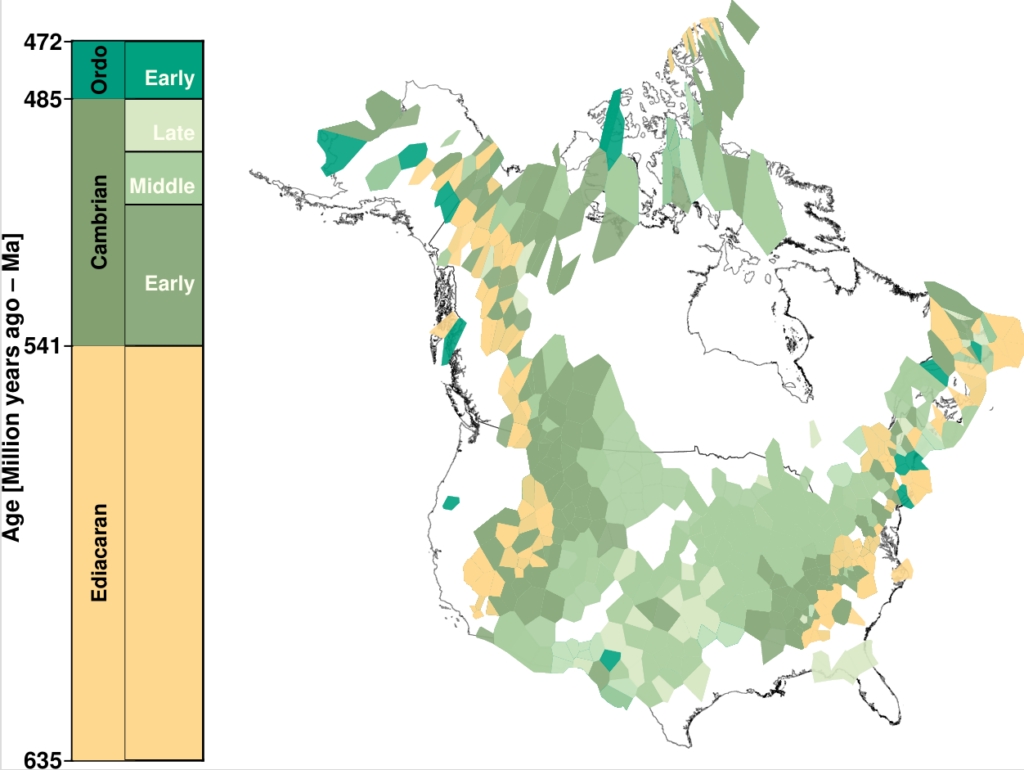
Figure 1. Map of the stratigraphic age of units sitting above the Great Unconformity in North America. Used with permission from Dhungana and Flament 2026. Dr Dhungana graciously provided this version with just North America. The areal extend shown here is very similar to Dr. Snelling’s Fig. 2.
Does this unconformity support, much less demand, a catastrophic flood to explain it? It is quite true that geologists debate the causes that led to this widespread erosional surface. Some propose that the unconformity is at least in part a result of a major glacial episode (Chakravorty 2019; Keller et al. 2019).
A different and more common view is reflected by this quote from Shahkarami:
“In most places, the Great Unconformity is a composite. It is actually a composite sequence boundary resulting from successive eustatic episodes of sea-level rise and fall overprinted by multiple tectonic events of subsidence and uplift. This surface should not be used for inter-basin correlations.” (Shahkarami et al. 2020)
Such tectonic events can be broad and widespread and as such, they have to be considered a plausible if not far more probable explanation. The different ages of sediment above and below this unconformity are consistent with multiple tectonic events and erosional episodes. (Flowers et al. 2020; Lee et al. 2021; Sturrock et al. 2021; Shahkarami et al. 2020).
Dr. Snelling and a number of other flood geologists consider the Great Unconformity[1] to be the base of global catastrophic flood deposits that include Paleozoic, Mesozoic and, in some interpretations, much of the Cenozoic record. However, what we see setting on the Great Unconformity surface is a wide variety of sediments of different ages. Even Clarey (2020) includes shales and limestones on these surfaces extending across extensive areas. Dr. Snelling lumps all these together and treats them as if they are all part of a uniform sandstone sheet at the Cambrian level that spans a significant part of North America. The limestone stromatolitic reefs of Cambrian age and found in many regions are particularly difficult to reconcile with considering the Great Unconformity as the base of flood deposits, but this will be addressed further later.
[1] Recently the National Park Service has begun to use a more detailed terminology (National Park Service nd). Where the crystalline basement rock meets the Tapeats it’s called the “Great Unconformity”. Where the tilted rocks of the Grand Canyon Supergroup meet the Tapeats, they refer to it as the “Great Angular Unconformity”. Where the crystalline basement meets the bottom of a Grand Canyon Supergroup layer, it’s called the “Great Nonconformity”.
Radiometric dating
In our Part 1, we pointed out a series of four questions that flood geology answers very differently than the consensus of modern geology. We proposed that these were each critical to YEC flood geology, while for the Tonto units, the answers could be very different without significantly impacting the overall validity of the consensus processes or timing. If one unit were deposited very quickly, that would hardly mean that many others were, regardless of the processes, but if the Tonto were deposited over even a five-year period, the flood geology narrative would be invalid. If it were deposited by normal tidal processes, then that would contradict the flood geology model. If the folds developed over a few years, instead of millions of years, it would mean re-interpreting the geologic history of the area but would not prove flood geology. By the same token, a slow folding history would sharply contradict the YEC flood geology proposal. How about the general age model?
Dr. Snelling (2025) has paraphrased our statement to read “However, they have thrown down the proverbial gauntlet that “if any of these four questions can be demonstrated not to be reconcilable” with old-age models, then it makes the “entire” old-age model “questionable.””
Recognize that the relative age of the rocks does not depend on how many million years old the rocks are. Geologists (or natural historians, as they were then known) recognized that the earth was much older than 6000 years in the 1700’s, long before the first rock was radiometrically dated in 1905. They recognized that the rates demonstrated by the events recorded in rocks imply great amounts of time. The absolute ages, the millions of years, are based on radiometric dating, but depositional processes, folding of rocks and tectonic processes provide many evidences that the earth is far greater than 10,000 years old. For most of the rock record, Snelling’s preferred timeline makes them even younger, less than 4,350 years old.
We will not go here into detail on radiometric dating and methodologies. That has been done before and still holds.[1] In this section, we will point out that Dr. Snelling and other YEC authors recognize that radiometric dating does reflect the same order of rock formation that we see in the rocks and that it shows that vast amounts of radioactive decay have occurred. If this is true, then how do YEC explain these facts? We will briefly give the most common YEC explanations and also why these are not accepted by non-YEC scientists. Dr. Snelling referenced an article of his, with what he sees as invalid assumptions in radiometric dating. Do these mean that radiometric dates are useless? We will give brief arguments against that, quoting works by Dr. G. Brent Dalrymple, formerly of the USGS, now a professor emeritus from Oregon State University and a recognized expert in this field. Then we will briefly discuss the results that Dr. Snelling provides from the Tonto Group in the Grand Canyon.
[1] Examples include: Assessing the RATE project by Randy Isaac, Radiometric Dating: A Christian Perspective by Roger Wiens; Misunderstandings Concerning the Significance of AMS Background 14C Measurements by Taylor, et al.; Radiometric Dating Does Work! by G. Brent Dalrymple.(Isaac 2007; Wiens 2002; Taylor et al. 2018; Dalrymple 2000)
YEC general explanations
Comparing the age models for an old Earth vs. a young Earth in the Grand Canyon is not a matter of whether the age of the Tapeats Sandstone is 500 million years old vs. another ancient age such as 200 million years old. For the young Earth interpretations to be valid, they depend on demonstrating that the Earth is really less than 10,000 years old. They must explain effectively why all radiometric clocks are wrong. It is not as if there were only one methodology that give ages that contradict young earth timelines. For this hypothesis to work, it would seem to mean that by a miraculous method, many independent decay processes were all deliberately set for the apparent purpose of confusing future investigators.
YEC really need to show a reliable clock from nature that tells us that the Earth is only a few thousand years old. The Bible never tells us how old the Earth is, nor when Noah’s flood occurred nor its areal extent. What is at stake is not the Bible, but the YEC interpretation of it. YEC writers recognize that radiometric dates, despite problems that they perceive in many results, give data that is useful. They represent real data that must be accounted for. Dr. Snelling (Snelling 2021) wrote:
“However, it could be argued that the accepted radiometric ages of the various Grand Canyon strata, including the basement granites and schists, date those rocks and strata in the correct relative order, and consistently in hundreds of millions to almost two billion years, except for the recent lava flows in the western Grand Canyon (Wiens 2016).” However, Vardiman, Snelling, and Chaffin (2005) have demonstrated from six lines of evidence, supported by experimental results, that the reason for this systematic consistency of radiometric ages in the Grand Canyon stratigraphic sequence is because during some catastrophic event in the past there was a systematic acceleration of nuclear decay rates, potentially by six orders of magnitude.” (Snelling 2021) emphasis added
This understanding reflects considerable effort in the “Radioisotopes and the Age of the Earth” study (R.A.T.E.) by many of the most prominent names among flood geologists, including Steven A. Austin, John R. Baumgardner, Steven W. Boyd, Eugene F. Chaffin, Donald B. DeYoung, D. Russell Humphreys, Dr. Snelling, and Dr. Larry Vardiman. (Vardiman et al. 2005, 2000) [1]
[1] In order to reflect YEC views of radioactive dating accurately, here is an extended quote from Vardiman, et al, (Vardiman et al. 2005)
“By the time the first book was published by the RATE group [Vardiman et al., 2000] the majority of the RATE group had decided that accelerated decay would be the primary research hypothesis, but that the other two concepts should be investigated as well. In fact, the final explanations offered by this study are actually a combination of all three hypotheses. Accelerated decay during several periods of earth history became the primary hypothesis because of the strong physical evidence the RATE group had accumulated that a large amount of nuclear decay had indeed occurred in the rocks themselves after their initial creation. This evidence suggested that most of the decay occurred during Creation week events, but also that a large amount must have taken place during the Genesis Flood. The RATE group considered the possibility that a substantial amount of decay might have occurred during the Judgment in the Garden of Eden, but then it was concluded that the implied levels of radiation and heating would have been so highly destructive to biology at that point in earth history as to render this possibility unlikely. The evidence for these conclusions comes from the physical presence of fission tracks, radiohalos, and residual He in rocks that contain U and other radioactive elements to be discussed shortly. Most creationists who had previously addressed these issues did not fully appreciate the evidences for radioactive decay beyond the chemical presence of the daughter isotopes themselves. Most believed that the large quantity of daughter isotopes observed today was primarily God’s doing during Creation, that is, the concentration of daughter isotopes was non-zero when time began. If this were in fact the case, then the problem could be solved simply by resetting the radioisotope clocks to account for this initial inventory of daughter isotopes. However, the physical evidence argues otherwise. There are many independent lines of evidence that large quantities of daughter isotopes were formed since Creation and even since the beginning of the Flood! These findings and assertions are major departures from the previously-held understanding in creation science. They not only force creationists to discover a much more complex scenario for the decay of radioisotopes than has been considered in the past, but they also require us to link such an explanation to serious Biblical and scientific constraints. Either accelerated radioactive decay accounts for the large daughter isotope residues in a short period of time, or a large amount of decay occurred at conventional rates and the earth is old. The RATE group now believes that an old-earth concept can be refuted on Biblical as well as scientific grounds, and also offers a plausible explanation of how and when large quantities of nuclear decay occurred in a young-earth time frame.” (Vardiman et al. 2005) emphasis added
It is very significant that YEC recognize that radiometric dating results are not random but provide ages that reflect the real stratigraphic order in which rocks were formed. They also recognize that the radiometric decay calculated was real, not an artifact of some flawed physics. The physics that forms the basis for the analysis is robust. Certainly, there could be cases where the sampling was poor or the analysis was done incorrectly, but there is no denying that real data supports the calculated ages.
Even so, Dr. Snelling claims that radiometric dating is hopelessly flawed. What issues do YEC consider critical failures for these techniques? Dr. Snelling referenced his article: “Radiometric Dating: Problems with Assumptions” where he presents three “unproven assumptions” that he believes invalidate radiometric dates (Snelling 2009b). They are as follows:
Assumption 1: Conditions at Time Zero
Assumption 2: No Contamination
Assumption 3: Constant Decay Rate
Regarding Assumption 1, Snelling himself reports:
“For the other radioactive “clocks,” it is assumed that by analyzing multiple samples of a rock body, or unit, today it is possible to determine how much of the daughter isotopes (lead, strontium, or neodymium) were present when the rock formed (via the so-called isochron technique, which is still based on unproven assumptions 2 and 3).” (Snelling 2009b)
What he is saying is that for commonly used isochron techniques, known as “age-diagnostic diagrams” there is no requirement of knowing or assuming the original amount of the parent or daughter product. Thus, Dr. Snelling recognizes that at a minimum, for some techniques, his unproven assumption 1 is not an issue.
Dr. G. Brent Dalrymple addressed both of the first two assumptions in his book, “The Age of the Earth” in this quote:
“As we have seen in the preceding discussion, most of the simple accumulation methods are encumbered with two requirements: (1) that the amount of initial daughter be known, and (2) that the rock has remained a closed system since formation. But how can we find the quantity of initial daughter or determine that the system has been open or closed? These seemingly formidable problems can be solved by the use of simple graphic devices that we will collectively call age diagnostic diagrams. These diagrams and their mathematical equivalents not only provide an age, but some provide an exact measure of the initial daughter, some provide an age for systems that have not remained closed, and all are self-checking. They are especially useful on old rocks with complex histories, and are the basis of most of the radiometric evidence for the age of the Earth.” (Dalrymple 1991)
How does this work? For instance, sometimes different minerals in different parts of an igneous body are sampled. It is unlikely that mineral grains distributed like this would have all been contaminated alike (Dr. Snelling’s unproven assumption 2). In isochron plots, open systems will show as scattered points, while closed systems will align, providing a measure of both the age and the original amount of the parent element and a check for the presence of contamination.
Dr. Dalrymple also addressed Dr. Snelling’s third unproven assumption issue:
“There are two basic reasons why significant changes in rates of decay are not expected. First, the nuclei of atoms are extremely small and well insulated by their cloud of orbiting electrons. These electrons not only separate nuclei sufficiently that they cannot interact, but also provide a "shield" that prevents ordinary chemical or physical factors from affecting the nucleus. Chemical activity in an atom, for example, occurs almost entirely among the outermost electrons and does not involve the nucleus at all. Likewise the "compressibility” of a substance may result in slight changes in the configuration of electrons but has no effect on the nucleus.
Second, the energies involved in nuclear changes are 109 times greater than those involved in chemical activity and 104 to 105 times greater than the energies that bind the electrons to the nucleus. .. Except for nuclear reactions, such energies are generally unavailable in natural processes such as those that form, change, and destroy rocks on the earth and in the Solar System.
It was not long after the discovery of radioactivity that experiments were conducted to determine whether or not the rates of radioactive decay could be changed (Emery, 1972: 766, Hopke, 1974: 517). In 1907, Rutherford and a colleague, J. E. Petavel, placed a sample of radium "emanation" (220Rn, radon) in a steel-encased cordite bomb. They observed no change in the activity of the sample even though the explosion generated an estimated temperature of 2,500°C and pressure of 1,013 bars. Madame Curie and M. Kamerlingh Onnes found in 1913 that lowering the temperature of a radium compound to the boiling point of liquid hydrogen (-252.8°C) did not change the radium activity by more than 0.05%, if at all. Other experiments involved varying gravity by measuring the rates on mountain tops and in the depths of mines or by whirling samples in a centrifuge; in yet others the samples were subjected to magnetic fields of as much as 8.3 teslas. These early experiments and subsequent ones involving extremes of temperature, pressure, chemical state, and electric and magnetic fields have uniformly failed to induce any changes in the decay rates of a wide variety of alpha and beta emitters.” (Dalrymple 1991) Emphasis added
This does not prove that small changes in nuclear decay rates could not have occurred, but to support a 6,000-year-old Earth, such changes would have had to be enormous and also all worked alike in the isotope’s decay rates for many different elements. Dr. Snelling and other YEC authors have claimed that there is scientific evidence to support their interpretation of accelerated radiometric dating during creation week and during the flood, but it is unpersuasive to non-YEC scientists.[1] They also propose mechanisms to explain how this decay occurred without the associated heat melting the earth or the radiation killing all of life. Again, the evidence is not persuasive. [2] (Isaac 2007; Loechelt 2020)
Dr. Snelling considers the top of the one-year catastrophic flood deposit as the top of the Mesozoic erathem (rocks deposited during the Mesozoic era, regardless of when that was). That would then mean that the accelerated decay, with all of the inherent radiation would have had to occur essentially throughout the entire post-flood Cenozoic period, yet life clearly thrived through this period. If such an accelerated event actually occurred, it is very confusing to try to place it. Given that Dr. Snelling dates Noah’s flood to 4350 years ago and Abraham lived about 4000 years ago (in geologic terms, late Holocene), that means that almost the entire Cenozoic record would have been deposited in about 350-450 years. When did the accelerated decay cease?
While the RATE project's proposal of accelerated nuclear decay is clearly motivated by a sincere desire to reconcile radiometric dating with a young-earth timeline, it introduces insurmountable physical paradoxes. If billions of years' worth of radioactive decay were compressed into a single year during the Flood, the resulting release of thermal energy would have been catastrophic. The heat generated would have been sufficient to melt the Earth's crust entirely, while the massive spike in ambient radiation would have sterilized the planet, rendering the survival of any life on the Ark physically impossible. Therefore, the scientific data does not support accelerated decay as a viable mechanism.
[1] Steve wrote about the claimed “helium problem” here: https://jesusinhistoryandscience.com/?p=3729
[2] A second heat associated issue comes from rapid continental movement that is part of what flood geologists refer to as “catastrophic plate tectonics”. Dr. Snelling is one of the authors of the original paper proposing that this process occurred during Noah’s flood (Austin, et al., 1994). This was proposed as the cause of the vast numbers of tsunamis that he uses to provide the sediments of the Tonto group and much of the geologic record. Accommodating recognized plate movements within a one-year timeframe means that whole continents had to average rates of meters per second. That is an astounding proposal! There are numerous issues involved in this, including a heat concern. Sean Ovis commented:
“Plates currently move at cm per year. If you increase the speed to metres per second, then you are increasing the rate by a factor of over 3 billion. That means the kinetic energy involved in moving the plate increase by a factor of around 10^19. Putting aside the issue of where the energy comes from, it is where the energy goes to that is the problem. Stopping a continental plate moving at metres per second would generate phenomenal amounts of heat - quite sufficient to melt the plate.” (Sean Ovis, personal communication) Emphasis added.
I (Steve) remember waiting on my brakes to cool while driving down mountains in the Rockies. Slowing down a continent must have generated heat that would be reflected in the rocks. The combination of accelerated radioactive decay and deceleration of continents should have left Earth uninhabitable.
Tonto Dating
It is worth looking at some of the more specific points for the Tonto Group. Dr. Karl Karlstrom, et al., (2018; 2020) provided well-constrained radiometric dates that now represent the accepted dates for the formations that make up the Tonto group. They were able to constrain dates for the base of the Sixtymile formation to 541 MYA and the top of the Muav Formation to approx. 499 MYA. Their dating integrates biostratigraphic data, but numerically they are based on their work with detrital zircon grains. Significantly, they base their estimates on the U-Pb age calculations for the average of the youngest population of grains sampled, recognizing that older grains should be present, due to reworking. We are not surprised to see grains from older eroded rock among the sandstones. Snelling recognizes this good work but also claims to have found a bed with much younger zircons in it.
Dr. Snelling reported the following issues:
“Although it often produced apparently concordant U-Pb dates (essentially matching 206Pb-207Pb, 238U-206Pb, and 235U-207Pb ages), there were still many detrital zircon grains that yielded illogically younger ages than the supposed depositional age of the Tapeats Sandstone. Recall that Snelling (2005b) reported CA-ID-TIMS analyses of three zircon grains recovered from a thin tuff bed in the Tapeats Sandstone in the western Grand Canyon that yielded concordant ages of 86.2 Ma, 98.2 Ma, and 90.1 Ma. Snelling (2005b) also obtained single zircon grain fission-track ages of 75 Ma, 158 Ma, and 408 Ma that are very much younger than the Karlstrom et al. (2018, 2020) tandem U-Pb ages for deposition of the Tapeats Sandstone. Yet fission tracks are the physical evidence of the quantity of nuclear decay that has actually occurred. These considerations and highly inconsistent results from what is touted as a superior analytical procedure only highlight the unreliability and fallibility of the U-Pb dating method.” (Snelling 2021b p.239-240)
First, what is the significance of the fission track dates? Is this result important? Is this telling us that this unit doesn’t fit the recognized age model? Dr. Karlstrom responded to Dr. Snelling’s claim as follows:
“Fission track dating is a thermochronometer that measures when a zircon grain cooled through the temperature window of 320-200 °C, not when it formed. Within and above that temperature range, the fission tracks in a crystal get shortened and annealed producing apparent younger ages.” Karlstrom, personal communication (2021)
As you can tell from Dr. Karlstrom’s comment, what Snelling demonstrated was that the zircons have had complex heating histories, not their actual ages. It is like confusing the tachometer for the speedometer. Both RPM and MPH have units of time, but they are measuring different things. Fission track data gives a minimum date for the rocks, but does not help in determining the actual age. These minimum ages are problematic in themselves for YEC interpretations.
More interesting is Snelling’s claim that he found U/PB data that also is anomalous. He references his 2005 chapter in the RATE II study (Snelling 2005). Here he presented U-Th-Pb analysis from six Muav samples and six samples from the same Tapeats tuff for which he reported the fission track analysis. It is interesting that not even one of his zircons gave the results that reflect conventional dates by a number of studies. Three are older, suggesting that older material is incorporated into each of these beds. The rest of the samples range from 68.2 MYA to 425 MYA. How could such data be explained? Snelling proposes that these are the result of accelerated decay during the flood. It is unclear why these two tuff beds would have experienced so much less acceleration than the rest of the rocks. The problem of the heat that might be needed to reset the zircon data is major, especially given that it seems to apply only to a few particular beds. What kind of process picks out just certain grains in a few beds?
Are there other, less complicated possibilities? The age results of Snelling’s analysis reflect less lead in the samples than one would expect from older rocks. Dr. Karlstrom noted that “Pb loss is common for Grand Canyon basement zircons that got reworked into Cambrian strata”. How does this work? Bowring, et al, 2006 reported one possibility:
“Experimental measurements of Pb diffusivity in zircon indicate that Pb loss is not likely dominated by volume diffusion, but rather related to loss from radiation damaged domains through crystal defects and fractures. Once the crystal lattice is distorted and damaged, Pb ions have “short circuit” pathways to diffuse from the crystal, resulting in grains that have a deficiency of Pb.” (Bowring and Schmitz 2003)
The zircons that Snelling shows in his 2005 article do not show obvious visual defects and his chemical abrasion is a recommended procedure to reduce risk of this type of errors. Could there be issues in the beds that Elston (1989) identified as “tuffs”? We asked Dr. Karlstrom and he replied,
“There were several beds that Elston thought were tuffs and I have not visited the one at RM 205, but others (RM 179) have turned out to be clastic sedimentary rocks (siltstones) with reworked Precambrian and Cambrian grains and possibly an ash component. I'll try to visit this one and re-sample it next April.” .” Karlstrom, personal communication (2021)
Unfortunately, Dr. Karlstrom apparently did not follow through on this testing. The fact that none of Snelling’s zircons fall in the range of Karlstrom’s youngest population suggests a different type of process. It seems for now that it is very possible that the “tuff” bed was a clastic bed with Precambrian zircons that experienced enough lead loss to explain Snelling’s results. Perhaps we will have documented zircons from above and below the bed that date to more expected ranges and this will constrain the anomalous material. This would be certainly a useful exercise for future study. For now, the results are just anomalous, but not a help for the YEC proposal.
In his response to our articles, Dr. Snelling questions why some of the zircons in Karlstrom’s study yielded dates significantly younger than the 507-508 Ma age. Why would that be? We don’t have details on the particular samples, but it is reasonable to hypothesize that the Pb loss resulted through the method Bowring proposed. Dr. Snelling also questions this in this quote:
“Nor do they explain from where these “younger” detrital zircons within the Tapeats Sandstone originated. Indeed, how could even the 507–508 Ma detrital zircons be incorporated in the Tapeats Sandstone if the underlying rocks that were eroded to provide the sand grains, including the zircon grains, are older than 507–508 Ma?” (Snelling 2025) (emphasis in the original).
Dating sedimentary rocks, such as sandstones, requires secondary techniques, such as detrital zircons. If Karlstrom had been able to date an igneous intrusion, the zircons would be from the time of the intrusion emplacement. That was not an option for dating the sedimentary sandstones. Even so, Dr. Snelling recognizes that zircons can be formed in volcanic tuffs. We know that such tuffs can be eroded quickly and we suggest that such a source is likely where the younger zircons in the Tapeats originated, but this cannot be specifically confirmed. Zircons from igneous extrusive rocks that were eroded soon after their emplacement would give dates close to the age of the sediments themselves. The Tapeats has zircons from a variety of igneous sources, but Karlstrom’s youngest set give a good estimate for dating the sandstone.
Summary of radiometric dating
In our stoplight table, for the general age model, we broke that down into two parts: general validity of technique and consistency in the Tonto Group. We considered the overall validity of radiometric dating green for old age models and red for flood geology models. We continue to believe this is accurate. This is especially true if we are asking: does radiometric dating support or contradict the proposal that the sedimentary record in the Grand Canyon above the Precambrian is no more than 4,000 to 10,000 years old?
Regarding consistency in the Tonto Group, we recognize that we don’t have all of the answers for details in the Tapeats. While we believe that these could be easily resolved, the nature of real data involves some uncertainty and variability. Hence, we colored these lights appropriately for this. Again, however, we do not know of any interpretation of the radiometric dating in the Grand Canyon rocks that would support the flood geology timeline.
References Cited
Alshakr, Ahmed, Mohamed Sultan, Mustafa Kemal Emil, et al. 2026. “Hyperspectral Fingerprinting of Dune Sediments Across the Arabian Peninsula: Insights Into Sediment Provenance and Transport Pathways From NASA’s EMIT Data.” Geophysical Research Letters 53 (12): e2025GL121122. https://doi.org/10.1029/2025GL121122
Benaafi, Mohammed, and Osman Abdullatif. 2015. “Sedimentological, Mineralogical, and Geochemical Characterization of Sand Dunes in Saudi Arabia.” Arabian Journal of Geosciences 8 (12): 11073–92. https://doi.org/10.1007/s12517-015-1970-9
Borsch, K., John Whitmore, Raymond Strom, and George Hartree. 2018. “The Significance of Micas in Ancient Cross-Bedded Sandstones.” The Proceedings of the International Conference on Creationism 8 (January): 306–26. https://doi.org/10.15385/jpicc.2018.8.1.30
Bowring, Samuel A., and Mark D. Schmitz. 2003. “High-Precision U-Pb Zircon Geochronology and the Stratigraphic Record.” Reviews in Mineralogy and Geochemistry 53 (1): 305–26. https://doi.org/10.2113/0530305
Chakravorty, Adityarup. 2019. “Did Global Glaciation Cause the Great Unconformity?” Eos, April 9. https://eos.org/articles/did-global-glaciation-cause-the-great-unconformity
Clarey, Dr Timothy. 2020. Carved in Stone: Geologic Evidence of the Worldwide Flood. ICR Institute for Creation Research.
Dalrymple, G. Brent. 1991. The Age of the Earth. Stanford University Press. https://www.sup.org/books/science/age-earth
Dalrymple, G. Brent. 2000. “Radiometric Dating Does Work!” National Center for Science Education. https://ncse.ngo/radiometric-dating-does-work
Dhungana, Santosh, and Nicolas Flament. 2026. “The Deep Earth Origin of the Great Unconformity.” Research Square (Preprint), January 13, 42. https://doi.org/https://doi.org/10.21203/rs.3.rs-8246233/v1
Elston, Donald P. 1989. “Correlations and Facies Changes in Lower and Middle Cambrian Tonto Group, Grand Canyon, Arizona.” In Geology of Grand Canyon, Northern Arizona (with Colorado River Guides): Lee Ferry to Pierce Ferry, Arizona, edited by Donald P. Elston, Billingsley, Georghe H., and Young, Richard A. American Geophysical Union (AGU). https://doi.org/10.1029/FT115p0131
Flowers, Rebecca M., Francis A. Macdonald, Christine S. Siddoway, and Rachel Havranek. 2020. “Diachronous Development of Great Unconformities before Neoproterozoic Snowball Earth.” PNAS 117 (19): 10172–80. https://doi.org/10.1073/pnas.1913131117
Helble, Timothy. 2024. “Flood Geology and Conventional Geology Face Off Over the Coconino Sandstone.” Perspectives on Science and Christian Faith 76 (2): 86–106. https://doi.org/10.56315/PSCF9-24Helble
Helble, Timothy K. 2026. “First Response to Whitmore and Garner: ‘Helble’s Critique of Creationist Research on the Coconino Sandstone Fails.’” Academia.edu. https://www.academia.edu/164825321/First_Response_to_Whitmore_and_Garner_Helbles_Critique_of_Creationist_Research_on_the_Coconino_Sandstone_Fails_
Hubbard, Bernard E., Donald M. Hooper, Federico Solano, and John C. Mars. 2018. “Determining Mineralogical Variations of Aeolian Deposits Using Thermal Infrared Emissivity and Linear Deconvolution Methods.” Aeolian Research 30 (February): 54–96. https://doi.org/10.1016/j.aeolia.2017.12.001
Isaac, Randy. 2007. “Assessing the RATE Project.” Perspectives on Science & Christian Faith, June, 143–46.
Karlstrom, K. E., M. T. Mohr, M. D. Schmitz, et al. 2020. “Redefining the Tonto Group of Grand Canyon and Recalibrating the Cambrian Time Scale.” Geology 48 (5): 425–30.
Karlstrom, Karl E. 2019. “Parsing Grand Canyon’s Great Unconformity-- Composite Erosion Surface From at Least Three Episodes Between 1,350 and 508 MA.” Paper presented at GSA Annual Meeting in Phoenix, Arizona, USA - 2019. September 24. https://gsa.confex.com/gsa/2019AM/webprogram/Paper332195.html
Karlstrom, Karl, James Hagadorn, George Gehrels, et al. 2018. “Cambrian Sauk Transgression in the Grand Canyon Region Redefined by Detrital Zircons.” Nature Geoscience 11 (6): 438–43.
Keller, C. Brenhin, Jon M. Husson, Ross N. Mitchell, et al. 2019. “Neoproterozoic Glacial Origin of the Great Unconformity.” Proceedings of the National Academy of Sciences 116 (4): 1136–45. https://doi.org/10.1073/pnas.1804350116
Lee, Jeong-Hyun, Min-Kyu Oh, and Taejin Choi. 2021. “Recognition of the ‘Great Unconformity’ in the Eastern Sino-Korean Block: Insights from the Taebaek Group, Korea.” Precambrian Research 364: 106363.
Loechelt, Gary H. 2020. “Accelerated Nuclear Decay in the Light of New Experimental Data.” Perspectives on Science and Christian Faith 72 (1): 37–50.
Marković, Rastko, Zoran Perić, Milivoj Gavrilov, et al. 2024. “Aeolian Dynamics at the Northern Edge of Deliblato (Banat) Sand Sea, Vojvodina, Serbia, at the Time of the Last Deglaciation.” Quaternary Research 121 (May): 59–72. https://doi.org/10.1017/qua.2024.13
Midwest Creation Fellowship. 2023. Dr. Andrew Snelling - Significance of Folds in Tapeats Sandstone at Grand Canyon. 01:06:34. https://www.youtube.com/watch?v=a-ntSuEi-wY
Mitchell, Stephen, and Kennen S. Tillman. 2024a. “Examining Young Earth Creation Claims About the Grand Canyon.” Peaceful Science, ahead of print, August 15. https://doi.org/10.54739/tyet
Mitchell, Stephen, and Kennen S. Tillman. 2024b. “The Tonto Deformation.” Peaceful Science, ahead of print, August 15. https://doi.org/10.54739/k1y8
Mitchell, Stephen, and Kennen S. Tillman. 2024c. “Tonto Depositional Processes and Rates.” Peaceful Science, ahead of print, August 15. https://doi.org/10.54739/giu8
Muhs, Daniel R., and James R. Budahn. 2019. “New Geochemical Evidence for the Origin of North America’s Largest Dune Field, the Nebraska Sand Hills, Central Great Plains, USA.” Geomorphology 332 (May): 188–212. https://doi.org/10.1016/j.geomorph.2019.02.023
Purtill, Matthew P., J. Steven Kite, and Steven L. Forman. 2019. “Geochronology and Depositional History of the Sandy Springs Aeolian Landscape in the Unglaciated Upper Ohio River Valley, United States.” Frontiers in Earth Science 7 (December). https://doi.org/10.3389/feart.2019.00322
Shahkarami, Setareh, Luis A. Buatois, M. Gabriela Mángano, James W. Hagadorn, and John Almond. 2020. “The Ediacaran–Cambrian Boundary: Evaluating Stratigraphic Completeness and the Great Unconformity.” Precambrian Research 345: 105721.
Snelling, Andrew A. 2005. “Fission Tracks in Zircons: Evidence for Abundant Nuclear Decay.” In Radioisotopes and the Age of the Earth: Results of a Young-Earth Creationist Research Initiative, edited by Larry Vardiman, Andrew A. Snelling, and Eugene F. Chaffin. Institute for Creation Research.
Snelling, Andrew A. 2009a. Earth’s Catastrophic Past. Institute for Creation Research. http://isgenesishistory.s3.amazonaws.com/digital%20downloads/earth-catastrophic-past-1-preview.pdf
Snelling, Andrew A. 2009b. “Radiometric Dating: Problems with the Assumptions.” Answers in Genesis, October 1. https://answersingenesis.org/geology/radiometric-dating/radiometric-dating-problems-with-the-assumptions/
Snelling, Andrew A. 2021. “The Petrology of the Tapeats Sandstone, Tonto Group, Grand Canyon, Arizona.” Answers Research Journal 14. https://assets.answersingenesis.org/doc/articles/pdf-versions/arj/v14/petrology_tapeats_sandstone.pdf
Snelling, Andrew A. 2025. “Responding to ‘Peaceful Science’ Critics on Grand Canyon Evidence.” Answers in Depth, November 7. https://answersingenesis.org/geology/rock-layers/grand-canyon-critic-response-1/
Sturrock, C. P., R. M. Flowers, and F. A. Macdonald. 2021. “The Late Great Unconformity of the Central Canadian Shield.” Geochemistry, Geophysics, Geosystems 22 (6): e2020GC009567. https://doi.org/10.1029/2020GC009567
Taylor, R. E., John R. Southon, and Guaciara M. Santos. 2018. “Misunderstandings Concerning the Significance of AMS Background 14C Measurements.” Radiocarbon 60 (June): 727–49. https://doi.org/10.1017/RDC.2018.15
Vardiman, Larry, Steven A. Austin, John R. Baumgardner, et al. 2005. Summary of Evidence for a Young Earth from the RATE Project. Radioisotopes and the Age of the Earth: Results of a Young-Earth Creationist Research Initiative. Institute for Creation Research. https://www.icr.org/i/pdf/technical/RATE2-Summary.pdf
Vardiman, Larry, Andrew A. Snelling, and Eugene F. Chaffin, eds. 2000. Radioisotopes and the Age of the Earth: A Young-Earth Creationist Research Initiative. Institute for Creation Research ; Creation Research Society. https://www.icr.org/i/pdf/research/rate-all.pdf
Wiens, Roger C. 2002. “Radiometric Dating.” American Scientific Affiliation. https://www.asa3.org/ASA/resources/wiens.html
Wiens, Roger C. 2016. “So Just How Old Is That Rock?” In The Grand Canyon, Monument to an Ancient Earth; Can Noah’s Flood Explain the Grand Canyon?, edited by Carol A. Hill, Gregg Davidson, Timothy Helble, and Wayne Ranney. Kregel Publications.
Zhu, Bing-Qi, Jia-Xing Zhang, and Chun Sun. 2021. “Physiochemical Characteristics, Provenance, and Dynamics of Sand Dunes in the Arid Hexi Corridor.” Frontiers in Earth Science 9 (August). https://doi.org/10.3389/feart.2021.728202
Recent Comments